Kissena Forum Archive

"Busted Helmet" aka Kissena Cycling Concussion Policy

8 comments · 131 views
Team,

I'm sure by now everybody has seen & read plenty of press around the dangerous long term consequences of concussions.

One of the most frightening aspects of these injuries is the second concussion which occurs within hours or days of the first one.

This second injury is sometimes referred to as a Second Impact Syndrome and can be devastating.

As an amateur club we want to have a practical way to address these concerns (pre & post season neurological baselines and in-event physician evaluations are beyond our means) so the Board has come up with our Busted Helmet Policy:

"If you crash hard enough to break your helmet, you are done racing (riding) for the day."

Please help us keep one another honest - don't lend folks helmets when they have busted their own, and if you think someone is acting a little "off" due to getting their bell rung - help remind them that it's only bike racing and that jumping back in is not the "HTFU" thing to do, it's just a bad bet.

If you'd like more information you can follow up with the concussion management guidelines USAC adopted in 2012:

http://www.medicineofcycling.com/wp-content/uploads/2012/01/ConcussionsInCyclists2012.pdf

or print out a Concussion Assessment Chart to put in your race bag

http://www.medicineofcycling.com/wp-content/uploads/2012/01/ConcussionAssessmentChart2012.pdf

(Full disclosure, Lisa Roazen, MD, FACEP is on the Medicine of Cycling research committee.)

Like all KCC rules, the Busted Helmet Policy relies on the honor system for enforcement.  We think this a smart and honorable way to ride & race, and hope you do too.

We'll be updating the club waiver to include this policy, and sending out a blast email as well.

Keep the rubber side down!
As someone who's recently suffered a concussion as a result of a crash in a race, I can tell you firsthand that it's incredibly hard to want to stop racing when that happens. You should not expect someone in that state to be able to think clearly. As a good teammate, I would expect one to act with a bit more tenacity than normal when helping enforce this policy. For what it's worth, my helmet did not crack.
@Vlad makes a really good point.  One little trick I'll share: people hopped up on adrenaline usually have a very bad sense of time - so if you can be REALLY thorough checking out their helmet, bike, front brake, wheels, saddle alignment, shifters etc you can buy a lot of time for them to calm down a bit or reinforcements to arrive and help you make your case.
Hold up, does this rule apply to collarbones too?

Jk homies. Head injuries are no joke. In addition to not racing that day you also need to remember to get a new helmet. Even if the helmet doesn't "look" broken or cracked, if it contacted the ground or any other hard object during a spill it needs to be replaced. Bicycle helmets are designed to be one time use. Even if they don't appear damaged their ability to absorb and disperse energy is greatly reduced once they've taken a hit.
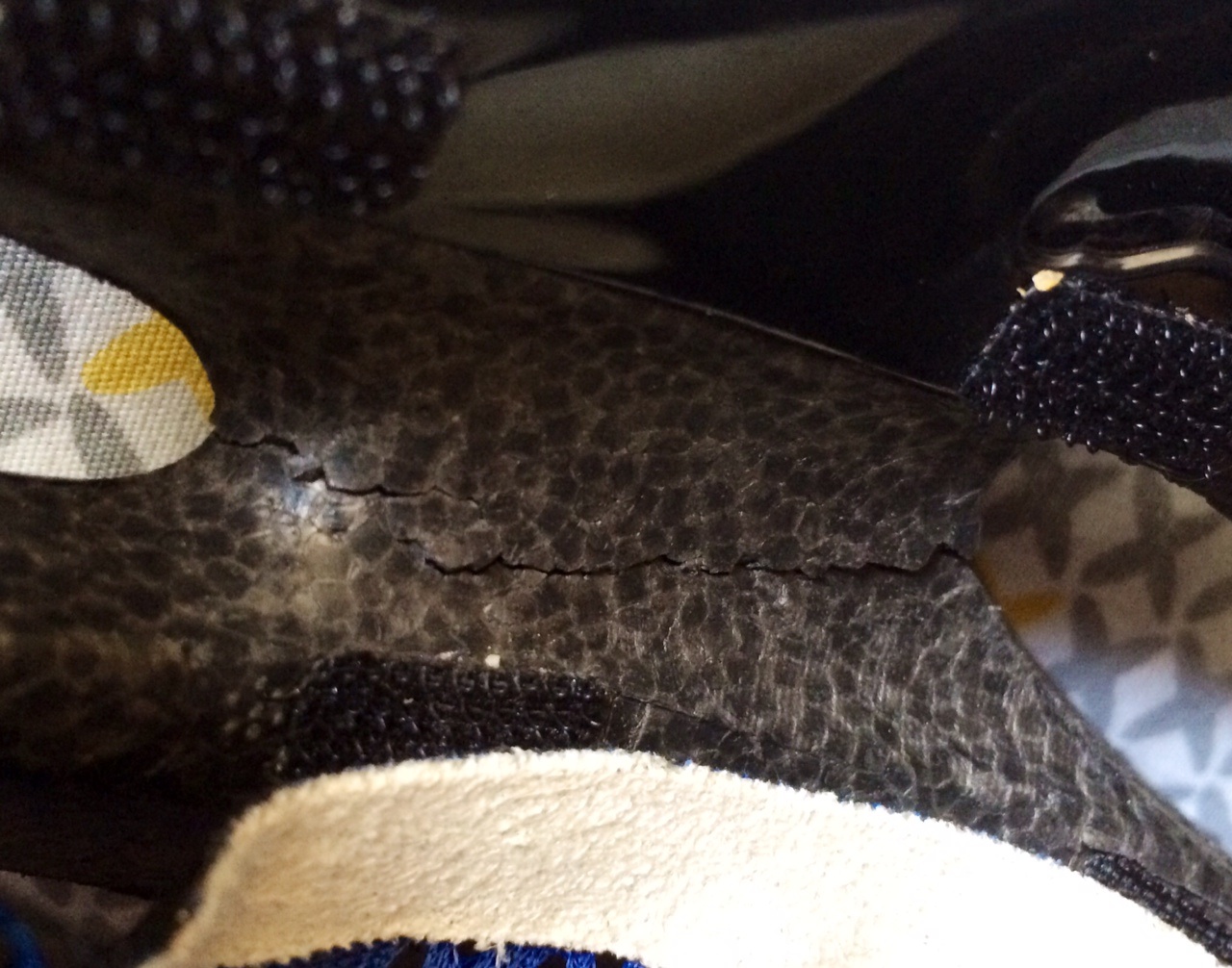
Sigh.  Think I busted my Rudy yesterday.  This is toast right?  I'm not exactly sure where to find the info and will keep looking, but if we have a helmet sponsor and anyone has the info handy, message me?  Or if anyone has extra helmets and wants to sell one, holler at me. 


image

yup - that is toast.

I might have a Rudy Project you can have. 

email me mperlberg@gmail.com


Emily the sponsorship doc is on the left, below the twitter feed.


Ha, wow, DUH.  Thank you! 

Update: clicking the link as of right now brings up a "disabled link" error message. 
Interesting article on concussion prevention in motorcycle helmets - basically they tried to reduce linear acceleration which didn't help, but angular acceleration reduction (what MIPS claims to reduce) does move the needle quite a bit.

Here is the text:

Helmet Add-ons Don't Lower Concussion Risk

Pauline Anderson

February 25, 2015

There's no magic bullet when it comes to preventing concussions. A new study suggests that the growing popularity of in-helmet add-ons, such as extra padding or external coatings, do little to reduce the angular force associated with concussions.

While something of a cottage industry, in-helmet add-ons have popped up over the years, fueled by the public's fear of head injuries and their long-term effect on the brain. However, few of these products have undergone even rudimentary biomechanical evaluation, according to experts who carried out the research.

The study will be presented at the upcoming 67th American Academy of Neurology (AAN) Annual Meeting in Washington, DC.

Investigators used an apparatus for impact testing of protective headgear that was modified from the one used by the National Operating Committee on Standards for Athletic Equipment (NOCSAE). It measures both linear and angular kinematics.

They tested four football helmet add-ons:

  • Guardian Cap (a soft shell layer that fits over the helmet);

  • UnEqual Technologies' Concussion Reduction Technology (CRT) (inserts made of a strong thin and flexible composite material)

  • Shockstrips (strips of adhesive foam-like material attached to the outside of the helmet)

  • Helmet Glide (fluid applied to the outside of the helmet designed to disperse kinetic energy and reduce surface tension)

The researchers outfitted two helmets — a Riddell Revolution Speed and a Xenith X1 — with each of these add-ons and tested them five times from three different heights (1 m, 1.5 m, and 2 m) using a crash test dummy head equipped with measuring instruments.

Measuring Bounce

The researchers were interested in both linear and angular motion.

"I'm measuring the bounce, which is the linear acceleration, and the rotation, which is the angular acceleration," said John Lloyd, PhD, an ergonomist, specialist in biomechanics, and research director, BRAINS Inc. Many concussions involve the rotational force of the head.

Dr John Lloyd

The researchers averaged peak measures of these forces across the five impacts at each height.

The study showed that for three combined add-ons (Guardian Cap, CRT, and Shockstrips), linear acceleration decreased 11% compared with a standard helmet that had no add-ons.

"That's a pretty good reduction in the linear acceleration, but that's not what prevents concussions," said Dr Lloyd. "The point is that it's the angular acceleration that reduces concussion, and these add-ons are not effective at reducing the angular acceleration."

In fact, they reduced angular acceleration by only 2%, according to the study.

The Hemet Glide, which was a prototype, did not fare well in these experiments and won't be on the market, said Dr Lloyd.

Wrong Focus

Helmet designers appear to be focusing on the wrong force when it comes to preventing concussions. They should be measuring angular acceleration, which, although relatively difficult to do, isn't impossible, said Dr Lloyd.

Until now, NOCSAE measured only linear acceleration when testing helmets. However, with new information accumulated by Dr Lloyd and his colleagues, that's about to change.

"The NOCSAE finally accepted that it's important to measure angular acceleration, and they're adding that now to their protocol," he said.

Down the line, there could be an even safer football helmet. Dr Lloyd, who is a motorcycle expert and rides one himself, has been testing his prototype helmet for about 3 years. He's now in the process of patenting it.

His state-of-the-art helmet is made of "shear thickening" materials that harden upon impact. The degree of stiffness depends on the force, but almost immediately upon direct impact, the material returns to its normal state.

At the same time, though, his helmet is designed to protect the brain during, for example, a football tackle where the head is thrown back.

"In the types of impact that produce greater angular acceleration and therefore higher risk of concussion, the materials remain relatively soft, thereby permitting the helmet to move independently of the head, such that the full magnitude of the angular accelerations is not transmitted to the brain," said Dr Lloyd.

In his lab, Dr Lloyd has tested his prototype helmet against a standard Riddell Revolution product and found a 50% reduction in angular acceleration.

"It works much better than any helmet or helmet add-on on the market," he said.

But his fellow researcher, Francis Conidi, DO, founder and chair of Seeing Stars Foundation, a sports concussion organization focused on research and education, doesn't think there will ever be a helmet that completely eliminates concussion risk.

"The only way to prevent concussions is to immobilize the cervical spine, but then you create a new set of problems for the athlete," as the neck needs to move to absorb energy when hit, he told Medscape Medical News.

Add-ons a Waste of Money

The growing choices of add-ons are a waste of money, said Dr Conidi, who is also director of the Florida Center for Headache and Sports Neurology, assistant clinical professor of neurology at the Florida State University College of Medicine, Tallahassee, and team neurologist for the Florida Panthers National Hockey League team.

Helmet add-ons may even increase the risk for concussions by adding weight and mass to the helmet. "When you think about it, it actually adds to the surface area of the helmet, which means there are more potential contact points," especially if the add-ons are on the outside of the helmet, said Dr Conidi.

The add-ons may provide a false sense of security, leading the athlete to take more risks on the field, he said.

Dr Lloyd is research director of BRAINS Inc, which supported the study. Dr Conidi is founder and chair of Seeing Stars Foundation, which supported the study.

To be presented at the 67th American Academy of Neurology (AAN) Annual Meeting, April 18-25, 2015.


Medscape Medical News © 2015  WebMD, LLC 

Send comments and news tips to news@medscape.net.

Cite this article: Helmet Add-ons Don't Lower Concussion Risk. Medscape. Feb 25, 2015.