Kissena Forum Archive

Kissena Coaching Program - Velocious Coaching

1522 comments · 14741 views
Team.

Good point Marc.  Just got back from a camp with Scott that featured a full day on race tactics and we ended up in a similar conversation about what people really want to know. I will be presenting some tips for basic / Cat 4/5 racing and Scott and Amber will be presenting advanced ideas.  In building the presentation, I asked both separately to send their 3 top "tips" and as you might image, they were pretty similar.  When talking to the pros, tips tend to "process".  I summarize this process as "situation awareness and qualified reaction".  The "pro" difference is in how they approach "awareness" in the race, and the trained response to change in the race.  You will find that when asked specific questions you will get answers that will be "situation awareness and qualified reaction", which will not be as linear as you might think (meaning the answer might be more fluid).

These two racers know how to win.  Scott has 275 pro wins and Amber has won Worlds so these are some of the smartest tactical minds in the biz. 

Also, what would REALLY help actually, is over the weekend, post your QUESTIONS here and i can summarize some and be prepared to tackle.

Looking forward to it!

Loaded Question here but will give it a go....

First off, lets a few points

1. What is power? Watt = how hard you pedal x how fast you pedal (torque vs. angular velocity)
2. Are watts different? No, it is always torque x angular velocity
3. What is the function of watts? Overcome forces of resistance, Air, Gravity, Rolling (some lump in gravity), Mechanical, Other
4. More power allows you to overcome force quicker = more speed RELATIVE to such forces

So on paper, those are truths but then you start adding this pesky little human element and the truths can become multifaceted. So let's add some human "truths" (well maybe 2/3 truths)

1. Most normal people CAN generate more power climbing vs. slight downhill, and in general flats
2. This is more true of smaller riders then larger riders, typically
3. Efficiency does come into play here

So when you climb, you are taking one of the mentioned resistances above, and adding more of it. So let's pretend you can separate then from each other and let's talk about gravity. Once you go up hill, gravity increases resistance in a linear fashion, in simplified terms, if you want to go twice as fast, you need to do twice as many watts (if you could magically remove the other resistance factors). So simple put, the RESISTANCE of the bike is now increasing linearly. So in the face of this resistance, two things happen. First, you have more pressure against your pedal stroke and for a lot of riders this helps improve your stroke, you pedal a better circle adding more TORQUE (see equation above) at a faster rate than your decline in cadence (if decline) so the result is = More Power. This is really isn’t hard physiological fact but has been demonstrated in study after study to be a reality. Second, is does change the way you engaged muscles but again, the human factor tough to pin down here. A newer rider or one a choppy stroke tends to actually engage quad a little better on climbs. I am not saying this is a good things, as it is not (well maybe short climbs) a more experienced rider tends to engage their glutes more (read below for flaw in this answer). Also, increased engagement of "core" typically occurs in climbing. These factors increase TORQUE

Now, the issue is this. Most pros put out very similar power climbing vs. flats vs. slight downhills (there are difference but close tolerance) BECAUSE they are efficient and have good pedal stroke (and a genetic blessing that allows them to pedal really hard). One caveat, is even small pros really need hills to hit the slightly higher numbers. I can tell you for both Scott Moninger (130) and Amber Neben (105), they need climbs to hit max numbers, but still pretty close and when you think of it by %, very small amount but very important amount.

Ok, now last element, when going downhill, you have to deal with air resistance. So again, image you can separate air resistance from all other resistance. Air resistance, unlike gravity which is linear, is exponential (cubed). So to go twice as fast downhill, you need to pedal four times as hard. This still requires more TORQUE as you can image, but does not typically allow you the same solid resistance against your pedal stroke so you are less efficient (if not a smooth pedaler). Most pro team riders would rather pull climbs then long, low grade downhill on the gas....its harder.


So never specifically answer your question but adding some insight.

Timothy Cusick
President | Peaks Coaching Group
O 717.467.5078 C. 717.515.5382
www.peakscoachinggroup.com
Thanks, Tim, I think you totally answered the question. Also clear, the more efficient we are the less pronounce the difference will be. It is great to have you in the board, I appreciate your time lots. 
Fascinating answer Tim.

Hey can you elaborate on why you think NormP is not a good measure - and where you think it *is* good (if ever)?
eloy said:
Thanks, Tim, I think you totally answered the question. Also clear, the more efficient we are the less pronounce the difference will be. It is great to have you in the board, I appreciate your time lots. 
And the natural follow-up question is, of course, "how do we become more efficient at pedaling?"
eloy said:
Thanks, Tim, I think you totally answered the question. Also clear, the more efficient we are the less pronounce the difference will be. It is great to have you in the board, I appreciate your time lots. 
And the natural follow-up question is, of course, "how do we become more efficient at pedaling?"
That costs "extra" :smile: 

Even harder question but:
1. Ride A LOT
2. Use rollers not trainer for most winter workouts (experience, not science) 
3.  Training focus - this type of muscle memory can be created via focus, think intervals.
4.  Proper bike fit and sit.
5.  Drills - 1 leg and stuff (low reward to be honest, but helps).
Jules said:
Fascinating answer Tim.

Hey can you elaborate on why you think NormP is not a good measure - and where you think it *is* good (if ever)?
Jules,

I is pretty close by 20 minutes, but to be safe, 30 minutes and above and it should be pretty solid.
Team!

Spent this morning doing a review with Scott and Amber for Monday night presentation and it is going to be a good one.  Please help get people to sign up.  This is not JUST advanced tips, going to have a good 15 minutes on the basics before getting into more advanced items.

Hope everyone having a good weekend!
TimCusick said:

2. Use rollers not trainer for most winter workouts (experience, not science) 

Good luck selling this one.  I've been pushing the idea for years.

Having trouble accessing the webinar. My computer won't let me "download the desktop version" and when I attempt to type a question, nothing...will try the "phone in version" I guess.
I really hope folks are on this talk. It is GOLD.


Seriously. If you aren't on, you are losing.


GOLD!
That was awesome! Let's go race!

Tim - thanks for doing this talk, and to Amber and Scott too. Really good stuff.
I am basically shocked. That Peaks Coaching webinar was absurdly dense with information, and I'm not "new at this." There was a bit of Pro-Cat-1 perspective to get past, but the amount of deep experience on display from elite U.S. athletes during the talk and the Q&A session was almost spiritual. I am actually considering abandoning my lead-out-train boycott.
Just keep coming towards the light Jeff!
https://www.youtube.com/watch?v=a3I4DB_QAcI
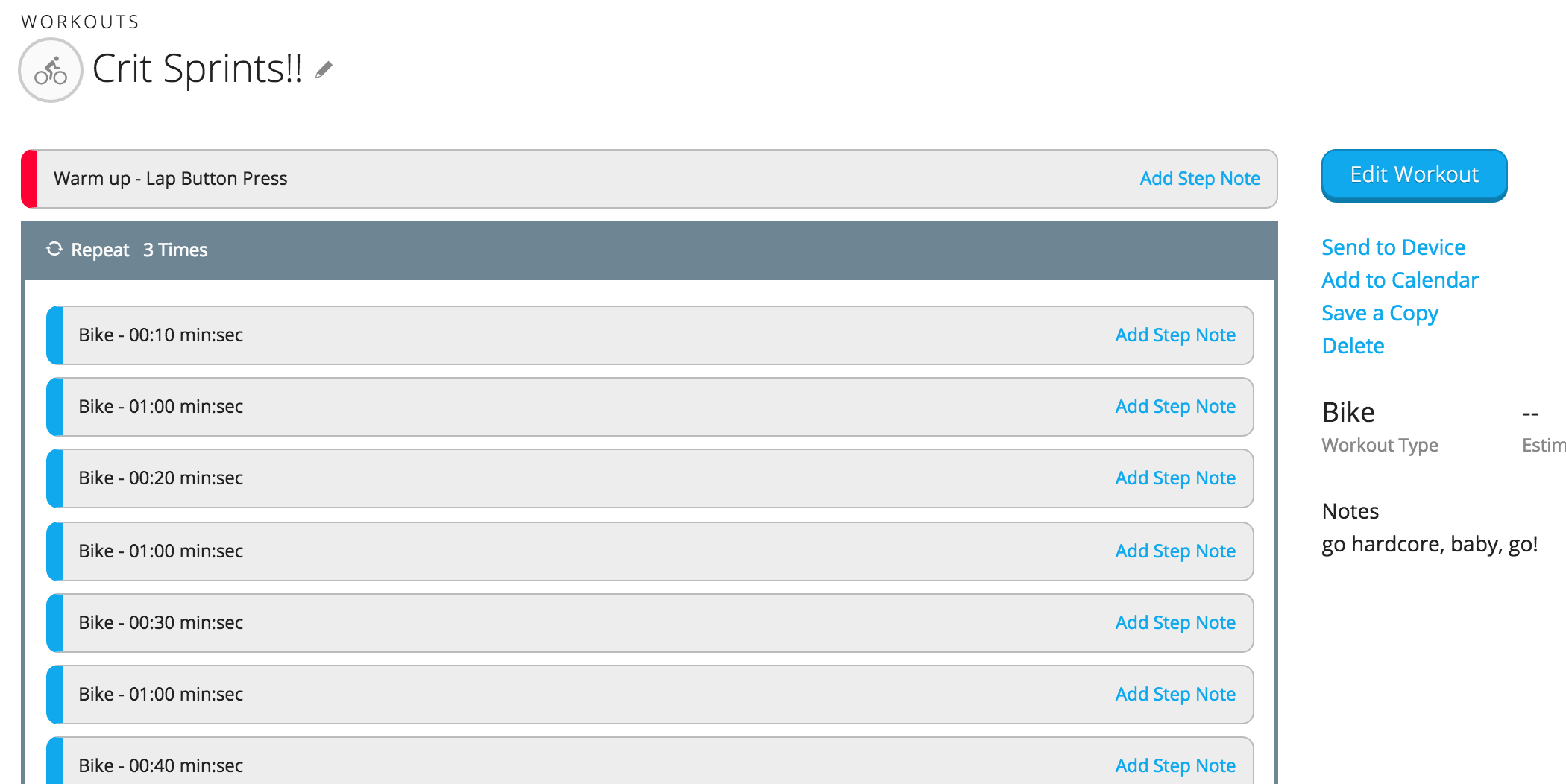
getting ready for tomorrow!

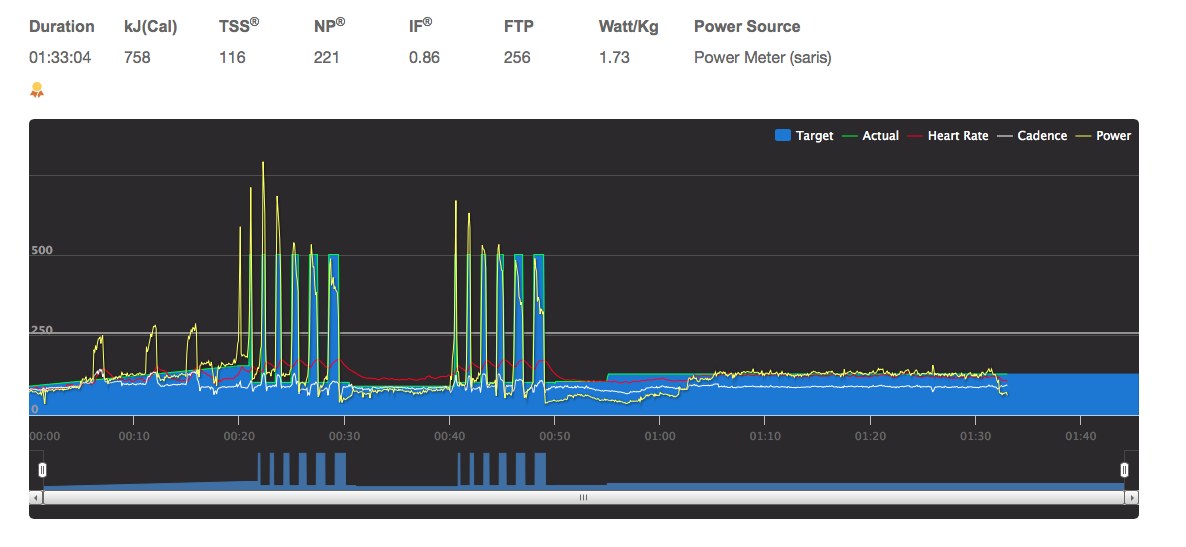
That was short but killer
yes, these are definitely not my strength. Next time more.

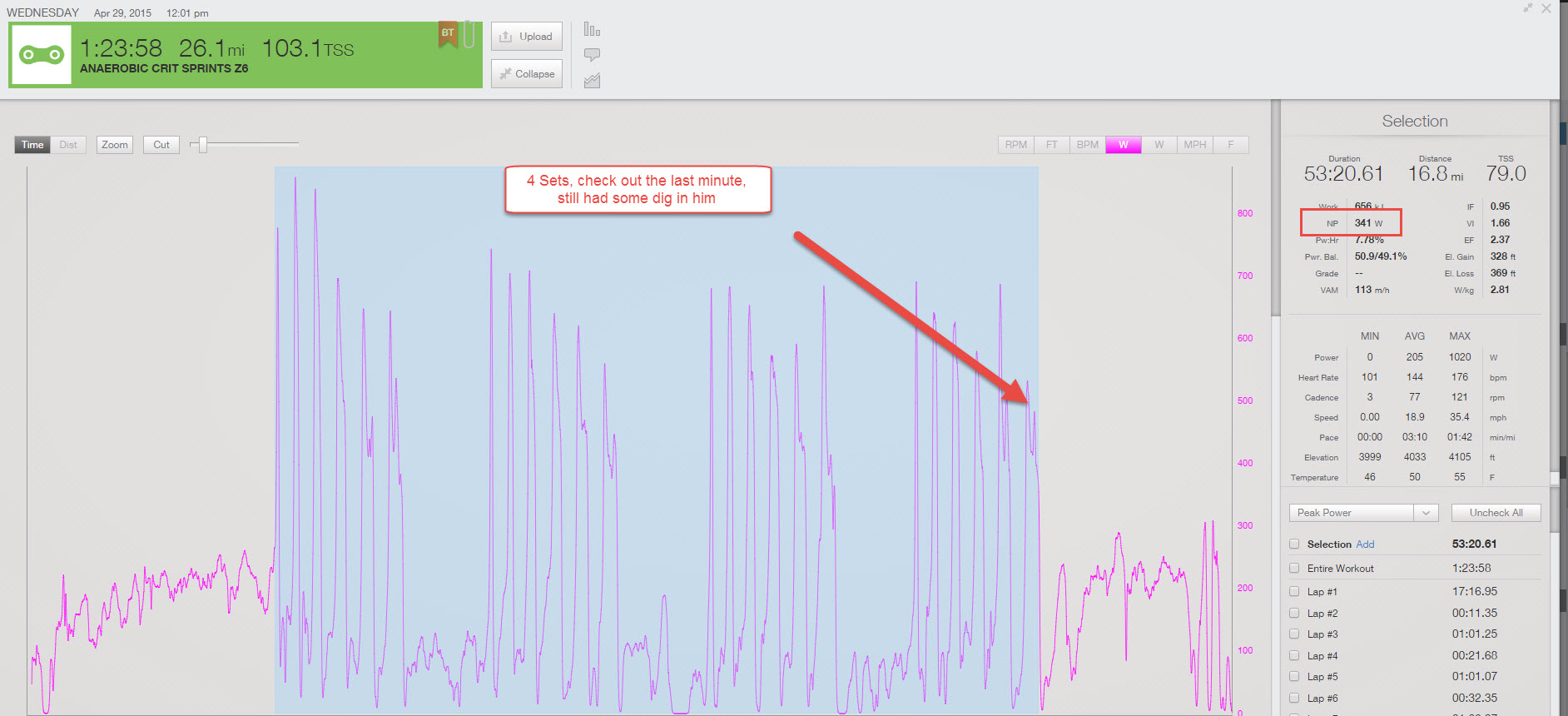
I got through all three today without too much drop in power, but I did have snot all over my face.

http://tpks.ws/bTHt
@David Gardiner - Did you do that on the trainer?
Yes did, why?
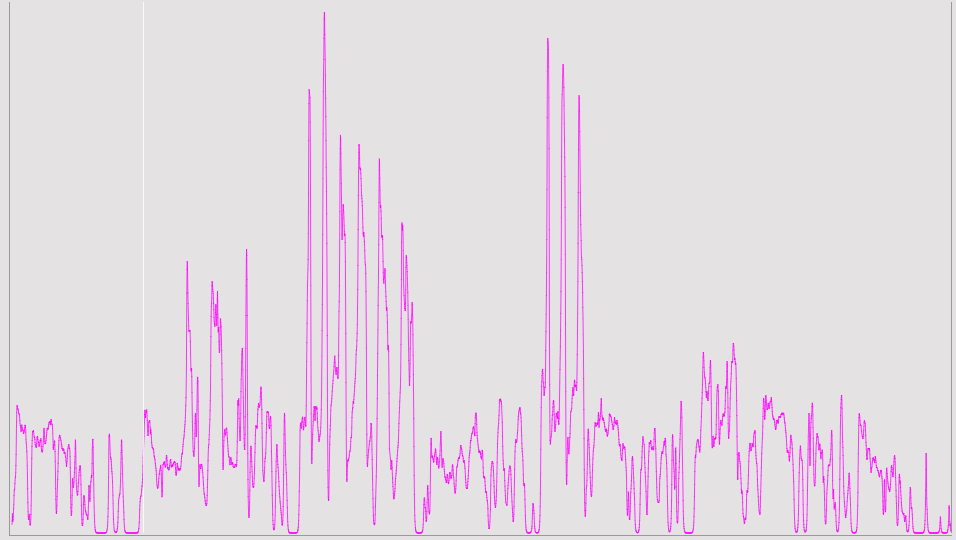
My MTB Pro was doing same workout, on an MTB bike on gravel road, what it takes to be a pro (65kg):


Good work!  The type of workout typically helps identify and then train repeat ability.  When you first read it, doesn't seem that hard....till you do it.  The early sprints load the lactate and make the later efforts HARD.  The goal is to do MORE not harder (even though they will tend to go hand in hand).  

If you are not a sprinter / trackie, these are even harder as your body if forced to act very inefficiently )fast twitch fiber WAY less efficient then slow twitch) so even more painful!

Nice work, keep building it!!
eloy said:
yes, these are definitely not my strength. Next time more.


Caught me out Rightly. I thought this would be a cake walk. Thought my heart was going to come out of my chest at one stage. Excellent.
I just got a chance to listen to the webinar!  It was so incredibly helpful! Thank you so much!

Thanks for posting the MTB file. That's motivation!
skipped it = too tired today....sitting in a bath tub and planning a 9:30 bed time tonight...I'll get my yah yah's out on Saturday at the park.

I don't want to barge too much in this thread, but when I read this quote from Alex Dowsett on his recent hour-record-breaking ride I thought Tim might get a chuckle out of it.

"The coaches gave me a plan which I didn’t like that much but deep down I knew that it was the right plan."

http://www.cyclingnews.com/races/alex-dowsett-hour-record-attempt-2015/results

And if you haven't had a moment where you thought similar thoughts, I would argue, you just haven't been coached that long! Stick with it everyone, you'll start knocking off those goals soon enough.