Kissena Forum Archive

Kissena Coaching Program - Velocious Coaching

1522 comments · 14741 views
I'm having trouble with the training peaks app.  No matter what I do, I can't import my race data into the race field it is supposed to go in to.  I've tried using Device Agent, I've tried dragging, I've tried uploading from the app.  Nothing works.

anyone have a solution?
works great for me.

Are you making sure to, before upload, delete the workouts that you are not doing?

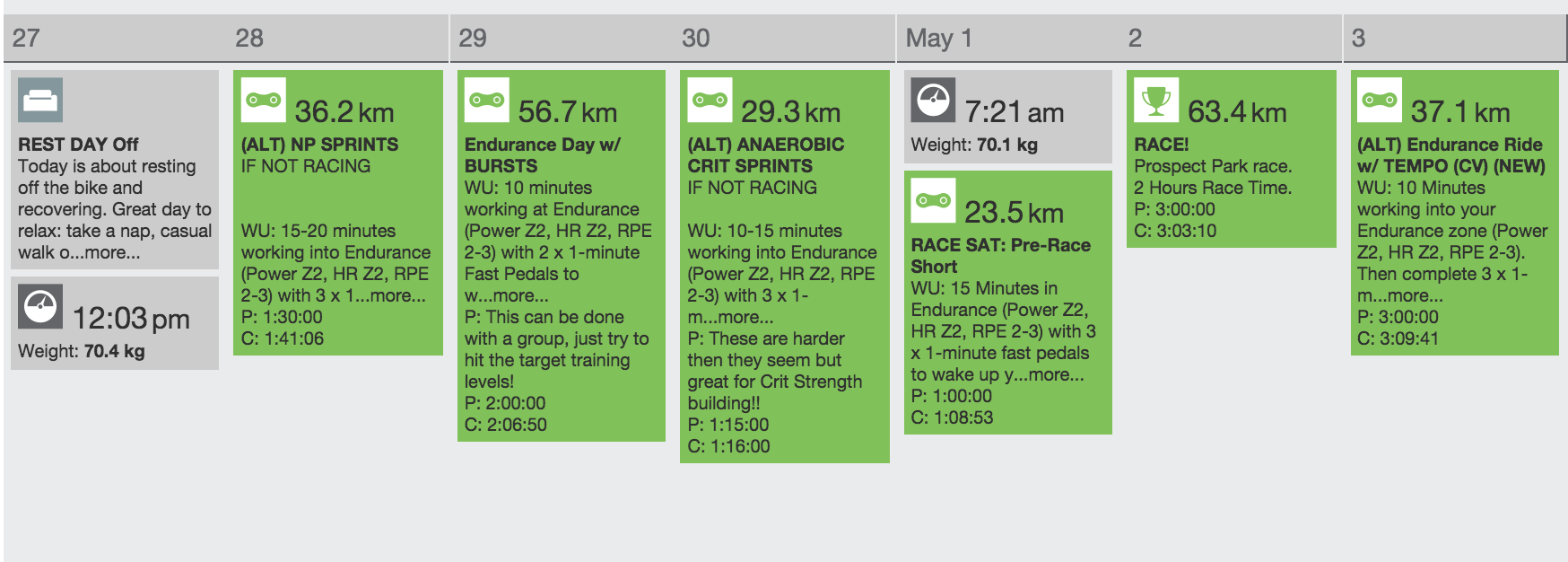
Here's last week #allgreen.

I use Garmin Connect to auto upload to both Peaks and Strava. Works awesome. 

Else, I explained how to do it manually a few posts above.


Also, if the problem is specific to Race data
  • go into the ride that did get uploaded.
  • click the (trophy or chain) icon and change it to a Race. 
  • Add a Planned Time if you want
  • Close out of that workout
  • Delete the empty race
Eloy,
     Thanks.  Did the  above.  Works.
Tim!

Again, truly enjoyed this week's workouts.

--- when we did SST about 2 weeks ago, I did them hot, basically at test pace. So decided to give it a shot again today. Both efforts today avg about 2W difference. But ended about 20W higher than 2 weeks ago.

Progress! one watt at a time.


Looking forward to what the next cycle will bring.
(hoping we stay in this "up FTP" mode)
COOL!


I am working on the next round of plans now, will be posting tomorrow sometime.
Eloy omitting your wattage #'s only increases my curiosity...
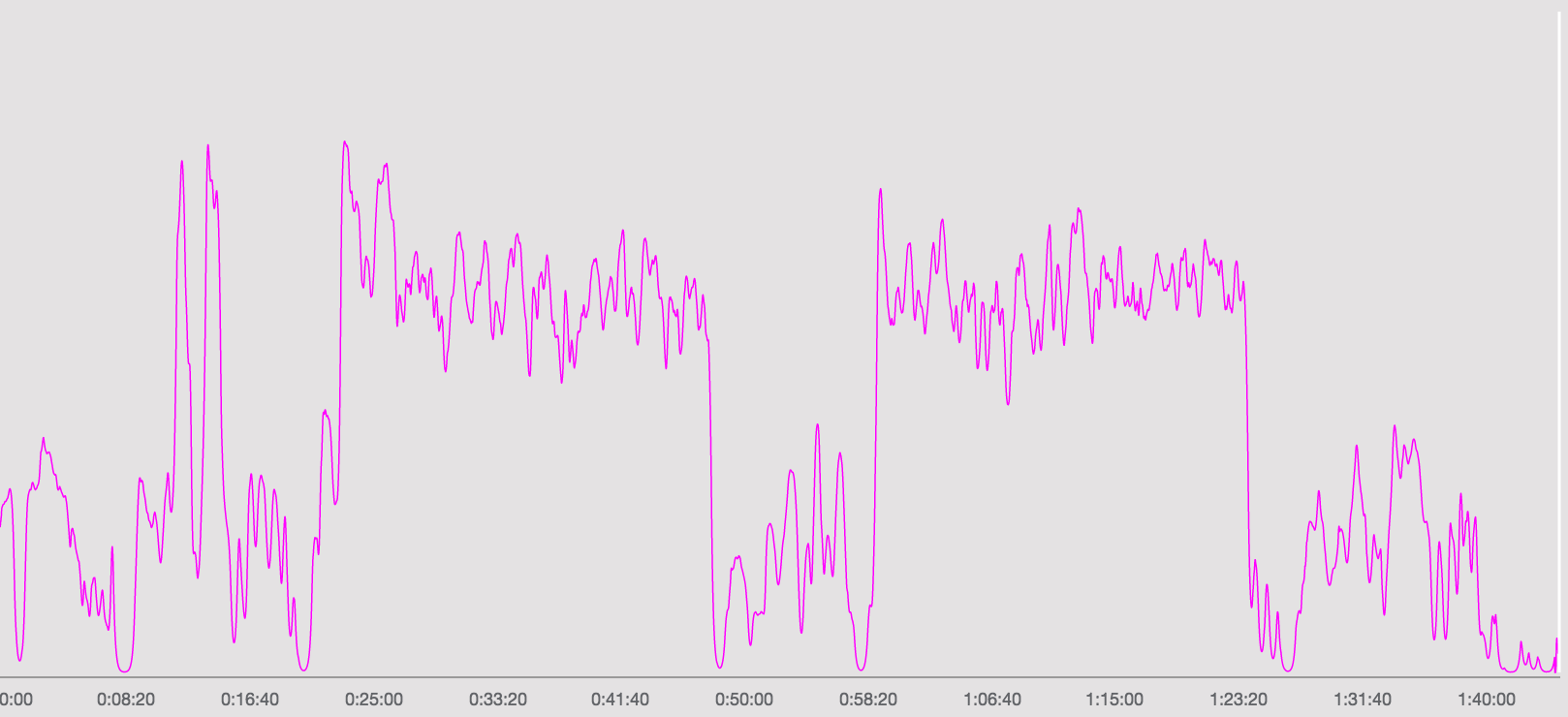
Yup. Those sure are some purdy etch-a-sketch drawings you made there w your bicycle
Team!

Sorry for the delay in posting, crazy week with ATOC kicking off.  Everything is posted now for next block, should be ready to roll.  Take a look and let me know thoughts.  Chaim, will tweak yours tonight.

Also, I loaded plan to someone that already has a plan (leaving nameless), didn't realize it to I was checking each one.  If you already have a coach, my plans will just mix in and make your account a mess so let me know if you want my plan removed or i can go in and delete the old plan....
Hey Tim - A quick question about rest weeks vs tapering. Specifically, what are your thoughts on a rest week that falls immediately before a taper week for an A race? Should you still follow the rest schedule, or use the taper week as a rest week? 
Adam,

This is a good question and one that is hard to answer unless working specifically with the athlete. Age, fitness, event demands play a big role, be more specific and I will give some specific thoughts.

Timothy Cusick
President | Peaks Coaching Group
O 717.467.5078 C. 717.515.5382
www.peakscoachinggroup.com
In my case, I'm 33 and have been averaging about 11 hours a week of riding. I trained consistently through the winter and feel pretty strong, though in the past few days I've had some soreness in my right leg. My FTP is 281, but that was recorded a few months back and I haven't retested and suspect it might be a bit higher.

The event is Killington Stage Race, which last three days and consists of a 37 mile Circuit (Sat), 61 mile Road Race (Sun), and 11 mile Time Trial (Mon) during Memorial Day weekend. It's very much a climbers race -- the final 5 miles or so of the road race rises about 1200 feet over five miles -- but I've done pretty well in those in the past. My goal is top 5 in GC, and to top 3 the RR (both are ambitious, but why not?)

Not sure if these details help, but this is something I've always wondered about, and hopefully it's useful to others. Thanks again for your feedback!
Adam,

At the number of hours you are training, take a 2 -4 day break before taper week at most. You want to "freshen" the legs some, but not total. Your Taper week should have some solid intensity work, don’t just noodle around. Try reducing total time on bike about 30% and intervals by 20%.

Timothy Cusick
President | Peaks Coaching Group
O 717.467.5078 C. 717.515.5382
www.peakscoachinggroup.com
Got it -- So I'd want to take two days off this week, and then stick to the schedule for next week, but just at the reduced level?
Yes, error on the side of more reduction

Timothy Cusick
President | Peaks Coaching Group
O 717.467.5078 C. 717.515.5382
www.peakscoachinggroup.com
Awesome -- thanks so much, Tim. Hopefully this will be useful to others as well. Personally, I struggle with rest. I feel like I need to be training hard all the time, otherwise I'll be slow. I know that rest is important, but doing it is difficult. 
re: Tuesday 5/19's non-racing workout.

Tim,

the timing doesn't make sense.  You suggest two sets of seven 1-minute efforts.  Just putting six minutes in between each 1m effort means that a set takes up 49-minutes.  Then put 8m between the sets, and you're up to 57 minutes.  Then the second set of 49, and codlin of 15 and you're at two  hours.  And that doesn't include the 20-25m of warmups.  All in a 1hr workout.
The 'long rest' is not 6-8 minutes between the sprints. Long rest is up to you. My take would be to get HR down to 90-110 range, so probably 2 minutes tops.

You do a set, then you take 6-8 minutes. Do another one and you're done.
Vlad,

The long rest is long rest. HR is not the determination of full recovery for maximal efforts. Ask anyone doing a lot of track work. The system needs a full restore to recharge. More and more data is pointing towards full rest intervals to produce maximal efforts, I will post more details when back in office.

As far as time, just expand time to what you can, sorry for the bad math.

Timothy Cusick
President | Peaks Coaching Group
O 717.467.5078 C. 717.515.5382
www.peakscoachinggroup.com
Thanks, Tim,

Yes, I'm with J.P. on this one... it took me over 2 hours, which is fine. For me it would be about 6 minutes before I could honestly go max again. Was super hard, but at least it yielded a new 1 minute power record -- several of them above the previous number --

Was painful then but feels good now. 
Yes, sorry about the time issue.

When doing shorter intervals, there are two approaches depending on the specific function you are looking to improve. To truly go MAX it takes a while to fully recover. Your aerobic system will catch up pretty quickly (depends on fitness) but it takes longer for the rest of the system to recover.

Classically doing short intervals, let's say 1 min with short rests is a good way to improve your Anaerobic Work Capacity (we call it Functional Reserve Capacity as there is a minor aerobic contribution) which because you are not fully recovered, you start each effort with some fatigue and you end up pushing through a series of such intervals in a semi-fatigued state and push your AWC limits.

The issue here is, that this type of work can "limit" true max efforts as you do start each with a touch of fatigue. To get true max (well, as close as you get in repeats) you really need to recover. So why go true max? Build POWER.

Think about it like strength training in the gym. If you want to build to squat 1,000lbs you would not go in and do max lifts by putting on 900lbs, lift it 2-4 times, rest for 1 min then try again. The reality is if you tried that reps would go down quick and you would have to potentially reduce weights. Talk to any good gym rat, they know it is max, long rest, max.

So in the end, I blend some of my AWC work with long rest intervals to make sure you are improving performance by pushing your power curve "up".

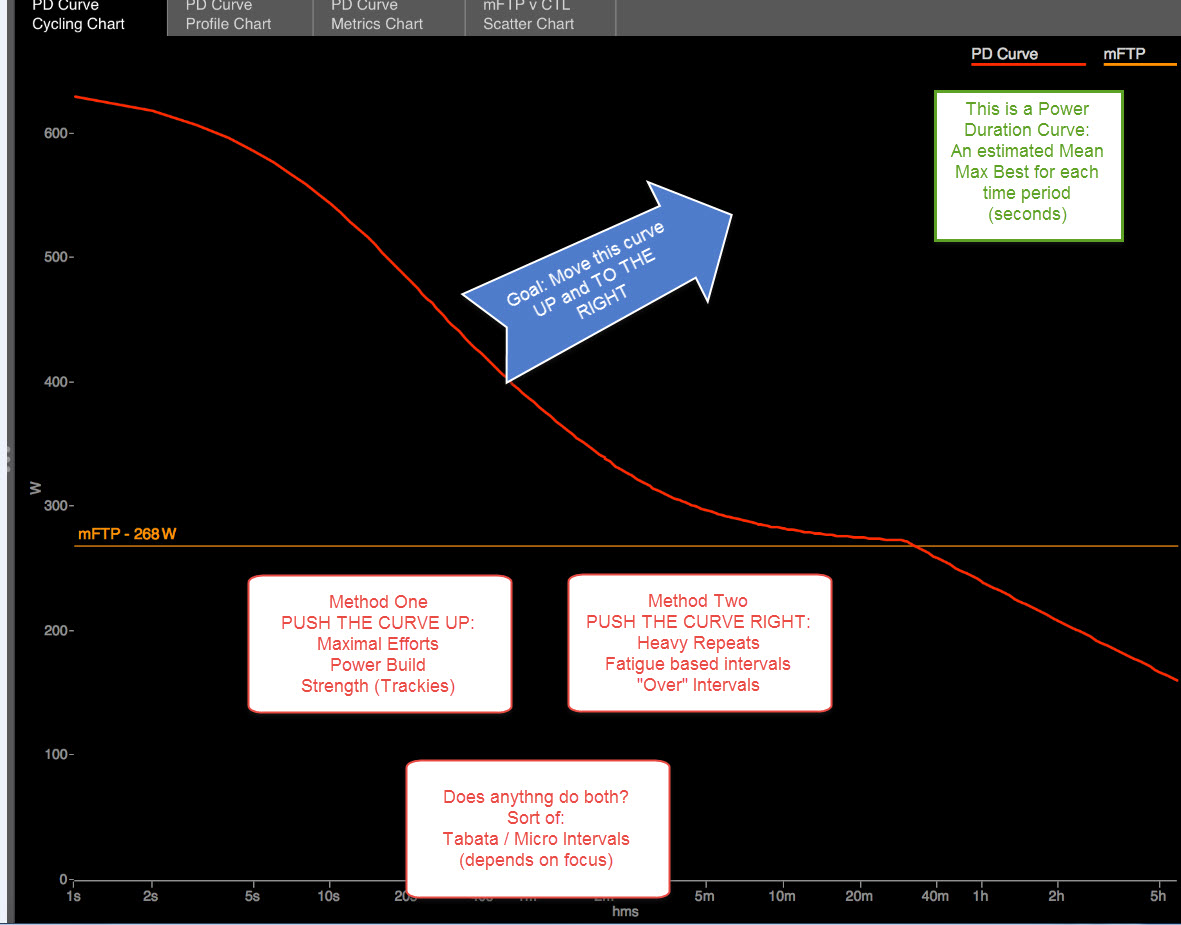
In the diagram you will see a Power Duration Curve for a sample athlete. The curve estimates her "Best" for every second. As you can image the more we add time, the more her watts drop, hence the curve. See diagram for some points.


Timothy Cusick
President | Peaks Coaching Group
O 717.467.5078 C. 717.515.5382
www.peakscoachinggroup.com

Tim, I came across a Velonews article that interviewed current national Road and Crit champ Eric Marcotte and the closing quote got me wondering. Adam Myerson, a pro I sort of know shut me out on Twitter when I asked him for his opinion, but maybe your team has some insight?

"There’s actually never been a race where [SmartStop] has lined up and they said, ‘This is for you Eric.’ I know my role with the team and I accept that role. If there’s an opportunity to get a result for the team and it happens to be me, then I’ll take it. But other than that, I’m always there for the other guy.”

 http://velonews.competitor.com/2015/05/news/marcotte-returns-to-chattanooga-for-u-s-pro-road-and-tt-championships_371075#ZZmMMcrLV7IjjoVY.99

What exactly does a guy have to do to gain the support of his team at a race? "Win" more team training rides? Are teams and DS focused too much on power files?

Don't get me wrong, I love me my power meter training, but as a guy who is posting some pretty good (for me) numbers this year, but also no real actual results to speak of, I do also understand that there can be a pretty big disconnect between power files and racing results.

Sure, if the National Championship course was changed dramatically, like it turned into Hill Repeats up the Devil's Kitchen climb, you would realistically say, "Eric, this year's not for you." But it's the same course this year that he won last year? And presumably he has some form after winning Crit Nats (although against a shockingly small field).

Marc,

Good question. It depends on how the team is built. Sometimes a team is built around someone, period. Easiest example was Postal. The team was built around Lance. A lot of teams actually used to structure like this. These days teams tend to structure around a few rider in general then the "plan" based off the individual skills / capabilities who will lead what. So the how do they get to be the "leader"...win races. Of course, this is a tough thing to do when you ARE NOT the leader. Power numbers help the team figure out who might be best suited to win on courses but most team use it only as one tool in the tool box. To go a touch deeper, power data for planning races is typically more about being able to gauge their current form then the absolute number.

The other issue with power and pro that most people do not understand is that it is really hard to track power in race season for most pros. Example. I coach a pro on a US Cont team. We started in Nov, tested every 4 weeks and built his off season 20 min power up about 10 watts a month from 350 to 390 watts. We tested every four weeks and had good clean results each time confirming our training plan milestones and targets. In March he starts racing the classic US spring schedule (Valley of the Sun, San Dimas, Redlands, Joe Martin, ATOC) so he is basically in race, rest recover mode. No testing. So he is not the leader and does lots of work for his leader. You would think in all that racing he would have some pretty good numbers to demo best or to supplement for testing? Nope. He generated a ton of training, big TSS numbers but in his role (and like most pros) the reality is you have very little long sustained hard efforts and even in the few crits sprinkled in there, they do not get an hour at full gas. At one moment he is being asked to drill it at the front to control, chase whatever, next minute he needs to sit up, drift back to pack and bring the team leader back to the front. All kinds of stuff like that breaks up the files.

This means that "who is the leader" is often more about history, form and course then power data but all play a role.

The points in the article also point out an honest reality. You go into a lot of one day races with Plan A and up executing Plan B or C. Cycling is a dynamic sport, I really do not think there is a harder sport to win then a good bike race.....

Timothy Cusick
President | Peaks Coaching Group
O 717.467.5078 C. 717.515.5382
www.peakscoachinggroup.com
Fascinating Tim! It never occurred to me that during the racing season it might become a mystery where exactly people's form is at. I guess that makes it even more impressive when people can time it well.
Arguably, long training blocks with little racing to interrupt, allow riders to watch their form more carefully, and more accurately know where it's at.
Tim,
     Is this webinar with Allen Lim on Tuesday a chance for him to shill Skratch or is it more for people to ask questions?

http://www.shop.peakscoachinggroup.com/product.sc?productId=449&categoryId=8

Tim

In this month's Peaks Coaching email, Hunter wrote the following regarding boosting one's FTP:
  • "A two-hour ride on the weekends will not increase your FTP. You need to be riding 4-5-6 hours on at least one day of the weekend to really significantly bump your FTP to the next level."
I am curious about your thoughts about the reasoning for this. I am targeting some TTs this summer and want to peak for CX season. I understand the need for a diet of sweet spot and threshold workouts within a balanced training regimen. I am not opposed to longer rides. I suspect that I have had my strongest FTP during seasons that have included longer rides, however that may be a correlation rather than causation since I was probably also training more those seasons.

I'd love to hear your thoughts on the relative contribution of 4-6 hour rides (and other types of training) in increasing FTP.
Accurately know where they are at yes but more importantly....control where they are at. Racing is good training but does introduce a certain element of variability to training itself. Most pros generally lose "fitness" through the season (actually they have some rest and rebuild points) as they race a lot, but get faster, perform better while their CTL drops.

Timothy Cusick
President | Peaks Coaching Group
O 717.467.5078 C. 717.515.5382
www.peakscoachinggroup.com