Training to Race: Faster, Stronger, Awesomer
This video series is pretty good too
https://www.youtube.com/watch?v=H-ieUi9A2iwOtherwise, if you want to do well, you should taper, and come into major events with some form (positive TSB)
I think we chatted a bit about this last time we rode together. This is a basic concept of all endurance sports, cycling and specially road racing:
If you spent all your energy now, you wont have anything for later -- sounds obvious, but it is the most common training and racing mistake.
It applies at multiple levels:
- Macro: if you ride crazy tons on April and May, you might be drowning by the big event in June
- Less macro: if you ride super hard Wednesday and Thursday you might not be fully recovered by Saturday's race (so intervals tuesday, easy/looksharp fridays)
- a bit micro: If you attack and attack for the first lap prime you might not finish the race (conserve, conserve, conserve)
- super micro: if you attack in the last lap you wont be able to win the field sprint if caught... etc... etc...
I need to do a better job managing my taper / TSS goinng into races, along w overall strategy stuff like you mentioned (ie conserving energy and attacking when it matters). all v helpful.
Greg,GregStreiff said:I've went into my last 3 races with -40 to -50 TSB and I wasn't feeling rested / particularly strong. Do others race with TSBs at this level? I have been assuming my recent performance is physiological and strategy related. But perhaps fatigue is playing a role.
There are any number of things to consider.
First, are you sure you've correctly estimated your threshold number? If you've underestimated, then TSB is lower than it should be. If you've overestimated, TSB is higher than it should be.
FWIW, I rarely see TSB that low, and I just did a quick review of several years of training efforts
Second, individual variability. As Sebastian pointed out, everyone is different. It's hard to know the difference between overtraining and sucking until you've done both. (Looking at other markers, like the ease of sleeping, ease of waking, desire to ride, are often worth paying attention to)
Third, Eloy's point. The super-short version is fitness + freshness = peak performance. It's ok to feel beat if that's where you want to be in your training schedule. Dial back a bit and you should be flying.
Fourth, there's an old saying, there's no such thing as over-training, there's only under-resting. Perhaps that's more of an issue.
Fifth, you may surprise yourself. I seem to put in my best 1m efforts in training when I'm nearing the end of a block of hard training.
Question. Has anyone ever hit a CTL of 100 or more? I would imagine the only folks that have no job and can afford to spend an hour or more at threshold each day?
I'm just over 80 and it seems to be getting harder to continue ramping my CTL up at the rates I have been averaging since March.
Greg,GregStreiff said:I just realized my HR zones in TP are different from what's on my Garmin. The garmin sets my thresholds lower than my TP calcs. I think this means my CTL is higher than TP indicates.
Question. Has anyone ever hit a CTL of 100 or more? I would imagine the only folks that have no job and can afford to spend an hour or more at threshold each day?
I'm just over 80 and it seems to be getting harder to continue ramping my CTL up at the rates I have been averaging since March.
I've been over 100 on a number of occasions. I don't think it's so much time over threshold, but lots of sweet spot and high volume will do the trick, though it did coincide with some stage races.
Back in 2005, I went over to France to see some stages of the Tour and ride some of the big Cols in the alps. It was effectively a two-week mega-training block with probably over 500 miles in two weeks, along with a 500+ TSS day (La Marmotte, a gran fondo climbing Cols Glandon, Telegraphe, Galibier, Alpe d'Huez, over 7 hours in the saddle) Four or five days after that ride, I did a 120-mile ride over the Madeleine, Mollard, and Croix de Fer. And then a few days after that, I hooked up with a 100k club ride, where I attacked with the strongest rider at half-distance and we hammered the rest of the way, with me groveling for what seemed to be forever. And I rode long and easy in between.
I needed some serious recovery after that, but in two weeks, I was flying.
Been thinking more about your query on TSS.
People with full-time jobs can have a CTL of over 100 TSS/day.
The way people can get it is to have 200+ TSS days both days of the weekend, and then they just need to average 60 TSS a day for Monday-Friday.
The big weekend days aren't necessarily hard. When I combine a Prospect race with the ride to and from, and then a 3-4 hour ride on Sunday, I can get 400 TSS in a weekend.
@neilx thank you as well. It's nice to have a few other datapoints. regardless of what your TP says your CTL is, you were flying when I saw you last weekend!
In an attempt to mix it up a bit, I went to Bikram yoga Monday night (first time doing any type of yoga in over a year). I tore a hamstring a couple years back and Bikram helps stretch it out.
I was feeling good. So at lunch on Tuesday I did a high intensity crossfit type workout at Blink (box jumps, etc). Abnormally hard workout for me.
Come Tuesday afternoon I was starving and went searching for a snack. A first year analyst offered me a chicken sandwich. Which was clutch, or so I thought.
As I ate the chicken sandwich at my desk, delayed muscle onset began to take effect from Bikram the night before. Things took a nose dive pretty quickly.
I finished the sandwich and was getting ready to run home but could feel my immune system pushing back...hard. I became tired and nauseous and had blurry vision.
So decided to take the subway.
Fast forward an hour later. I am at my place puking my guts out. Whole body is sore. Hurts to move. Flu like symptoms. Couldn't eat anything. Was in utter pain.
Called in sick yesterday. Slept for like 16 hours straight.
I feel better now but my CTL has dropped.
Moral of the story -> don't eat chicken sandwiches from random co-workers and don't over do it at the gym because your CTL will drop.
(Reminds me of that time I had a big race in Portugal but spent the weekend
doubled over in pain listening to my stomach do a full ctrl-alt-del. No
first year analysts involved just pre-cooked chicken, a car trunk and a
warm day. Never again will I eat lime flavored chicken.)
Feel better Greg.
“I wanted to quit because I was suffering. That was not a good enough reason.” -Ted Corbitt
Endurance athletes are very familiar with the discomfort that comes from pushing your body into the ‘hurt locker.’ Your legs are burning, your breathing is in overdrive, your energy systems are like a fast burning fuse, and everything just... hurts. If this goes on for long enough, your head soon asks for a cease-fire, begging you to, “just ease up, nobody will know,” or, “I don’t want to deal with this any longer!” or “Urg, this sucks! Make it stop!”
Don’t believe anyone that tells you they actually enjoy being on the suffer bus. It runs counter to our survival instinct and your brain will play all sorts of tricks on you to convince you to make it stop. We can often stay in it because we know it’s temporary, not life threatening, and, most importantly, we believe that we need to endure it if we are to complete something we care about. We must be motivated to reach the other side. That said, we can get better at it.
If there’s one thing that scientific research has told us about coping with discomfort, it’s this: the best techniques rely on not fighting it, but embracing it. Here are the techniques I use to embrace the suck. I advocate using these techniques with one humongous caveat: that under no circumstances is anyone to use mind tricks to cope with an injury. These techniques are to help you deal with the unpleasant sensations from an effort, not tissue damage – there is a big difference.- Practice suffering. The single most effective strategy to becoming better at suffering is to force yourself to experience it. When you practice suffering, you are strengthening neural pathways in the brain that make you better at suffering in the future. What this means for you: Don’t shy away from opportunities to put yourself the hurt box. They’re a gift. Put on your big girl/boy pants and force yourself to feel uncomfortable. If you are dreading the session or feel nervous about how much it’s going to hurt: you’re on the money.
- Build the expectation of pain. Contrary to popular wisdom, you can improve your ability to tolerate a sufferfest by preparing for the worst rather than pretending it won’t hurt as much as you think. Scientists call this ‘feed-forward’ but you can think of it as “bracing” for it. Your ability to suffer improves if you prepare for it to really What this means for you: Develop a pre-suffer ritual (or pain pledge) where you accept the potential for ‘worst possible discomfort’. Are you willing to go through this today? Your answer will help shape your ability to cope.
- Segment every single effort into tiny chunks. Your brain will poop its pants if it thinks it has to endure a long, arduous bout of suffering. We even know the part of your brain that’s doing the pooping: the anterior cingulate cortex. What this means for you: Break every session into small chunks and only think about the segment you’re on. Doing 10 x 5 min threshold efforts is much easier than smashing for 50 min straight. Riding 10 x 10-mile segments is far easier than riding 100 miles straight. Break. It. Up. Always. Your brain will thank you.
- Start Counting. Your brain loves repetitive sounds as means to deal with pain because it helps quieten other parts of your brain that are screaming at you to stop. What this means for you: Count your pedal strokes over and over again to help reduce the perception of effort and increase your tolerance of discomfort. The worse it feels, the more obsessively you count. Don’t aim for high numbers. We’re looking for repetition: 1,2,3,4,5,6,7,8…. 1,2,3,4,5,6,7,8. Get your Rain Man
- Learn a meditation or mindfulness technique to practice keeping your focus on a single cue (typically your breath or your heart rate). This works much in the same way as counting, except it helps you also deal with intrusive thoughts of stopping, declining motivation, or negativity when the suffer bus gathers speed. What this means for you: Download a free app to learn the skill of passive attention – accepting the sensation (“Hello pain”) without judging it (“This sucks!”). My favorite app for learning this skill is called Headspace. Start with 10 minutes per day for 10 days.
Source: https://www.liv-cycling.com/global/campaigns/5-ways-to-embrace-suffering-on-the-bike/21527
my postscript:
Took some time off the bike last week and felt really strong at FBF last night. I am running a surplus in Training Peaks, felt great and knew I had it in me to finish strong. But once the real suffering started to take hold, I just didn't want to deal with it.
The real suffering started when I was out front with another rider, which was just stupid, I should have stayed hidden. Tactics is a separate issue and I am getting better at racing, but I struggle being okay with pain.
Suffering is something I used to be fairly good at and weirdly something I looked forward to. My aversion to pain is recent thing. Perhaps a function of getting older. What it comes down to is I need to learn to be okay with suffering and get comfortable knowing the pain is temporary and I will recover. #2 (build the expectation of pain) is what I need to remind myself of when it gets tough.
I've thought about taking time away from the bike and not racing. Or getting an individual coach. I train hard and have a high FTP (tested in 2015 and 2016, both times at about 318). Granted I am about 15 lbs heavier this year than I was in the past, it shouldn't matter that much. So yea, I don't know what to do. Being ok with suffering, having that blockhead mentality / competitive spirit is innate.
Take my recent branchbrook race for example. I took 20th. I didn't want to sprint too hard at the end. Over the duration of the race, my average HR was 152 bpm, and my max was 170. I looked at the guys that placed in that race, and their averages were higher in most cases and peaks in the 180s. I have a peak HR that is north of 180, despite what Training Peaks says. I hit it running easily. So to me these other riders are willing to work harder.
FWIW, I've hit really high HR numbers on indoor tainers, just under 200bpm during some intense computrainer sessions. Compared to on the road and race numbers (pre-power meter) I've only managed to hit highs in the 180s. I think about the most painful race I've ever done (Giro del Cielo TT) and I only managed to hit 188 (avg of 183 over 17 minutes). It was morning and in the cool of the mountains, but I have similar peak HRs during hard crits.
But numbers aside, I think confidence is a big motivator - at least it is for me. If you don't think you can contest a sprint or make/chase a break or lead someone out, your mind will shut that shit down and you'll end up rolling in with the field or worse getting pulled from a race.
In my limited experience perfectly happy & content people don't win at bikes. You've got to find that inner spark of madness than makes you love this sport and feed it until it is a roaring inferno that gets you up early, pushes you through your set of five even when the second one feels like total solar meltdown, makes you decline that beer, double check your bike days before the race, makes you pre-ride the finish, and keeps you afraid enough not to burn needless matches, etc.
It's always tempting to look for explanations in the numbers but plenty of people (myself included) will point to some of their best results when they were hungriest for the result, and not their fittest.
HOW BAD DO YOU WANT IT?
"Champions don't have balance". We are always being told the importance of "balance"...finding a "balance"...which is great if you are exercising...but if you are competing, you can take that "balance" and shove it up your pa-toot. You need a singular focus and a killer instinct. Without them...you will be devoured by those who do.

Sign up for three action-packed and fun-filled sessions of practice and drills scientifically proven to make you safer and faster on your bike. These skills are as applicable on the road as they are on the trail or the cyclocross course. Most of the drills will be set up on the grass at Prospect Park, so are very safe. You should bring your road bike, but your cyclocross bike works too (skidding drills not so much though).
Please note that you MUST RSVP!
Where
Prospect Park, meeting at Grand Army Plaza
When
Monday, Aug. 14, 6:30 a.m.
Friday, Aug. 18, 6:30 a.m.
Monday, Aug. 21, 6:30 p.m.
Bring
Helmet
Road or cyclocross bike
Water
Please RSVP here
Your collarbones thank you in advance!
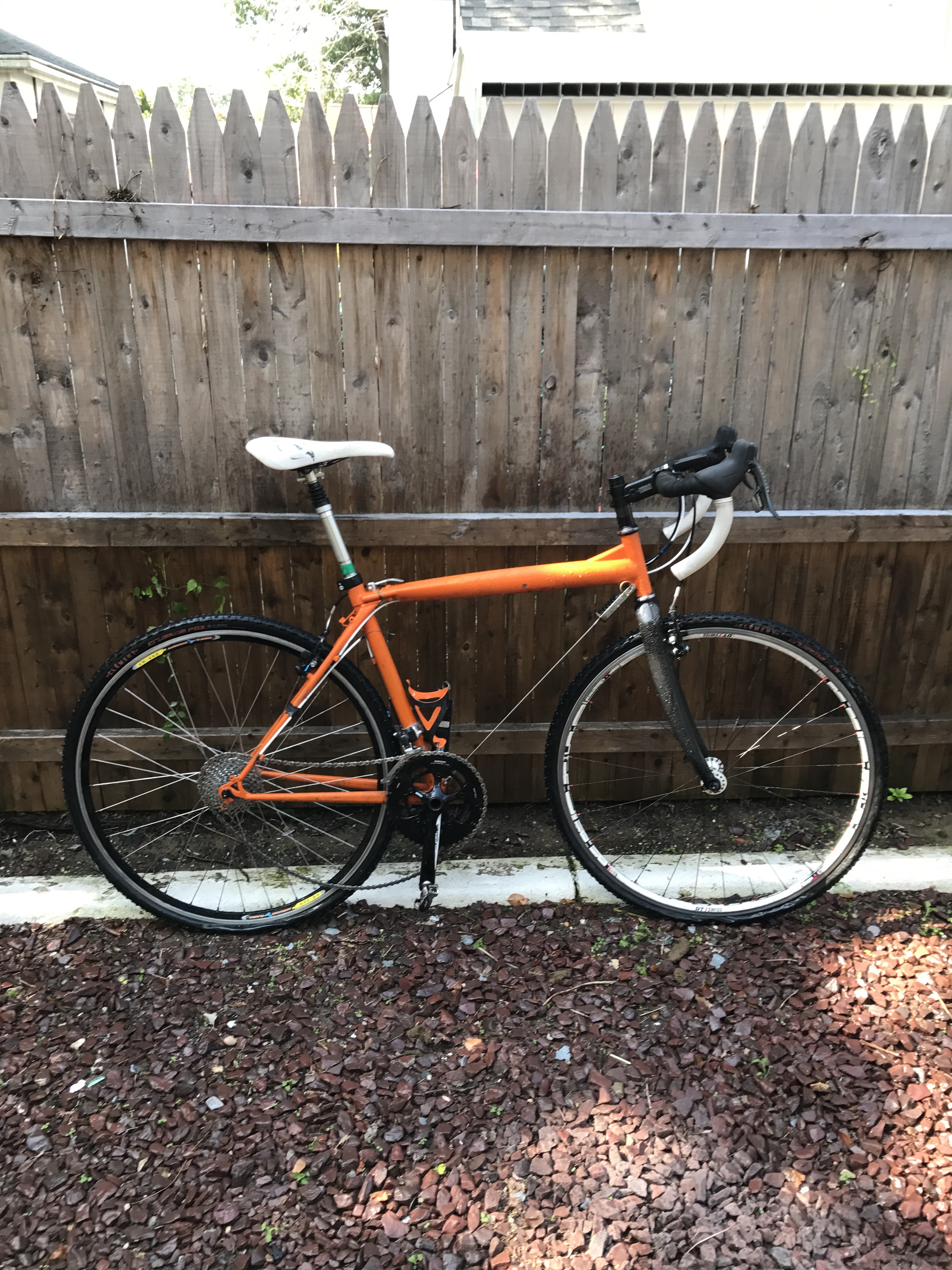
I have no explanation for this....I haven't ridden my Spooky road bike in almost 2 months. Since the Slingshot rer der. snapped in half I can't ride that for awhile. Anyway...I set a record time on a training ride I have been doing for over a decade. I have not even looked at my power #'s sine June 1st. There can be only 1 explanation....riding a 25 year old, heavy, flexy cross bike with no down tube makes
you stronger. Unless any of you have a better explanation...bend the knee before the SLINGSHOT !!!

https://youtu.be/KpBUGFRdXxA