Kissena Forum Archive

Training to Race: Faster, Stronger, Awesomer

2133 comments · 23940 views
I remember a post that included a GCN Cavendish "how to sprint" where we got into technique in the discussions. Can't find it now, but search for it.

You have to work on your technique. Obvs.

So for beginners, that usually means you have to work on technique separately than power.

When focused on technique, you do it in the small ring, mid to high on the cassette. Speed or power are not the goal, focus on your body and the bike. Listen. Analyze . Adjust. 

Sprinting good is hard to explain. After every try, stop and think. What can you do better? Then try that, and repeat this process until the day you die.

You should also work on your power, and at some point soon, you start to bring it all together: Technique and power and Greg winning races.

Good advice.  And good question as well.

I agree with Eloy.  Early season practice starts with small ring sprints, where you're sprinting for form only, and getting used to the movement, the spin, cadence, shoulder placement.  Small ring sprints are not meant for power, but for form.  Not for speed.
Once the weather gets consistently better, we'll start doing them in the park, 3 per lap for 3 laps.

If your front wheel is coming up, you're pulling with your hands.  If your rear wheel is coming up, you're bouncing too much.

Without knowing which end is coming off the ground, I'm going to assume you're pulling your handlebars up and your front wheel is lifting.  If this is the case, you should try to break out of that habit now.  It's a dangerous technique and I've watched riders crash themselves out doing it, because your front wheel twists as it comes down.

There are some good videos on youtube.  Keyword search 'sprint technique'.  

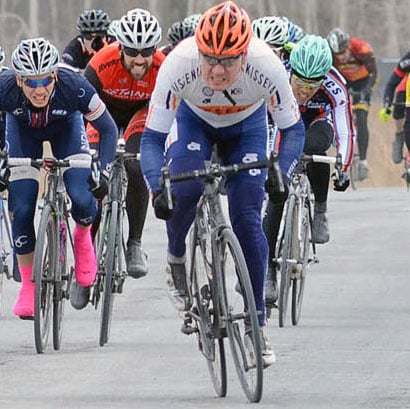
Out of the saddle, bent down, leaning forward and weight slightly pitched forward, but not too much and can be adjusted during the sprint.  Head up - ALWAYS.  There's a natural tendancy to pull your chin down, like you're squeezing your whole body.  Practice not doing this.  You need to see where you're going.  This will be the most power you push out on your bike, so you have to see what's in front of you.

Hands gripped tightly in the drops.  Shoulders and elbows squared, but NOT locked.  You still, just like riding, need to use them as shock absorbers.  They will be tighter than when riding, but this is the place where you're pulling your bike up.  Don't pull up.  Instead, use your other hand to push down.  Meaning, instead of wrenching your left hand up as your left leg swings over the top of your arc, push your right hand down (though slightly) as you rock your bike.  
Left foot up right hand down.  Right foot up left hand down.  Use your opposite hand as a guide to help hold your wheel straight.  Don't pull on the handlebars.  The effort should be from your quads, and eventually, from your hip flexors and hamstrings.
And when I say push, I don't mean push.  I mean, grip your handlebar and follow it with your hand.  Your body should be naturally rocking down on one side, and that's why you don't want to lock your elbows or shoulders.  You're absorbing that movement from your own body.  Keep the wheel straight as your body pivots left and then right, following the movement of your legs.

A good technique to practice is riding slowly and rocking your bike side to side while out of the saddle.  Keep the bike riding straight, even though it's tilted to the left and then the right.  Move the bike under you while looking forward.  Feel what your hands are doing in order to keep it straight.

And instead of using your hands (and shoulders) for the effort, use your core.  CORE.  This is why we do core workouts.  And why we do small ring sprints.  Squeeze your gut.  Not your shoulders.  Over emphasize this in the small ring when going slow, use that core when using your legs.  Feel that burn in there.  Relax your shoulders when that happens - we have a tendency to tighten our whole bodies because we're not used to it.  Let your core do its job.

It's good to practice these movements in the small ring without sprinting.  Just ride with the form of the sprint, then spin it up into a sprint.
Once switched to the big ring, concentrate on form again, instead of speed and power.  Work up to it.

And breath.  Hard efforts makes us sometimes hold our breath.  Breath while sprinting, nice deep breaths.  They will get shorter as you go faster, just remember to breath.  With small ring practice, comes breathing practice.  Hear your breaths in tune with your cadence.

For me, each sprint is different.  Each one could use work, my shoulders were too tight or I leaned too far forward or back.  When I do sprint work, I try full standing sprints, standing to seated sprints, seated to standing, track stand sprints (hate those), and fast rolling sprints, sprints in the drops, and sprints on the hoods(not good, but sometimes it happens).  And sprints and breathing.

You may never get to sprint in a race, or may do so once or twice a season, but you will always put out hard efforts to jump off the front, bridge a gap, fast paceline, and these techniques and form will be used throughout the race and the season.
thanks for all the advice. very helpful. I could certainly benefit from doing some sprint specific training -- focusing on form -- as you all have suggested. I will also likely do a full fitting w Ilya soon. I wasn't having this issue so much with my Cannondale, so thinking part of the problem is the saddle being too far forward and having too long a bike stem. I would also note this tends to happen a bit more if I am sprinting up hill, which supports the "too far forward" thesis...I think

bummed about this weather. 
@4:30 https://www.youtube.com/watch?v=Ci3Ez0MSpuY Look how smooth Ewan is, not sure the "head on the ground" works for big guys, but definitely if you're sprinting at 40mph, aero is the only way to go quicker. [edit, IMO biggest deal is getting comfortable generating 115-125 cadence for the 20sec effort, for that you need a lot, lot, lot of practice to dial in the neuromuscular—motorpacing good for this].

Caleb is an awesome example.

There's no question he is super talented, and there's also no question that he developed this sprint with intention and purpose. This didn't just happen naturally. He listen, learned, analyzed, and iterated his technique.
Queue the Prospect face-first carnage in 3...2...1...
thanks everyone for the guidance.

to follow up on an excellent bit of reading comprehension by bruce, it is in fact my rear (not front) wheel that departs from the road surface.  seems to occur at the beginning of a sprint rather than middle or end
@Brendan the consensus is it's about form and retraining your body. There's a kinetic chain you need to activate, you want all that power from glutes, calves, quads etc to end up being applied 90 degrees to crank arms. If bike is hopping, it means that power is going elsewhere, likely due to a combo of inefficiencies. One super basic solution is to do 115-125 20sec drills—you need good form to complete them and they generate the requisite physiological adaptations. From there it's training to increase power.
If you can do this you'll be golden...
https://youtu.be/abHnNGLt-AU

Physiological adaptations to high intensity short duration training types


Nerve–muscle connections

  • Increased recruitment of additional motor units, which respond in a simultaneous fashion to improve force production.
  • There is an increased activation of synergistic muscles to assist force production for strength, power, speed and hypertrophy.
  • Neural pathways linking to target muscles become more efficient at transmitting the message (stimulus).

Timing of neural stimulus

  • The timing of contractions becomes more co-ordinated, especially with power, speed and strength training, in order to meet the force generation required to move loads.

Summation of motor units

  • The ability to summate (fire a lot of impulses in target muscles all at once) is improved with strength and power training because they require maximum activation of target muscles to create maximum force.

Neuromuscular fatigue

  • Effective integration of multiple body segments to create explosive movements or lift heavy loads requires more neuromuscular involvement than any other training; hence strength, power, speed and hypertrophy training are the best types of training to improve the neuromuscular systems resistance to fatigue.


Fibre size

  • Muscle size increases with hypertrophy training and to a lesser degree strength training.  This is due to an increase in the number and thickness of actin and myosin filaments, an increase in myofibrils and an increase in sarcoplasm (fluid within the muscle cell).

Fast – twitchfibrebehaviour

  • Strength, hypertrophy, power and speed training modalities all focus on contractions from fast twitch fibres, thus these training types improve the specific fast twitch function being trained, whether that is strength, speed, power, size or a combination.

thanks everyone for the guidance.

to follow up on an excellent bit of reading comprehension by bruce, it is in fact my rear (not front) wheel that departs from the road surface.  seems to occur at the beginning of a sprint rather than middle or end
My guess is that when you start your sprint, you're moving your hips and body too far forward, unweighting your rear wheel.  Simultaneously, there's too much of an imbalance between the pushing down on one side and the pulling back and up on the other.  It also could be that your cadence is too low at the starting point as well.
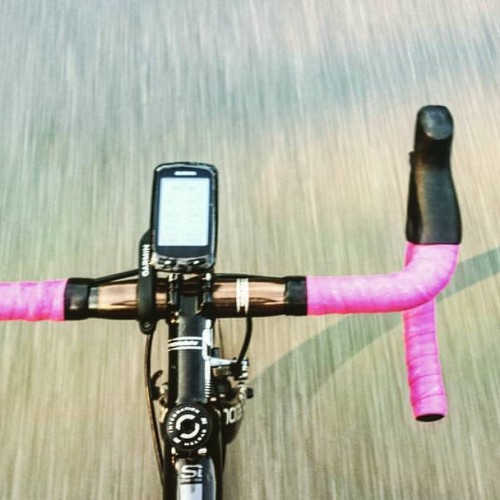
I don't think form or technique has anything to do with it...it's basic physics...between those brake levers and that laptop computer on your bars, your front end is so heavy it's kicking your rear wheel up
Kirin is still in town; don't be shy about reaching out :)
Mental training and prep are just as important as intervals and good sleep. Armstrong's Beard has few fans these days but this advice is still good.

I've made every one of these mistakes, sometimes still do.

1. Placing strict expectations on your performance

2. Leaving self-confidence to chance

3. Worrying too much about results or outcomes

4. Misinterpreting pre-race jitters

5. Worrying too much about what others think

6. Striving to perform perfectly

https://www.trainingpeaks.com/blog/6-ways-athletes-sabotage-racing-success/
In advance of Bear Mt classic (and other hilly races), how do folks attack hill work on weekdays? When I lived in NJ, it was easy. Hills every day. But living in BK, I have two options: the Prospect Park hill or bridge repeats. Any ideas or is there a secret hill somewhere I don't know about?
Greg I always felt that hill specific work was overrated. Your heart & lungs don't know which way you are pointed. Get your intervals done, and done well. It shouldn't matter too much which way your nose is pointed.
Jules said:
Greg I always felt that hill specific work was overrated. Your heart & lungs don't know which way you are pointed. Get your intervals done, and done well. It shouldn't matter too much which way your nose is pointed.
There is a outside chance that I'll be in NYC that weekend and available for Bear Mtn.  As you all know, I'm in flat-as-a-pancake Houston, but these fools do wicked power intervals, no joke.  I'm definitely building my power! so keep crushing those intervals, your climbing legs will love you for it.

Greg, I took a look at my numbers last year @ bear Mtn.  My first round of the ~2.9 mile main climb took me a 13:40 min, at an NP of 290w.  I'm 165lbs, so 3.9 w/kg  (I was cat 5 last year and presumably I've gotten stronger over the past year ... I hope).  I blew during the 1st climb and was dropped; I'm sure those guys were averaging 4.2 w/kg or higher during the climb.

So considering the above, when I was training up for the GMSR, below is an example trainer plan given to us before the race for the really long climbs.  Since you're in Brooklyn, Prospect Park is perfect for the plan below.  For MS1, I just did the flats starting just after Machete Circle and slow rolled it back on Parkside Ave back to the start.   For MS2, start at the Machete Circle (bottom of the hill) again and work it to the top, which should get you a good ~5 minute interval (MS2) and then rest for 5 minutes back to the bottom of the hill.  

Kissena Training Peaks
August 26, 2016 workout:
 WU: 20 Minutes working ENDurance (PW:Level 2 / HR: Zone 2 / PE: 4-5 ) with 2 x 1 minute Fast Pedals to wake up legs
-----
MS1: Once warmed up complete 6 x BIG GEAR WIND ups. Get in your 53x13 (ish) gear, grab some breaks to a track stand, then hit the big gear sprint! Explode from the start with the focus of getting on top that gear as fast as you can! Sprint until you hit 90 RPM, then rest for 2 - 3 minutes. Recover for at least 5 minutes before going on to MS2.
-------
MS2: VO2max Intervals. Find a long stretch of road where you can complete this workout without stopping or interrupting the interval efforts (low grade hill / rise of about 1.5 miles works perfect). Complete 4 x 7 Minutes at 106% - 115% of FTP (PW:Level 5 / HR: Zone 5 / PE: 7-8 ) with 5 minutes rest in-between. Cadence: complete the interval efforts at 75-85 RPM!
CD: 15 Minutes

GMSR stage 2 has a 2 mile grinder climb, the longer VO2max will help prep body
@Scott Kuhlke thank you. very useful. also shows me I need to get on training peaks. 
Here is a power file for an old race with a couple of very long (30+ minute) climbs. I trained for this in Prospect Park. Never made it to Bear Mtn that year, even for training.

http://tpks.ws/pX6OX
I read through the forum and watched those sprinter videos but not seeing anything on technique. So thought I would pose my question to the group. Basically when I sprint and really push it my bike comes up off the ground with each pedal stroke. clearly coming off the ground is counterproductive bc you lose traction. so is there such a thing as sprinting too hard, do I need to work on my pedal stroke, or is there a different answer all together? 
Found the thread on Cavendish. You'll want to see the video and scroll down to read our comments.

https://kissenacycling.vanillaforums.com/discussion/comment/83955/#Comment_83955
@Brendan the consensus is it's about form and retraining your body. There's a kinetic chain you need to activate, you want all that power from glutes, calves, quads etc to end up being applied 90 degrees to crank arms. If bike is hopping, it means that power is going elsewhere, likely due to a combo of inefficiencies. One super basic solution is to do 115-125 20sec drills—you need good form to complete them and they generate the requisite physiological adaptations. From there it's training to increase power.
If you can do this you'll be golden...
https://youtu.be/abHnNGLt-AU

Sorry, just catching up. But did that guy fish those rollers out of Chernobyl?
Also, your rear wheel is skipping because you're "humping." Be smoother.
Family show, Brendan. Keep it PG out there.
Wednesday....It is "hump" day...see what I did there Jules ???
eloy said:
I read through the forum and watched those sprinter videos but not seeing anything on technique. So thought I would pose my question to the group. Basically when I sprint and really push it my bike comes up off the ground with each pedal stroke. clearly coming off the ground is counterproductive bc you lose traction. so is there such a thing as sprinting too hard, do I need to work on my pedal stroke, or is there a different answer all together? 
Found the thread on Cavendish. You'll want to see the video and scroll down to read our comments.

https://kissenacycling.vanillaforums.com/discussion/comment/83955/#Comment_83955
thanks @eloy !!! this is a great resource
Out of curiosity, does anyone know how normalized power is specifically computed? I am new to the power meter game and upload my rides to Garmin Connect and Strava. Garmin seems to be a bit more generous because all my rides tend to have a 10-20W higher NP in Connect. Also, my raw average power, which you would think should be the same for both Garmin and Strava, is consistently higher by about 5-8W on Garmin. 
https://www.trainingpeaks.com/blog/normalized-power-intensity-factor-training-stress/
Out of curiosity, does anyone know how normalized power is specifically computed? I am new to the power meter game and upload my rides to Garmin Connect and Strava. Garmin seems to be a bit more generous because all my rides tend to have a 10-20W higher NP in Connect. Also, my raw average power, which you would think should be the same for both Garmin and Strava, is consistently higher by about 5-8W on Garmin. 
It's a moving average over a 30 second window.

https://www.trainingpeaks.com/blog/normalized-power-intensity-factor-training-stress/
Mostly think of NP as an estimate of the power average had you not coasted at any point.

Good definition here:
https://www.trainingpeaks.com/blog/normalized-power-intensity-factor-training-stress/
I think the intent is to give you an equivalent "steady average" of your actual ride.

You could do a super ragged ride with a lot of surges and NP tries to convert that to an equivalent ride with zero surges.


@Will Kalbacker

I basically think of it as what Eloy mentioned, with Jules' proviso.  I have my primary bike computer screen set up with NP at the bottom.  I use it to judge how hard I'm doing the ride or race.  In races, I've noticed that the less aggressively I race, the closer my NP is to AP.  
mugwump said:
@Will Kalbacker

I basically think of it as what Eloy mentioned, with Jules' proviso.  I have my primary bike computer screen set up with NP at the bottom.  I use it to judge how hard I'm doing the ride or race.  In races, I've noticed that the less aggressively I race, the closer my NP is to AP.  
And that's exactly what Variability Index is. (NP/AP)

I think VI is a primitive measure of what W(prime) is trying to get at. Obviously a ride of X average power should be easier than a ride of X normalized power that has a huge VI.

(@TimCusick or am I barking up the wrong metric?)