Kissena Forum Archive

Training to Race: Faster, Stronger, Awesomer

2133 comments · 23940 views
https://m.youtube.com/watch?v=YWzRE1BiAvw There are quite some good exercises here. 

In my experience, a lot of what goes into maintaining an aero position on the bike comes down to core strength just as much as it’s flexibility. It really pays off to do a 10 min routine with planks and stuff like that. 
+1 on Yoga or Pilates or both.
I've paid for 4 sessions with a PT at the Y near me as I've maxed out what I can do at home with adjustable dumbells, I'm primarily focused on bar squat/deadlift form but am going to do a lot focus on core strength. Pilates is a good recommendation to add in during the season. @RJ Simoni do you do yours through a class or just home sessions?
@RyanCollins - I do mine through classes at my gym.
Ryan, either at home or gym will do you a world of good. Gym sessions are a bit harder to drop out of once scheduled 
@RyanCollins

FWIW, several years ago, I felt like I had lost too much core strength, so I decided to remedy it as simply as possible.  I worked myself up to doing a two-minute plank every morning (45 seconds seemed long when I started).  Felt pretty good about it.  Then, I was speaking with a competitive rower older than me, and she was doing a three minute plank every morning.  I upped my game.  When three was easy, I started going for four minutes, was even doing 4.5 minutes occasionally, but that seemed excessive.  

So, I've been pretty much doing a three minute plank every morning since a bit before the pandemic.  When it gets boring (I sometimes read, sometimes listen to the radio during the effort), I do a 45-second left-side plank, then 45 on the right, and 1.5 minutes face down.  I also periodically stay face-down and put an arm behind my back for 45 seconds at at ime.  

Simple, short, definitely helped with riding.  
@mugwump Good advice, I've been pretty consistent with 3 60sec planks per gym set, along with some other work but I like the motivation for morning consistency. 
@RyanCollins I'd encourage you to take advantage of the FREE training sessions we get from Basecamp (up to 3 or 5 i think).

I'm just about to start: Base Building Plus - Road High Volume - Classic Zones - 10-12 hours per week
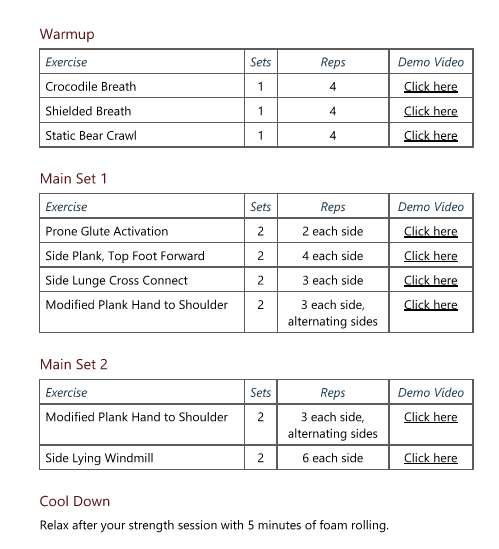
and this includes FREE strength training routine with links to videos:
 
"As a thank you for purchasing our training plan, please download this strength and activation exercise routine from Menachem Brodie, BaseCamp strength coach and founder of Human Vortex Training. Whether you’re a new rider or a seasoned pro, you will benefit from learning to coordinate balance and control, and from correcting the muscular imbalance developed in cycling-specific workouts.
This short but potent in-season strength training regime is designed to be done 2-3 times each week."


A bit of a way out but Basecamp also does a 4 month online Winter Group Coaching (Dec-Mar). Strength training is also included in this. I think it's $500 for the 4 months. This is great for the off season  and includes a social element and races if you want to test yourself. The strength training includes lots of planks & stretches and I've definitely benefited from this re comfort-wise when it comes to tucking into a more aero position.

If you want to go mad you can also hire a coach through Basecamp, it's around $300/month. I did this from July '24 through April this year and felt some great gains. @BlakeFoster also currently has one.

Did I mention the training plans & strength sessions are FREE?


@KevinWomack
Thanks, I'll take a look, I have had great success in the past with a coaching service as well for cycling specifically.  But am very open to more strength training work. I've enjoyed the gym work recently now that I'm working on a squat bar and dead lift, all the teens at the Y are afraid to use it so it tends to always be available. What is the process for getting set up with Basecamp?
@KevinWomack
Thanks, I'll take a look, I have had great success in the past with a coaching service as well for cycling specifically.  But am very open to more strength training work. I've enjoyed the gym work recently now that I'm working on a squat bar and dead lift, all the teens at the Y are afraid to use it so it tends to always be available. What is the process for getting set up with Basecamp?
Click here, this has the link along with a bunch of info & other goodies.


I recently used a BaseCamp coach who gave me weight lifting workouts specialized to help muscle tightness and weakness I was feeling and they were helpful. 

I’ve also been using the Kissena basecamp plans for the last couple years and they’re been useful and helpful.
As we're in August, this is the time when lots of people confront burnout (if they haven't already).

This article on trainright seemed pretty decent on the subject.

https://trainright.com/training-burnout-prevention-recovery/

The following passage jumped out:

"Incorporate “play days”: Burnout is the absence of joy. You initially fell in love with your sport because it was fun, even if it was difficult. Or perhaps it was fun to be part of the community. Staying connected to joy is key for avoiding or overcoming burnout. We schedule “play days” for athletes where having a blast is the only objective for a ride, run, or other activity. Training data is sometimes recorded, but we recommend ignoring it (even hiding it) during play days."

If you've been focused on training for months, I think dialing back the specificity and going out and having fun on two wheels can be hugely rejuvenating.
Burnout is one of the reasons I started using Xert Magic Buckets this season.  You can ride however you want as long as you hit a certain amount of training stress for each zone.

https://baronbiosys.com/magic-buckets/
Just got off an into call with Hexis. Looks very interesting. Seems to be bundled with Basecamp; I'm not sure if the club is still using that. 
Some of us still use the basecamp plans, and these training plans are currently available to all of us.

I think Basecamp offers a Hexis discount if you join one of the larger Basecamp guided programs.

Hexis seems pretty good, in their wholistic approach and considering nutrition around whats on your training plan. I think @PatrickGrehan has been using it with some good results. Maybe he can chime in.

I was using Hexis with my Basecamp coach, it's pretty good and aligns feeding/fueling with your training (tied in with Training Peaks). Splits out how much carbs/protein etc you should be eating.

Only issue is that the get the best out of it you need to be super diligent in entering every single thing you eat & drink. You can scan barcodes on some items but if you want to eat a sandwich for example, you have to enter every single ingredient which becomes a mission... 

Going out can be even more complicated e.g. having to add 1/4 pound ground beef/burger bun/cheese/lettuce/fries + 3oz gin/ 1/2 oz vermouth (x3).

That said, I'd recommend trying it. I believe there's a free trial. If you can get into the groove I think it helps you plan fueling for races etc if you have it all in your TP calendar.
People have been using base camp and Hexis. @KevinWomack really likes Hexis. I have used it a bunch, along with many other nutrition tracker. It does recommend a high amount of carbs. I’m fairly used to it; but have had great experience without bonking and have been recovering well by staying in the recommended ranges. 

I found it a bit hard to stick to in a regimented way, since the food you eat impacts your macros differently, the live updates made me feel like I had a hard time sticking to their plan. 

I don’t use it for main meal tracking anymore c I have a separate system for that. I do still use it for fueling recommendations for every ride I do. 

I use it paired with training peaks which requires a ride activity (with a start time set in TP or Hexis, doesn’t matter), and a TSS/IF target set for the ride. 

If you don’t have a start time picked, Hexis won’t give a fueling recco
Why you all are fit and fast while I incessantly talk about pizza.

Alo, me for the next week in Maine with my family...

https://youtu.be/VunWdHCjbI8?si=rHZdvThJiRtGZ7e0&t=233
Does Hexis work differently than My Fitness Pal? I’ve used that in the past and it integrates with Training Peaks.
Hexis looks at what’s in your training plan (ie the future) and what rides you’ve done (ie the past) and makes macros suggestions to prepare for your upcoming ride/wourkout and then makes macros suggestions for recovery post ride 

The integration w TP is much deeper than MFP
Hexis seems pretty impressive; it is a tracker like MFP (although MFP has a *lot* of junk in it's library a this point) but it takes into account what you need to recover/refuel from yesterday as well as what you need to do in anticipation of tomorrow. It also has a "day before race" where it will help you carb load.

Links to Training Peaks and a few others to gather your ride data and determine what the metabolic cost was.
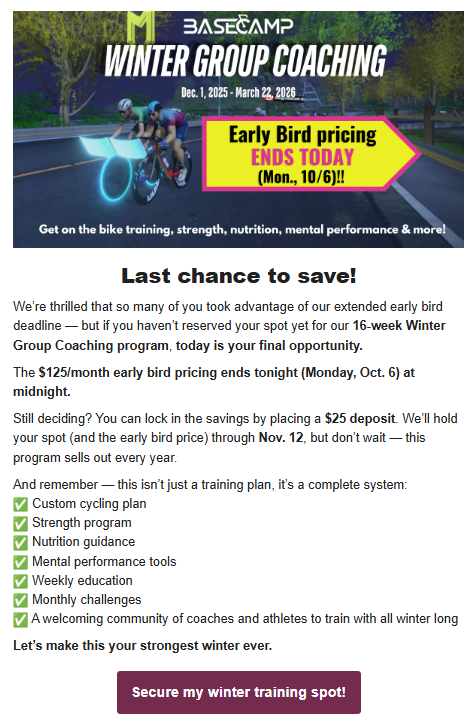
Bumping this up as it's the last day for early bird discount for winter Basecamp. ($50 discount)

Worthwhile if you are looking for something more structured over the off (road) season. ~$125/month. From memory last year there was also some zoom 'interviews'/deep dives with some pro team coaches, pretty cool.

 ~4 months structured group training
 Virtual racing
 Custom cycling plan
 Strength program
 Nutrition guidance
 Mental performance tools
 Weekly education
 Monthly challenges
 A welcoming community of coaches and athletes to train with all winter long

FYI for those who thought they missed it... Basecamp extended its early bird pricing discount

Time to grind: 

https://www.youtube.com/watch?v=tcar3G2v73I

Any feedback from the more experienced members?
Years ago, like 25 or so, I did 50rpm repeats up the Alpine Climb for several weeks.  I was working with a coach who was pacing me with a moto.  It definitely gave me a good climbing boost.

This winter, I was using Rouvy for some of my indoor sessions.  They have a climbing interval program which focuses on low cadence efforts, like between 50-60rpm.  The resistance was around 80% of threshold.  Didn't do it enough to tell you whether or not it helped with VO2.  
Anybody shilling an 8% vo2max gain from a workout is not to be trusted. First, if it's well trained athletes, they'd be crushing pog. Second, if it's *untrained* athletes, just about anything will raise your vo2max 8%.

There are no "secret workouts" just consistency and good sleep.
Jules said:
Anybody shilling an 8% vo2max gain from a workout is not to be trusted. First, if it's well trained athletes, they'd be crushing pog. Second, if it's *untrained* athletes, just about anything will raise your vo2max 8%.

There are no "secret workouts" just consistency and good sleep.
I think this is fair, but also think this might affect cyclists who are used to high cadence/lower torque workouts and training. Anecdotally I used to be a low cadence guy and when I started getting on training plans most workouts called for high cadence. It definitely helped with certain types of riding - but felt like I lost some extra power on the top end. I imagine aging is mostly the culprit but I am slowly reintroducing lower cadence higher torque workouts.
I think we can agree that 8% seems like an unlikely too-large improvement over too-short a time.  

That written, it's worth asking if low-cadence workouts could help make a rider more powerful.  I think there is a place for low cadence drills both doing extended climbs and sprinting.  Maybe not 10 weeks in a row, but certainly occasionally.  This is also a good thing fnor people who find their motivation flags when the do the same workout too often.  

N=1, I've found the low cadence work prescribed by Basecamp plans to help a lot with a building a smoother pedal stroke and muscle fatigue.
I forget where I read it (maybe one of the intros to a Tim plan?) but low cadence, high torque works the muscular/skeletal system (which is why your heart rate is generally lower but feels more exhausting) and high cadence, low torque works the aerobic system (which is why it feels less fatiguing but your heart rate is generally higher)