Kissena Forum Archive

Bicycle Tech/Gear Discussion Thread

8105 comments · 108281 views
MaxThorn said:
Does anybody use an electric dryer, the kind that you often see designed for ski boots, on your CX shoes? If so, what have been your experiences? Any models you'd recommend? 
I've been afraid of overheating and delaminating shoes, so the only time I use an electric dryer is several seconds at a time with a hair dryer.

a bunch of years back, I got a pair of Stuffits to try out. in place of newspapers.  They seem to work pretty well.  But maybe they worked too well.  It looks like the company is out of business.  

here are some images: https://www.google.com/search?q=stuffitts&biw=1553&bih=817&tbm=isch&source=lnms&sa=X&ved=0ahUKEwig-N7d9r7QAhURySYKHTw6Ay8Q_AUIqgEoAQ

in lieu of newspapers, paper towels work well, you might want to replace them more often.
favorable review of a sponsor's bike: http://www.bicycling.com/bikes-gear/tested/tested-the-value-packed-giant-tcx-advanced-pro-2
Many of you know that I won the Van Dessel ADD frameset (plus extras) in the Supercross volunteers' raffle. Now it's time to build it out and of course I wanna know what y'all think. Keep in mind that while Van Dessel touts the ADD as a "do-it-all bike," this thing is gonna see a lot of action on the 'cross course.

The big-ticket items are wheels (gotta be disc), and a groupset. As for the latter, Cyclocross magazine describes the SRAM Rival 22 as "workingmans cyclocross group," which sounds just about as appealing as I could hope for. In wheels, the clincher/tubeless/tubular debate comes into play, as ever. Overall, I'm trying to get the best of both without losing my shirt. 
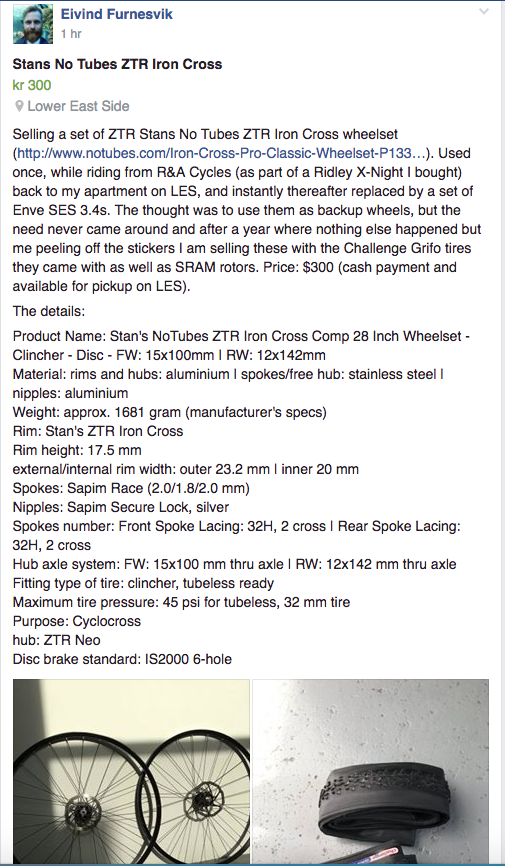
After several years of riding on clinchers and tubulars I bought a tubless setup: stans no tubes iron cross comp wheelset with WTB cross boss 35 tires. This is an awesome jack of all trades setup. The wheels are light (and I've seen them as low as $300 on sale recently at competitive cyclist) and the tires work work great for a wide range of conditions other than real mud. Cyclocross Magazine called them tire of the year last year. 

i have not had an issue with the tires burping even at stupid low pressure and I no longer worry about getting flats out at Cunningham park (something that happened too frequently with clinchers). The only difficulty is that when new the interface between the tire bead and rims was so tight that I couldn't seat the tire and inflate with a pump on my own. I had to bring it to a shop with a compressor. 

Enjoy your new bike
Patrick, have you tried removing the tires yet?  I know Brendan had a hell of a time getting his tubeless tires off due to the super tight bead seating.  
iron cross rims will likely not be as much of an issue as the american classic 101 rims i was using; they have different internal shapes. different ideas about how best to keep a tubeless tire seated

i recommend tubeless 100%. good balance of cost and usability.  obviously if you're a billionaire, get $300 worth of tubular tires on $2500 worth of tubular wheels and pay a shop to glue it all for you.  

if you're going to be doing tubeless you'll want to invest in one of the Bontrager TLR Flash Charger style pumps that can build up to a certain PSI and release it all at once.  it's like a manual compressor.  made tubeless a lot less frustrating for me.

tubeless is all about rim/tire combination. some work better than others. try to figure out whether the combo you're working with works well before buying either rim/tire.  i have one combination of rim/tire that i had to use a park tool repair stand as a vice and pry the tire off.  probably not recommended to even use the tire after what i put it through to get it off.

with wheels you should also make sure the hubs are convertible so that you can put them on your next frame which will likely be thru-axle.  also that ADD has a thru-axle option, right?

if cost is your #1 concern just go neuvation?  or learn to build your own wheels, but that will cost more for a while due to costs associated with equipment to build and mistakes of learning curve

i have sram rival 22 on my cross/commuter.  i have red 22 shifters on my road bike and i can't really tell the difference between shift quality on the two bikes. the levers just feel  a tad lighter on the red and they aren't as cold (carbon v. aluminum).  totally recommend rival.  i only got red because it's the weird hydraulic rim brake version and the red was, for some reason, about the same price as rival


Patrick, have you tried removing the tires yet?  I know Brendan had a hell of a time getting his tubeless tires off due to the super tight bead seating.  
Not yet. I suspect it will be an ordeal. 

On on an unrelated note I recently discovered a sticky substance on the sidewall of my rear rubles tire. Not by the tread, but on the sidewalk and near the rim/bead. I thought that maybe I rode through something while on trails, but the weird part is that it smells like honey! I wiped it off the tire but the scent and some of the "honey" remains. I can't imagine that there is a sealant that smells like honey (shop installed tire). The easy answer is that there is honey on the trails somewhere, but I still think it's weird.
sweetness! honey watts!
Hm, realistically it's probably some sort of energy gel you either ran over or came across somewhere.

But I'd like to think that we have bears roaming around the woods of Long Island...
custom bits galore.
https://www.youtube.com/watch?v=DiVltK8TdEE

@BrendanRigby, yeah the ADD compatible with thru-axle. 
Well, @PatrickG, what do you know:


Hey all - long time no see! Have been kind AWOL from the forum and IRL for a while as I get back into shape after months off due to my knee injury. 

I've been totally loving my new Kickr, and have a question for those of you who use the Kickr with workouts programmed into your Garmin…

When I have a workout loaded on my Edge 820, with power zone intervals, it seems like the Kickr is actually automatically increasing resistance (to help reach power goal) when I hit the interval. I have the Kickr connected to the Edge 820 as a sensor, but I didn't realize the integration went that deep with something so basic as a workout set up in Garmin Connect. Am I nuts, or does the integration really work that way automatically?
@BenFinoRadin, the integration does work that way! Not sure how much set up it takes (not a whole lot apparently) but it makes sense that if you're following a workout you made in Garmin Connect your Garmin would control the Kickr. 

Here's some more about what you can do with your Kickr and Garmin: 
https://www.dcrainmaker.com/2016/07/everything-you-ever-wanted-to-know-about-ant-fe-c-and-bike-trainers.html#the-bike-computers
So "riding" tonight on my Kickr I also turned on my Garmin.  My Kickr was paired with my computer, my Garmin with my Stages.

The Kickr was measuring ~10% more watts than the Stages.  The Kickr seems to be more accurate and the Stages is calibrated.  

Anyone else have something similar happen w/ their power meters?  Is there a way to get them more aligned?


The Kickr was measuring ~10% more watts than the Stages.  The Kickr seems to be more accurate and the Stages is calibrated.  

Anyone else have something similar happen w/ their power meters?  Is there a way to get them more aligned?

How do you know the Kickr is more accurate?

First, do you have the latest firmware in the Stages?  Have you kept the bike in the room with the Kickr for ten minutes or so?  Have you adjusted the offset?  How about calibrated the Kickr?

Those are the basics.

Then, the next question is: are you left or right dominant? If left, there's a chance part of the issue is that difference.  10% seems big, but a few % possible.
Kickr is calibrated using "spindown".  Download wahoo  utility to phone,  pair with kickr,  after riding kickr for ten minutes,  open app and follow instructions for spindown

I've had issues doing spindown while kickr is talking to zwift. Spindown likely works better when kickr is not talking to any device but wahoo utility 
I think the move is to aim the thing behind your rear wheel....launch for the line early and leave everyone in your wake slip sliding away
http://www.cyclingnews.com/news/worldtour-team-orica-scott-to-lube-as-they-ride-in-2017/
https://www.youtube.com/watch?v=_rrtDcx-3Js
mugwump said:
How do you know the Kickr is more accurate?

First, do you have the latest firmware in the Stages?  Have you kept the bike in the room with the Kickr for ten minutes or so?  Have you adjusted the offset?  How about calibrated the Kickr?

So after playing around with the Kickr and downloading the firmware for Stages, I've got the two devices reading more or less the same wattage (I'd say generally within 1-2%) of each other.  Since they are totally different technologies, I'd say that is pretty good.

Thanks for the advice Brendan and JP.
Re: Marginal gains from using light grease or oil in hubs

After finally getting around to servicing several of my wheelsets that lived through wet winter commutes and training rides through snow storms, I've decided that the 2.5+ watts I'd lose using marine grease and seals instead of like a drop of light oil or whatever is worth it for the extreme protection from water.

Also I finally replaced the freehub body and hub bearings on my Hed rear wheel sonic hub.  While it is smooth, it has an annoying amount of noticeable drag that I just don't understand.  Maybe the Hed just needs more miles to "crush" the grease and loosen it up.  In comparison, a cheap set of Mavic Aksium wheels circa 2010 that I've commuted and trained on heavily are still incredibly smooth with a shockingly low amount of perceived drag.
perceived drag is what you feel when a wheel is in your hands...not under load....who knows what is really happening when the wheel is bolted into a frame and all your weight & power are being applied...I suspect the drag you feel is negligible.  If you believe the shit SKY has been dishing about marginal gains....I'll counter with a sneaky courier and an unknown parcel
Love a good hub update.  I use marine grease in one set of hubs and phil wood grease (not oil) in another

The drag should change when you put it in the frame and clamp down the QR.  Preloads everything from end to end, compressing the axle. Hub design affects the outcome 

If you have really excessive drag, your bearings might be in ever so incorrectly. My $80 Taiwanese Internet direct hubs came with bad bearings. They died after Supercross muddy day 2. Pressed in new bearings incorrectly, thought I broke the hub,  loooooads of drag.  Bought hub press, Removed bearings, pressed new ones in, now drag is same-ish as my dt Swiss hubs! Alignment and position matters with cartridge bearings. Also your new freehub bearings might just need to be broken in 

Edit: also, not all cartridge bearings are created equal. Apart from roundness of the balls, uniformity of the balls, and smoothness and games of races and balls, some have better seals in terms of blocking water, some have "no contact" seals that have much less drag. Also some hubs use "angular contact" bearings like the ones in your headset. Those have higher drag 
twoyacks said:
perceived drag is what you feel when a wheel is in your hands...not under load....who knows what is really happening when the wheel is bolted into a frame and all your weight & power are being applied...I suspect the drag you feel is negligible.  If you believe the shit SKY has been dishing about marginal gains....I'll counter with a sneaky courier and an unknown parcel
There was a really good article on cyclingtips that went through a few different options (link in the marginal gains thread a few months ago).  They were using top of the line ceramic bearings, but I think the physics of the grease and oil they were testing with would be consistent with steel ball bearings.

I believe it was per bearing but it might be per pair of bearings like in a front wheel hub, but the takeaway was that there's a potential loss of about 2.5watts using "standard" all purpose grease v their best result which was with a model RC car oil or grease (someone talk to Ragot).  The worst?  Surprisingly it was Phil Wood.
Phil Wood tenacious oil or waterproof grease? 
http://kissenacycling.vanillaforums.com/discussion/comment/87380/#Comment_87380

Tenacious Oil.  Quote below is for bottom brackets.  They extrapolated the data for wheel hub bearing performance with the formula of multiplying by 5.5 (see second set of quotes):

Shimano’s notably thick and sticky grease performed as expected with 0.39-0.46W of friction, depending on fill rate, but the results of the Phil Wood Tenacious Oil were surprising. Five drops increased the average measured friction of the high-end hybrid ceramic bearings tested to a (comparatively) whopping 0.79W per pair — roughly on par with an inexpensive Shimano 105 bottom bracket — while a single drop still performed worse than the factory-applied lubricants with 0.47W of drag.

Smith limited his study to BB/PF30-sized bottom bracket cartridge bearings but based on previous experiments, he was able to extrapolate how similar changes in lubricants might affect friction levels in hubs — in particular, ones built with a pair of cartridge bearings up front and four cartridge bearings out back.

According to Smith, such hub configurations generate roughly 5 1/2 times as much friction as a pair of bottom bracket bearings alone. Using that ‘5.5x’ multiplier, Smith contends that replacing factory bearing grease to CeramicSpeed TT grease throughout both hubs and bottom bracket could save as much as 2.5W.

That's right suckez....

twoyacks said:
That's right suckez....

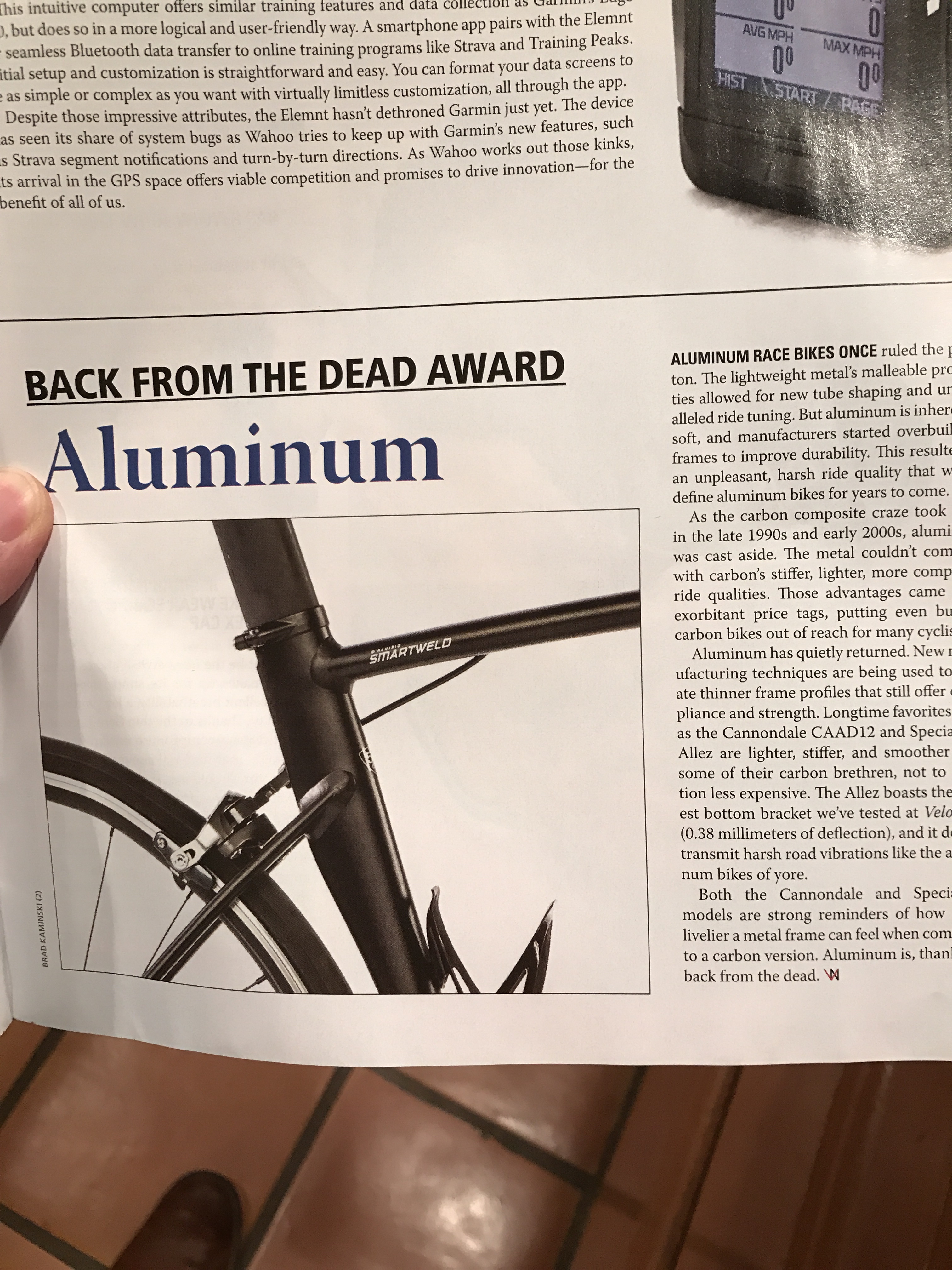
VeloNews does itself no favors with articles like this.  The Cannondale CAAD series has always been popular  (we even had a CAAD9 4 Life fan club in Kissena for a few years).  Specialized has been making decent aluminum bikes for years, as has Trek.  
Velonews pays the bills with articles like this...Specialized fo sho sent them a little cheese
i wonder how many watts the marine grease i put in my shimano spd pedals is costing me