Kissena Forum Archive

Bicycle Tech/Gear Discussion Thread

8105 comments · 108281 views
I've been having a weird issue with my Kickr…

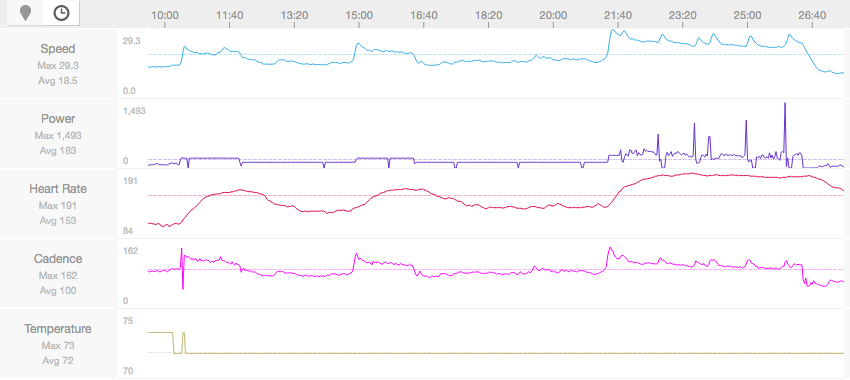
I'll be laying down some nice consistent power, and then suddenly the resistance will ease way up, requiring me to shift way down the cassette in order to get the power back. It will then slowly come back to normal, and I'll have to shift back up.

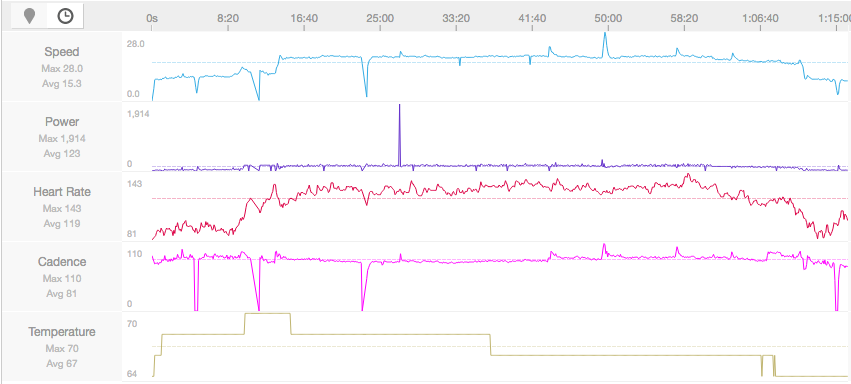
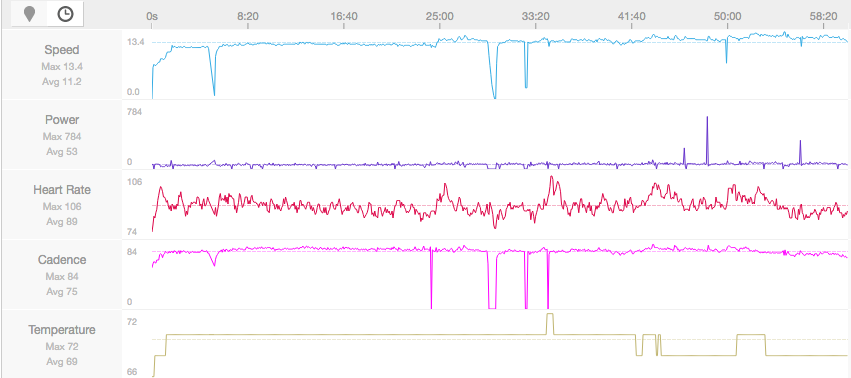
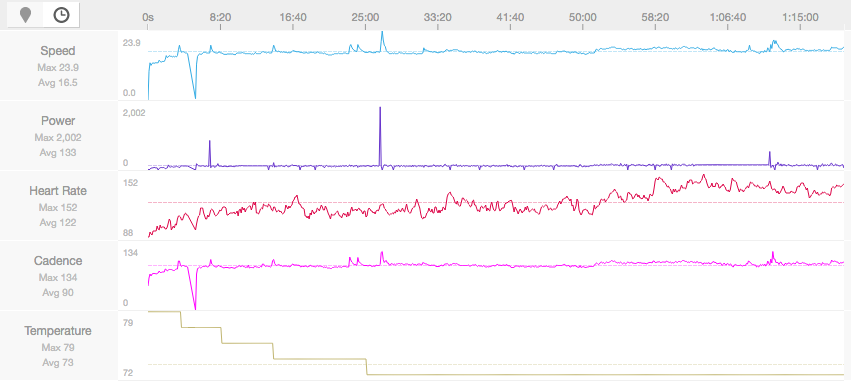
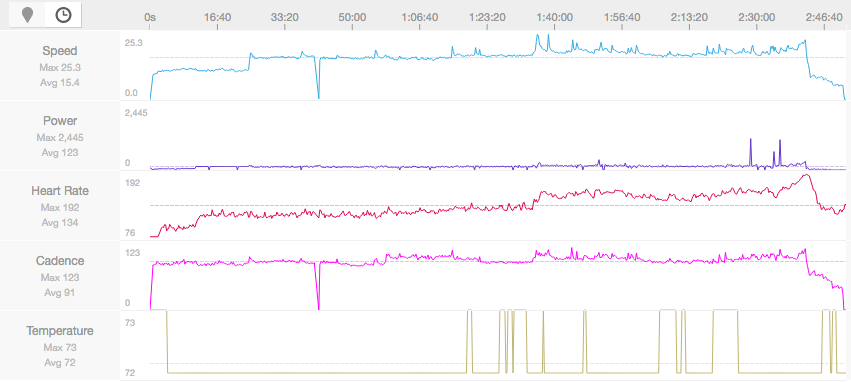
Looking at my power data it seems like the issue is that there are these spikes where suddenly it registers +1,000 watts. Since I am working with programed power zone workouts on my Edge 820, it makes sense that the Kickr would adjust if it sees +1,000 watts, in an attempt to get me back in the zone. As much as I'd like to take credit for those four figure power numbers, there's clearly something weird going on. I've done the spindown calibration already.

Has anyone experienced seen this before? Here are some screenshots of my power so you can see what I'm talking about…

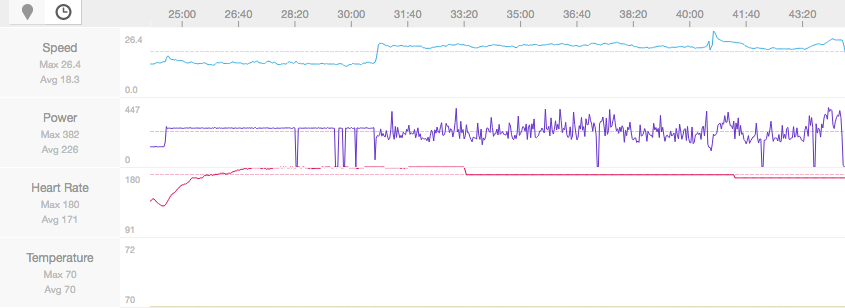
The first one I'll share is perhaps the best example. I was 1/4 into my FTP test, and suddenly this happened (argh!) – if you look you can see that my power goes from solid to super sporadic, and right around where this happens, my speed goes up. Looks like my HRM was crapping out too, but that's another story.

cc @Redbeard @TimCusick


i wonder how many watts the marine grease i put in my shimano spd pedals is costing me
Has to be at least .02 watts.  That's probably shaving an extra safety pin off your number on race day.  Totallllllly not worth it, bro.  Flush it out and use a quarter drop of a unicorn tear to lubricate.  Rinse and repeat every 50 miles for maximum watts savings.
ben, without looking into it more i'd tell you to make sure all firmware is up to date on edge and kickr and all wireless receivers are as close as possible to whatever they're transmitting to.  if you're using the ant+ usb dongle get a USB extension cord and put it right next to your kickr.

could be an issue with your garmin interacting with your kickr (i think i read about garmins having issues doing workouts with kickr, moreso than wahoo's own head unit).  can you run the workout from zwift on your computer via ant+ USB dongle?  that would isolate one variable
twoyacks said:
Velonews pays the bills with articles like this...Specialized fo sho sent them a little cheese
I think the issue has more to do with inexperience and lazy habits.  
@BenFinoRadin, I've heard of power spikes and general weirdness being caused by the kickr's optical sensor being dirty or dusty.

Here's a video that may help out:
https://www.dropbox.com/s/ivqih9kj322fnt9/How%20to%20Video%20-%20Top%20Cap%20Install.mov?dl=0
Update – turns out it was the Bluetooth connection to my phone that was shoddy. The only reason I even had my phone connected was to have a second display (other than my Garmin) for stats. I stopped using it, and the problem has completely disappeared. The Ant+ connection to the Edge 820 seems a-ok.
More on bearings and grease: I serviced the old square tapered cup and cone bottom bracket in the fake-lo-cross bike and realized that what seems relatively smooth with cranks on the spindle feels like a pepper grinder when turning the spindle by hand.

The previous owner set the cups too tight and used the cheapest, crappiest grease that was completely disintegrated and black.  Spent a good amount of time cleaning up the parts, the shell, scrubbing off rust and packed it full of marine grease.  Sadly the non-drive side cone has a little damage, but all in all it is much much smoother.  I'll take it apart next January, hopefully after some mud-bog cross races and Cunningham sessions and see how it fares.  

Next up: Repacking the 1" threaded headset!


tl;dr version: I bought a giant tub of marine grease and am finding any excuse to liberally apply anything that needs grease.
omgomg did we buy the same marine grease? https://www.amazon.com/gp/product/B000CPJMY8/ref=oh_aui_search_detailpage?ie=UTF8&psc=1

it's everywhere in mah bike!
That's it!  It's the bessssst.  Let me know how it holds up for you if you're using it on your commute bike.
was just servicing my dt swiss 350s hubs and discovered they have bearings made by TPI, same as the bearings in my half-priced Bitex hubs from www.bikehubstore.com.  interesting...
I mean cartridge bearings are cartidge bearings. Curious if Shimano's DA cup/cone races are smoother in any measurable way with "premium" cartridge bearings.
I mean cartridge bearings are cartidge bearings.
scoundrel! after all the drivel i posted on this forum about bearings, you go uttering such scurrilous villainy?!  there are different specifications of ball roundness, uniformity of roundness, not to mention greases, smoothness of the races, materials!  not all bearings are created equal!

but yes, bearing selection will not determine the outcome of your local criterium.
Haha I guess I meant more of it as "expensive and cheap hubs can both use the same cartidge bearings but the bearings by themselves aren't the only factor in a well designed and manufactured hub ".

Old school cup and cone designs have the edge when it comes to truly differentiate themselves in the market. I personally love them because they are more "fun" to service.
yeah cartridge bearings are boring. my dt swiss hubs don't even need service and i've had them since 2014.  lame

also: those $12000 and $13000 bikes at piermont should have had cooler hubs.  they had perfectly ordinary DT Swiss 240s!  not bad hubs at all, but not even DT Swiss's most expensive hub
I didn't even bother to look at the hubs on the Look bikes at Piermont.  Just saw the Zipp 404s and Enve rims and assumed they had top of the line proprietary or rebranded hubs.  Sad!
@Brendan Rigby

Came across this DIY tubeless installer.  Thought of you.

https://www.youtube.com/watch?v=EtmatxJG_zg&t=170s

but... whY?
ha, thanks jp!  i did see that video one night when i was fighting my tubeless tires, covered in sealant and small cuts on my fingertips.  ultimately went for a more intense metal product...bontrager flash charger tlr. at the time it was the only one in the US market (others have since come out, and other types of air-cans-that-just-hold-air-and-work-with-any-pump are out now too in the US (I think?))

i had a horrible vision of getting plastic shards embedded in my eye, so i opted to eschew the soda bottle route.  also, we never have any soda bottles because real cyclists only drink soda from a can and only at the end of a long stage.
@Brendan Rigby

You have these? Seems like the solution to trying to un-bead and get a tube in there and re-inflate

http://www.velonews.com/2017/01/news/reviewed-dynaplug-micro-pro-tubeless-tire-repair-kit_428098
I have something similar but not as good. Perhaps I'll invest!
anyone have issues with slow leaks on tubeless tires?  My rear tire holds air for the day but the next day it's pretty soft.  Could the issue be that the tire isn't seated properly?  I would think that a puncture would leak a lot faster.  Not sure the issue.
   
slow leak can mean you need to top off the sealant.  with tubeless stuff, add sealant when in doubt.  when was sealant last installed?  i just started getting some slow leaks (began ride at 70 PSI front tire today, ended ride at 31), topped of my sealant earlier tonight. last sealant install was back in September.  4 months seems to be a good service interval.

also, sometimes the slow leak is around the valve. make sure your valve washer in nice and tight.  if you have a valve leak, here's what i do to fix it:
  • make sure at least the recommended 2oz/60mL of sealant is in the tire
  • take wheel out of bike
  • position the valve at six o'clock (on the ground) and then rock the tire in a circular motion like you're panning for gold so that the sealant sloshes all around inside the rim.  you need sealant to get up onto the valve and pushed into the crevices by the air pressure.  
  • make sure you have enough pressure in the tire to force sealant in there as you're doing this.
it could also mean the tire isn't seated but if it wasn't seated it would probably be a lot faster.  generally if it's not seated, the outcome will be different.  tire will fall off the bead shelf and into the inner channel.  not rideable and won't look normal.

slow leak could also be because there's a big hole that the sealant can't seal.  but you'd be able to visually see this.  generally a big sidewall gash.  if you have a sidewall gash you can use a normal car/lawnmower "tire patch kit" to cover the hole from inside the tire.  i've done that after ramming my cross tires into a rock like a moron.  or the device sean recommended above, try that?


Every time I think of tubeless you guys bring me back to earth.
i find it preferable to having to ever change a tire at the side of the road.  i have gotten i think 1 flat in 2+  years on the road and it was because i didn't top off the sealant per the instructions on the sealant bottle (the stuff does dry out).  this does not count the flat's i've gotten off-road on my delicate tubeless 150 tpi cross tires from ramming my tire into a rock and ripping open the tire itself.

when you're riding/commuting in shitty weather (cold rain, slush) the misery of having to get the wheel off the bike, the gloves off the hands, and a tube into the tire is well worth the cost of doing work on tubeless in the warmth of my apartment.  also, depending on the tire/rim combo, you can ride your tubless tires while flat without them coming off (although i'm sure absolutely zero manufacturers of tires will say you should do this if you plan to reuse the tire)

having said that, i'm sure i'll suffer some devastating double flat in the near future
anyone have issues with slow leaks on tubeless tires?  My rear tire holds air for the day but the next day it's pretty soft.  Could the issue be that the tire isn't seated properly?  I would think that a puncture would leak a lot faster.  Not sure the issue.
   
Why not listen for a leak?  And if that doesn't work, then fill the sink and put a bit of the tire/wheel in and see where bubbles come up?  
mugwump said:
   
Why not listen for a leak?  And if that doesn't work, then fill the sink and put a bit of the tire/wheel in and see where bubbles come up?  
So the leak is so small that I don't hear a sound.  for example, today, I pumped the tire to ~100 psi, and when I got home (after a ~40mile ride) the tire was at ~50psi.  I can try putting in the tube and looking for a leak, however, I haven't put sealant in the tire yet (the wheels were stock, so I assume they didn't come "pre-sealed").  I'll give that a try first, and if that doesn't hold the leak, I'll put in the tub and see where its coming from.

Thanks for the tips, @mugwump and @Brendan Rigby.  If I have any issue on installing the sealant, I'll let you know.
how long ago did you get the wheels?

depending on your rim/tire combo, best to avoid taking tire off when putting sealant in because you might have trouble getting it back on. http://www.twoknobbytires.com/bicycle-maintenance/tire-sealant/

one way to test if there's a good amount of sealant inside is to take the tire out and shake it around. in my experience, if there's 2 oz of fluid in a road tire/cross tire, you can hear it sloshing.  however, that's not very scientific and i've had tires that seem to have an acceptable fluid level (not losing air) that don't slosh.  but i do think that if you hear sloshing, there's definitely enough fluid for normal humans

easiest way to add fluid it remove valve core.  the small bottle single-serving bottle that sealant comes in fits into the valvecore-less valve perfectly.  squirt in with valve at 3 oclock or 9 oclock. if you do valve at 6 oclock you will be more likely to get sealant all over yourself; the sealant will blow back at you because it's all accumulated in a giant puddle right at the valve hole.


is this for a new TCR? I think we got exactly the same bike.

If so..., yes, the tire is already mounted and seated tubeless, but you need to add sealant. As Brendan suggests, just remove the valve and pour the right amount in. 

If you do have a leak (whether a hole or tire is not 100% seated) putting a tube in will stop it, obviously. But then the tube will hold the air, not the tire, so impossible to find the hole on the tire.
@eloy @mugwump @Brendan Rigby, so I put in 1oz of sealant into the tires, left overnight, and rode ~35 miles today.  No issues, or "deflategate" to report.  Thanks for the suggestions!
http://www.velonews.com/2017/01/news/tech-milestone-boonen-wins-first-race-with-disc-brake-bike_429063