Kissena Forum Archive

Kissena Coaching Program - Velocious Coaching

1522 comments · 14741 views
If not an A race, just use the Omnium as training as will be good motivation to go hard at the end of a cycle!    Flip the active recovery day to the day before it starts....
TimCusick said:
If not an A race, just use the Omnium as training as will be good motivation to go hard at the end of a cycle!    Flip the active recovery day to the day before it starts....
Thanks Tim.  Had the Omnium this week.  I came into it with a -13 TSS and definitely felt it.  TT was ~5% below my FTP which was a bit sad, and the crit, well, I just pulled out after a few laps.  I didn't have it combined w/ some pretty slick roads.  But the RR today was good.  Concentrated more on being patient in the 1st half and conserving and getting in the mix on the 2nd half.  I know if this was an A race things would have been quite different, but happy enough with the results and fun had during the RR.  Good progress so for w/ this years training plan. I am most happy for a rest day tomorrow :)  Race report to follow
Informative article on interval training by Tim here: https://www.pezcyclingnews.com/toolbox/toolbox-building-better-intervals/#.WoOOEiPMxgg

@TimCusick

I found the section on power vs. capacity to be clearer than what I have read in the past.

Tim defined power as the "highest power output for a select time driven by a specific energy system" and capacity as the "ability to increase fatigue resistance and repeatability of such time and specific energy system".

Makes me reflect on past seasons during which my focus (and results) tended to be on extending duration of intervals and higher repeatability rather than increasing power. I assumed that because I am nearly 50 that I can't raise my power by much, but perhaps I have not given power the correct focus and can get a few more watts out of my puny legs. 

So I understand that I may want to put more emphasis on maximal power with long recoveries, but I assume most racers want to improve BOTH power and capacity. How would you recommend distributing power vs. capacity during the season when completing intervals in the training plans? Am I better off focusing on building power early in the season and add capacity later or the opposite? 

I guess I am wondering if you've seen benefits to tweaking the timing of power vs. capacity.

Thanks
It has been my frequent observation that most riders have the power but lack capacity but this takes a bit of explaining.  Most "cyclists" are really good at "self-selection of events"; meaning we tend to select performance events that we are pre-dispositioned to do well in.  People with flat power curves tend to enjoy TT's or longer, steady road races. People with steeper curve like punchier races like crits and CX.  That is not an absolute but a general observation.  Assuming that a rider does tend towards performance in events they are best suited for, my observation is generally true.  This means placing more emphasis on capacity / fatigue resistance vs. power building can bring better results to most.  This is a general statement as there are benefits to both fitness and performance of each type of approach.

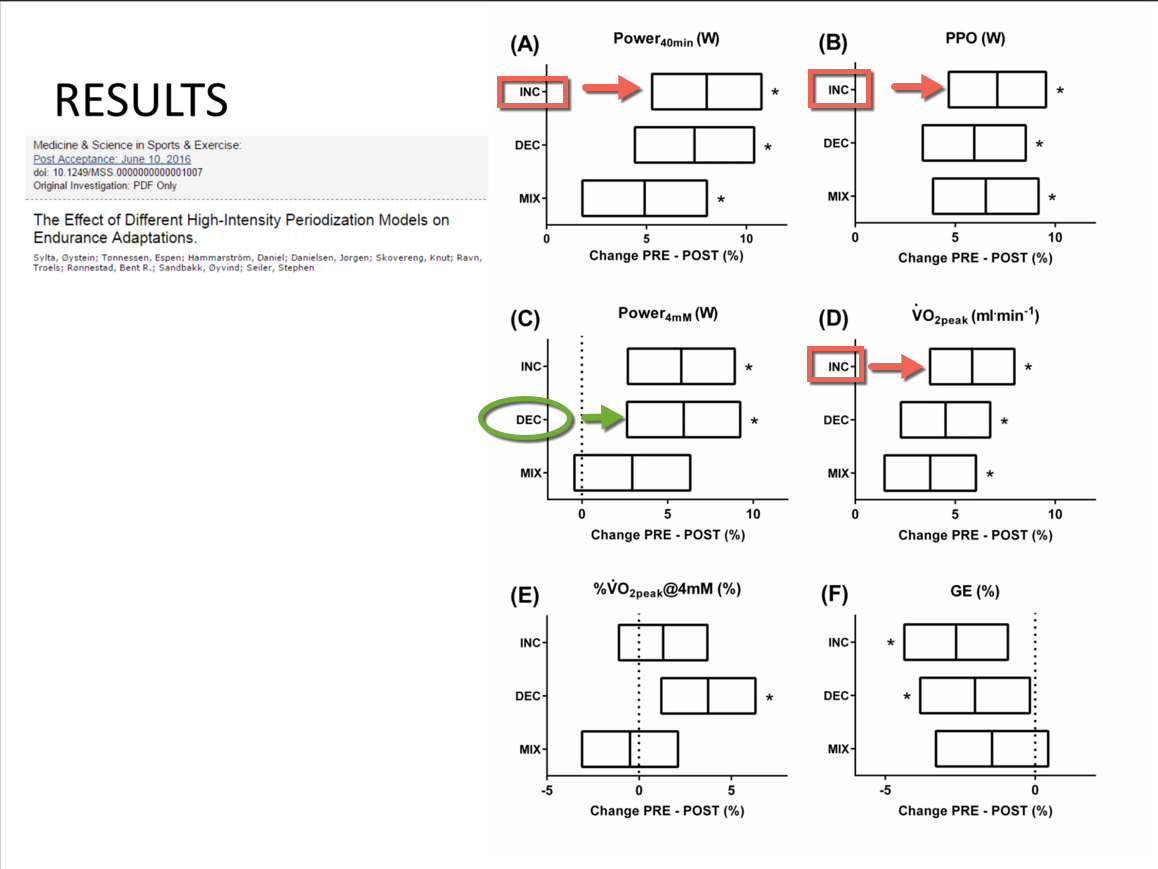
As for accomplishing both, the answer is "order of progression".  Meaning you can put them in a specific order in macro cycles in your training.  Most people use a pattern of increasing intensity:  Think three training cycles that focus on SST/FTP then VO2max then anaerobic power (ex: 4 x 15 minutes intervals with 5 minutes rest to 4 x 4 minute intervals with with 4 minutes rest to 6 x 1 minute intervals with 7-10 minutes of rest).  Studies have shown that this pattern is the better of the patterns (marginally).  You can also reverse this pattern (decreasing intensity) and still get pretty good results.  Why might you select one over the other?  Event specificity.  For most events for category cyclists the increasing format will pay be best rewards as it generally has better results and is focused on the demands of most road cycling events with the exception of longer TT.  If someone was a longer TT specialist, might suggest the decreasing method. 

Look at the results of a test of these ideas. (INC = increasing format, DEC = decreeing and MIX = mix).  Note the INC system was better 40 min power, better peak power and better peak VO2....the study is reference top left if you want to look it up. 

Most of my training plans are a mix of INC and MIX as I find that best for both the physiological and psychological adaptation for category cyclists.  


Tim I've often heard there is something special that happens around the 3 hour mark for endurance rides. Ignoring event specificity what is the difference between a single 3 hour ride and a pair of 1.5 hour rides over a couple of days?
This is a tough one to answer as involves a lot of myth and some science.  The general answer is yes but you used time as the "point" where I would use kj's.  The way you asked the question is to broad to answer without a lot of explaining.  So my reply is "what for"?  Meaning you ask about doing 2 x 1.5 hour rides vs. 1 x 3 hour ride but to answer that specifically I would need to know what are you training for?  
@TimCusick

A question about left/right power balance.  I think I used to be near 50-50, but last year, I seemed to be favoring the left 53-47, and I'm seeing more 54-46 these days.

A few questions:
Could this be a reporting issue?  I had an Elsa and Garmin 500, and I recently switched to DZero (Elsa's seals gave way) and Wahoo Elemnt Bolt.

If it isn't reporting, then is this something to be concerned about?

If it is something to be concerned about, are there any recommended drills or exercises to build up the weaker-seeming leg?
I would bet it is reporting.  It is important to note the Quarq does NOT measure left / right pedaling, it measures your "power balance" which basically separates your power between 12:00-6:00 and 6:00-12:00.  This is not the same as left right power.  Now think about the units recording rate...1 record per sec...your average cadence is probably around 85 rpm so so what is happening to the extra data?  What is the algorithm that determines?  Point - be careful of over precision with these types of measurements. 

Second, left/right pedaling metrics are over-rated and hyped and the reality is that focusing on making them balanced does not help your power output.  There is not a single study supporting the idea that i know of but there are numerous ones that counter it.  To over simplify, it becomes a matter of "economy" vs. entrance "gross mechanical efficiency" and economy wins every time. Don't get me wrong, doing things to make you a more efficient pedaler can help and are encouraged, but doing them in the name of achieving balance is not the best advice.  (Note: good data for injury recovery, fits and equipment changes...helps in these areas).

So if you are concerned about your general pedaling efficiency here are my top three activities:
1.  Low resistance fast pedaling - rollers, little gear, fast pedaling 
2.  Extend fast pedaling interval of 5 minutes
3.  Max pedaling intervals of 15-20 seconds on, 20 seconds off (low resistance also)

Back to coffee 
@TimCusick Thanks for the response to the power vs. capacity question. You started by talking about capacity and then translationed to research about order of intensity in macro cycles. 

Did I understand you correctly that if most athletes respond slightly better to increasing intensity in the order of targeted systems that the same might be true for power vs. capacity? Is the takeaway that work on extending time and repeatability before increasing intensity might lead to better results than the reverse? I presume that is a best guess based on the data you presented as I’d be surprised if there are data about my question. 

I think I once read something in which Hunter Allen recommended working on power before repeatability, but I suspect this was based on gut or theory rather than data. Maybe the answer is to do an n=1 study, but I am curious if you’ve noticed trends in your athletes or the data. 

Thanks 
It is my observation that focusing more on the development of capacity vs. power brings better performance results for most cyclists. To build in order is a more about "variability" then specific results...simple stated, as long as you focus on one then the other, the results will generally be the same.  Hunter and I have had a lot of discussion on the "which is first" and both would say it is more motivational and reward to do power first as results seem to happen "faster" so that is a good approach in training as that is part of building success.

The hard part is how.  For an elite athlete you might do it as
1.  2 weeks focusing on Power 
2.  1 week "rest" 
3.  2 Weeks focusing on capacity 

That might be your 5 week focus in a "build" period.  The rest is not a true rest as in time off bike or active recovery, but no intensity for a good part of the week.  I would also note that for elite cyclist, I really would only do 2 intensity workouts a week.  
Thanks for translating the concept into practical implementation. Makes sense. 

I’ve you and others say to limit HIT to 2-3 times a week, but I assumed this was mostly for us mortals (amateurs). I assumed elite cyclists were doing more because they had developed crazy high TSS scores with that broad and deep base building. 

I know I’m guilty of doing too many days of intervals to make up for the lack of time to do longer rides in the endurance zone... especially during CX season 
Elite / pro gather TSS with volume.  The reason they ( well I generally limit my athletes) to 2x a week is they can go really, really hard once it is time to do so.  Harder then us normal peeps.  Good conversation! 
Super fascinating Tim, thank you. As to the question above, I didn't have a specific even in mind other than typical road race training. Over the years I've seen a lot of long rides on weekends, and I'm never sure if 3 hours (or 2k kj?) is a magic physiological number or if it's just a reflection of the typical distance of weekend-warrior races.
The body typically stores about 1,800-2,000 "calories" of stored glycogen between liver and "muscle" which is readily available energy to be utilized in exercise.  This can be supplemented by eating as you exercise but there is a limit to how many calories the body can digest and use during such exercise.  If you burn through all readily available glycogen there is some evidence that it does improve the "storage capacity" of glycogen. The benefit of riding longer rides beyond that point is multi-faceted.  In the absence of the readily available glycogen your body will increase its focus on fatty acid utilization as a fuel source and eventually even its focus on proteins.  There is also some "hormonal" effects, particularly the release of insulin and glucogon transitioning to  Gluconeogenesis.

So there are some good effects, most of which are metabolic as described above and muscular (recruitment of fiber, muscular endurance and others).  The answer to the question then depends on what you are training for.  If most of your events burn under 2,000 pjs, longer rides become less important ( not "unimportant") and training focus will different then those doing events that burn 2,000kjs +. 
That is a damn good answer Tim, many thanks!
Tim I feel like I've seen a similar study for women's cycling. Does this ring a bell for you?

https://www.frontiersin.org/articles/10.3389/fphys.2017.01069/full?
Tim, I'm in Week 13, Base 4.  This week is test week, but I also had 2 races this past weekend (B races) where I definitely tested myself. 

I also have some erratic travel this week and it may be hard for me to fit in the tests, however,  I may be able to find a trainer to put in endurance / tempo efforts (without any form of power meter thought).  Any thoughts / recommendations for this week?  I'll have my bike back this weekend.

Thank you!
Scott, I would not add the extra pressure of the test unless you think big fitness change BUT would, once travel is over, get in the test.  Testing can be done as training ("Training is testing and testing is training").  Just pick a hard SST or FTP day and sub in the test.  
(putting this here because @TimCusick 's feedback is always great)

https://www.trainingpeaks.com/blog/understanding-the-limitations-of-tss-and-if-during-hiit-training/

There is a lot to unpack here but I am getting 3 main takeaways:
  1. specificity of power profiling and training is at much more sophisticated level than it was (at least for amateurs) even five years ago. FTP is bordering on what HR ranges used to be
  2. You cannot "spike" your ride with short sprints to bring up the NormP/TSS (even if those numbers are higher you're not getting the same training effect as a similar TSS Ride sans the jumps)
  3. Modern field tests sound much more painful than the older ones!
As strange as this sounds to say, I'm ready to start my base training for 2018. @TimCusick, I've just finished your eight-week transition and functional strength plan, which I began after a few weeks off the bike following a full CX season. I loved weightlifting in the gym 2-3 days per week and cross-training. Now I feel ready for a proper race training plan. What do you think of the following arrangement for the rest of my year, with a focus on preparing for and performing at my best during cyclocross season?  

1.1 Winter Base Training, 10 weeks (3/19-5/27) 
1.2 Winter Base OR 1.3 Spring Build, 8 weeks (5/28-7/22)
10 Weeks to Peak Cyclocross (7/23-9/23)
Cyclocross racing (thru 12/17)

This is the year-long plan I came up with on my own, looking at my options among your plans. I'll want to mix some road racing in there, too, during the middle of summer. The way I've scheduled it I'm worried about two things.

(1) performing at my best for the bulk of the cyclocross season. I want to race a long cyclocross season--fourteen weeks, give or take. My thinking was that I would aim to peak somewhere around week four and then try to carry that form through the next ten weeks. Or is that too long, and I should be training for two distinct early- and late-season peaks? 

(2) getting enough rest so that I don't get burnt out. Based on what I listed above, should I add a rest week or two somewhere in there? 

MaxThorn that is a good combo of plans.  That is a "medium" base (1.1) which is good for what you are building towards, then the 1.2 or 1.3.  I suggest following the 1.1 with the 1.2 (not 1.3) as you want a little less intensity in that time range as your will have a 12 week to peak and a 14 weeks season, that is 26 weeks of "intensity" there.  If you go with the 1.3, will make like 34 weeks of intensity, that is a lot.  
Jules,

Had to think about it overnight.  I have a love / hate relationship with those types of posts / articles for numerous reasons.  I am always happy that people are out there exploring and pushing ways to improve the efficacy of training regimes but tend to do a little "facepalm" when people over think things.  So before I finish first cup of coffee, here is my opinion on it:

1.  Stress is an external measurement of a training load being placed on the system.  Strain is a the internal response to such load (together they lead to adaptation).  Simple way to see it, power as measured in Watts is a stress number (external) and heart rate measured in bpm is a strain number (internal).  You apply a stress of increased watts, the system goes under strain and heart rate goes up. 

2.  TSS = Training STRESS Score is a formula for quantifying total STRESS from a workout.  Over the the past few years people try to take feeling of Rate of Perceived Exertion (RPE) from workout and say "this is harder as I feel more tired" which is really an attempt to say "this was harder for me and strained my system harder then the TSS demonstrated.  The external "stress" is the same, the RPE is really what people want to justify. This leads the answer...well deeper...  ( a simple example.  Go to Boulder, climb Flagstaff til you are at 10,000 feet then do 5 x 3 minute VO2max intervals.  Your watts go down 20%...people want to take those lesser watts and say "it is the same stress as when i am at sea level as harder at altitude as if felt so hard" when the real answer is it is less stress as the simple limiter is O2 uptake, forcing you to perform below what you are capable of)

3.  What people think they want and what they think they are trying to do is better quantify the strain the system is going under by individualizing.  This is an excellent idea but the "how to" gets lost in the process.  Now, break down the article and what they are talking about.  First, they talk about the individualization of training target.  This is a good answer and is one of the better improvements that all this tech has brought to cyclists in training.  The points about the variations in targets from one individual to the next is right on.  For me, this was focus #1 of WKO4 and Andy Coggan and I spent a lot of time making it work.  In my opinion, WKO4 really formalized this approach with iLevels and Optimized Intervals 4 years ago and now more and more people are finally "getting it" and jumping on. More power to them.  

4.  The idea of taking this individualization further and applying it to TSS is where things get challenging.  The reality is we originally chose stress as it is the most "stable" way to do it.  By accurately quantify stress, we can ensure that comparisons are "equal".  Any rider doing a workout of 200 TSS has had the same stress applied to the system; period.  Now can their be variations in "strain"?  yes but now quantifying them gets really hard.

5.  To attempt to quantify strain, you need to break down what is "strained".  The best approach is to start with two areas; muscular and metabolic.  Then break these down into two areas:  muscular breaks down to neuromuscular power and strength and for metabolic, lets say anaerobic and aerobic.  This is a simplistic approach but actually is not a bad starting point.  These two "system" are strained each time you train (you can add more, mainly cardiovascular but that gets even more complex).  So not think of their example, Joe Sprinter vs. Jane Timetrial.  Basically you have Joe with a lot of fast twitch that has a high Pmax to FTP relationship (say 4:1 meaning 1,200 watts sprint to a 300 watt FTP) vs. Jane with a lot of slow twitch that has a lower relationship (say 2:1 say 400 watts Pmax to 200 watt FTP).  Now they both go out and do a workout of 10x45 second maximal sprints with 4 minutes rest between.  What happens?  Well Joe nails it and his numbers are much higher, but if he went maximal, I bet his drop off rate from one interval to the next is also pretty high.  Jane cannot generate the watts but will tend to have less drop off rate. When done, Joe will have the higher TSS from the workout due to his ability to hit those intervals at a higher number (higher over FTP which is the basis of TSS).  So what does this mean?  The article suggest that Joe should get an even higher score because he went "harder", dug deeper and for Joe...probably hurt more...therefor the RPE was higher and there must be more strain.  Is that true?  Sort of.  Because Joe CAN GO harder the stress on his metabolic system is way higher, he will use more glycogen (deplete more) and be more depleted then Jane but his muscular strain, in my opinion, is actually less as his fiber type make up make makes him more suitable, already more naturally adapted for this type of work.  So should he get more TSS for simply having more fiber type that support the workout format?  Since he CAN do it, does that mean the stress is higher?  What about Jane? The article suggest that since Joe would get a higher score, Jane compared score would be lower.  Is that true?  Since Jane could NOT go harder due to muscular make-up she will have less metabolic (anaerobic) strain and use less glycogen but forcing her slow twitch dominate muscle make up to do all that sprinting really creates way more micro-trauma to the fibers, which also increases the "strain".  She will need more time to recover from such a workout due to that, so should her STRESS score be higher?   By now, be you are sort of seeing the trap.  The key reason we normalized a stress score (TSS) was to give a universal answer that people can use across different athlete types to quantify in a generalized way the a score of stress to avoid getting caught in the above circles.  

6.  If you have read this far (congrats) doing well!  Now the goal of individualization IS the right target and I love that groups are trying to do it.  The individualization of time and intensity targets is well under way and WKO4 and more and more others are doing that well.  The goal now is to accomplish what the article is trying to do, individualizing the workout stress, strain and adaptation relationship, but you need a more robust solution then the "editing" TSS.  

7.  Stress + Strain = Adaptation.  For stress scoring, Power and TSS have that nailed and the focus should not be on editing that. For strain, heart rate and HRV do a solid job there so think they are covered well.  Now a  few services are trying to score "Strain".  This is a novel approach but flawed.  The reality is the body is to complex and too many daily variables to really measure.  If you have a "strain" score, it has to take into account: moment by moment nutrition, life stress, training environment, mechanical factors (can you put out the same power on a trainer as out on a road?) and more.  The real trick is to jump over strain, and score adaptation.  Once you have a good adaptation score, coaches and athletes will the a real tool as adaptation will score workout based of the projected "affect" (specific adaptation to) that type of workout.

Holy shit is that a long answer, but you asked....


TimCusick said:
MaxThorn that is a good combo of plans.  That is a "medium" base (1.1) which is good for what you are building towards, then the 1.2 or 1.3.  I suggest following the 1.1 with the 1.2 (not 1.3) as you want a little less intensity in that time range as your will have a 12 week to peak and a 14 weeks season, that is 26 weeks of "intensity" there.  If you go with the 1.3, will make like 34 weeks of intensity, that is a lot.  

Thanks for helping me manage the intensity, Tim. That's helpful. I may reevaluate near the end of the 1.1 plan: I may want to build (1.3) into some late-summer road racing fitness, then chill out for a few weeks before starting the CX prep plan, and peak later in the season. In any case, I'm glad to get started on 1.1! 
Wow @TimCusick thats a huge answer - thanks so much for the time and patience it took. I'm going to need a second coffee to digest it - at least!

Two followup questions
  1. what setup do you like/prefer for HRV measurement?
  2. I'm having trouble jumping over stress so quickly; it seems like the discussion is circling the idea of different muscular and metabolic strains. Perhaps something based on athlete characteristics like (muscular) MUss and (metabolic) MEss
Presumably (?) the strain & adaptation characteristics vary for each?

my training strain score is always full on high. ¯\_(ツ)_/¯
Really comprehensive stress/strain explanation, thank you @TimCusick

Def going to be looking into incorporating HRV into recovery-planning via ithlete
Jules - TSS is a metabolic score and does not do a great job of taking into account the muscular effect.  In the article, this is what they are really trying to explain but are heading in the wrong direction.  Think about it this way.  You do two workouts, each is worth 100 TSS points.  Workout 1 is a 15 minute warm up, then 8 x 1 min max efforts with 5 minutes between then around a 10 minute warm down.  Takes you 65 minutes ish.  The IF is .99 cause you crushed it so you get 100 TSS points.  Now, workout #2 you ride steady mid range endurance for 2 hours collecting 50 TSS per hour and get 100TSS points.  So they are the same TSS?  Why? the applied stress load was the same and the metabolic "cost" will be the same (look at kjs of work) and you probably burned generally the same glycogen for both (assuming mid range endurance at a pace that yields 50 TSS per hour).  So, in general the metabolic cost and time to recovery should be the same.  Now, the difference can be the muscular cost.  The 8 x 1 min has a good chance of doing a lot of muscular micro-trauma (natural muscular "damage" that will repair with some rest, what drives adaptation to stronger muscle) so the RPE and resulting FATIGUE might (probably) will be higher.  So the measure of the STRESS is the same as that is the quantification of the applied load, the STRAIN will be different and you might need more rest to recover.   The author wants to reflect this increase in STRAIN due to the modality of the stimuli (intensity) in TSS but that is not correct, the STRESS is the same...it is the strain you go under that is different.  TSS only measures training load, not content.  To truly measure STRAIN you need a model (or lab) capable of understanding the athletes physiology, muscular fiber make up and anaerobic and aerobic response of the athlete to such stress....if you had that, then you can have a STRESS (TSS) and a STRAIN score.  Maybe someone will invent a way to do that, soon....:-) 

Also there are few programs out there saying they measure strain, but if you can't model or test the underlying physiology, you cannot predict strain, period.  
...and to add, YES just like your statement the STRAIN and ADAPTATION vary but knowing the underlying physiology makes it much more predictable...hence my last point in the above post. 
 
TimCusick said:
...and to add, YES just like your statement the STRAIN and ADAPTATION vary but knowing the underlying physiology makes it much more predictable...hence my last point in the above post. 
 
Thank you Tim. Why doesn't it work to model the strain as a function of power (for time x) over peakpower (for time x)?

An athlete with an 1100 watt 10 second (maximal) sprint would accrue less strain with a 5x500 watt effort than an athlete with a 600 watt 10 second (maximal) sprint?

To be clear - I'm asking why that doesn't work - I'm confident I'm not the first to ask! :)
if I understood Tim's note, while strain can be somewhat predictable, using power to measure strain doesn't work, because there are countless other variables that affect strain -- hr, sleep, nutrition, last time you were sick, work status, relationship with your children, position on the bike, day of menstrual cycle, body temperature, injury, recovery, swimming before the ride, strategy considerations, course difficulty, etc, etc, etc, etc, etc...

In fact, simply, this statement will not always be true:
An athlete with an 1100 watt 10 second (maximal) sprint would accrue less strain with a 5x500 watt effort than an athlete with a 600 watt 10 second (maximal) sprint?