Kissena Forum Archive

Mentoring

404 comments · 3490 views
Please don't take my posting the link to imply I agree with his point of view entirely. I wouldn't have won the FBF series without the cat 4 guys. Period.

I do think we sometimes spend lots of time thinking about idealized situations that rarely play out the way we plan. Bike races are so unpredictable we might be better served by thinking about our plans as a toolkit, and knowing which tool to use in each situation.

Learning some "bike skills 101" stuff is pretty essential and can be applied flexibly across many situations in many races. I think JP's tactics talk was an effective way to learn the basics of this stuff but we can still work on it.

Some things we could improve (very general)

1) pre and during race communication. knowing who is fit and who is not on your own team. knowing who should be worked for in every situation. especially when the game plan isn't going down as expected. knowing if you feel like shit, and making sure your teammates know.

2) knowing when to be at the front. knowing how to get to the front and what you can do when you get there.

3) knowing when and why to attack

4) knowing when there is a breakaway and what to do

5) knowing how to finish when there are only 2 out of 10 teammates at the front with 1 mile to go.

I'm also not implying I know how to do these things well. Just more general stuff we could get good at.
All,
I can't believe you all ignored Tilford's essential disquisition on the proper wearing of helmets. Much more important.
http://stevetilford.com/?p=17401 (How NOT to wear a helmet).

Thanks for the link JP. This is essential reading on how and how not to style in a helmet.
An instant classic.
Mike,

Pretty sure no one thinks your hating on bathroom meetings and tactics talks.

Joe
I agree that article is silly. "Don't try cause you can't succeed" Great advice dude, we'll all just get better by drinking fruit juice. Yeesh.
More importantly though, how far (map above) can numbers 2,3, 4 be expected to stay at the front?

I'll offer to drop off the "baby renshaw" but how long an effort should that be?

How does it work? If the sprint is 15-20 seconds and the Baby Renshaw is 30 seconds is the next one 60 seconds?

j
Jules,

I think the best answer is to try it out. These things are going to be determined by fitness level of the riders in the train, the eagerness of other teams, and the size of the field.
@ Mike: understood, but we need to start with a plan - even if we throw it out after lap 1....
I'd def be down to try something out.
Here's my response, as yet unposted on Tilford's blog (because I don't know if I want to engage crazy--a technique I have learned the hard way at the hospital--don't engage crazy, there's no winning), but I'll post here in two parts.

Also, will point out that JP is on to something when he points to the sorry state of Kansas racing. I haven't raced in Kansas City, but I've raced since the mid 90s in the midwest and consequently have lined up against Tilford many, many times. And here's what I've noticed. #1 the guy is a stud on the bike, no question. #2 the guy has always raced on well supported basically club teams (i.e. Trek Midwest Regional team) as a privateer pro, doing the Laura Van Gilder thing, making a living off of prize winnings, choosing races wisely. So it doesn't surprise me that he's anti-team-meetings.
Here's the rest of my unpublished response to Tilford's ass-talking:

Tilford97 is off the mark on this one. The idea that a discussion of team tactics is not appropriate for "Cat 2 and lower" is quite possibly the most ridiculous thing I have read recently. Let's break it down a bit.

He says: Bike Racing 101 is the basic knowledge that any guy that been doing it over a couple years should have.

I say: And by discussing "bike racing 101" with your teammates, some of whom may have a great deal of knowledge and experience to share, you can accelerate the learning curve. Or by following Tilford's suggestion, "any guy" can go out there trying to win races for yourself for a couple of years, and you will magically absorb all the knowledge that you need. Because, it's just bike racing 101. Easy, right?

He says: Leading a team mate out to the last corner, not chasing a team mate, etc. is all included in that. As a group, a team shouldn’t need to discuss that before each and every race.

I say: But what if this is your first season of racing? Even by Tilford's "just do it" theory of learning how to race, the new racer hasn't had enough time to learn the basics. What is that guy supposed to do without direction from his teammates? Tilford97 is making all kinds of assumptions in this statement that reveal how disconnected he is from the reality non-elite amateur racing. If us lowly category 2 and below racers should not be wasting our time talking to each other about race strategy, exactly how are we going to know who to lead out to the last corner, for example? Most teams I've been a part of are made up of folks who live near and far from each other. We train in basements, on our own local roads, and maybe a few times a month we connect on a larger group ride. The pre-race strategy meeting is an important way to see who's who and what's what.

At a bare minimum, it's a roll call and we know who's there that day. Next, we can get a little info that would be useful to know during the race. Maybe the guy who's the unofficial "team sprinter" had a crap week of training, has been up all week with a colicky baby, sick with the flu and doesn't have the goods this week. Your teammates need to know this, preferably before the last lap of the race.

Tilford97 also assumes that lower category riders who sacrifice themselves for others are somehow denying themselves the opportunity to win. I know it's easy to think that cat 4s and cat 5s are made up of new racers, young guys who just need the freedom to let their legs shred the competition, if they only weren't burdened by a team plan. When in reality, a lot of us are old guys, with families, jobs, no natural ability, no time to train, no chance whatsoever of getting to the podium of our local crit or road race, ever. But we do have moments, "minutes of glory" where we can ride like a champion, and so our personal victories come from chasing down that dangerous break for the team's stronger riders on that day. And for Tilford to try and take that moment away from us with comments like "It is pretty apparent that they have no idea what they are talking about" is just f-ing obnoxious (and wrong).

He says: "But the reality is that anyone could have been at the front pulling. When guys are getting dropped in a race because one guy is at the front pulling, then the other riders weren’t that good to start with."

I say: That's right, anyone could have been at the front pulling. But when was the last time Tilford watched the closing kilometers of an amateur road race? Everyone is suddenly a sprinter, the pace slows, the pack thickens, it's curb to curb, dangerous and messy, because no one is willing to be the guy who leads it out.

Thank goodness for those "foolish" Cat 4 teams who came in with a plan and have few guys willing to string it out, or at least make it double/triple file for their teammate to give him a shot at the podium. When they do this, the make life good and safer for not only their guy, but all the other true contenders in their race.

He says: It is pretty apparent that they have no idea what they are talking about, but everyone (other Cat. 4′s) agrees that it was an honorable sacrifice and good team work.

I say: Obnoxious. Pure class to make fun of cat 4s trying to figure it out. On our club, there's plenty of pre- and post-race discussion, training, tactics, you name it. And people learn from it and get better because of it. When a less experienced club member says something that is off-base, one of us guys who have been racing since down-tube shifters, steps in to provide a different point of view. Not once have the club's mentors said, "you guys are wasting your time, you should give up talking race strategy." Thank goodness.
Thanks Jules, editing notes are always good, especially when things are written when I'm in a mood. That said, I've decided not to respond on Tilford's website. I'm satisfied that our team of newer racers won't give up the idea of thinking about and organizing before, during and after a race. It's critical to the learning process.

Perlberg is right too though, that a lot of plans go straight out the window depending on the tenor of the day. But as a team, you are in a much better position to adjust if you start with a few good ideas. And yes, understand the concepts.

The more racing you do together as a team, the more you ride together, the less talking you'll have to do before a race. For example, if I show up last minute to a PP race (it's happened once or twice...haha), I'm not worried that JP, Myles and I haven't hashed out a strategy. I've been racing/riding with those guys long enough to know what they are going to do before they do it. I'm getting there in terms of feel and understanding with Perlberg and WDC too, they've traditionally been very, very strong in the Spring Series.

Of course as you CompuTrainer monsters start to collect results and upgrade to Cat 3, we'll be cajoling you into racing the 1/2/3 races in the parks as soon as you feel ready. Then it will become more important for us to have team meetings with new teammates lining up for the A race of the day.

And again for the Cat 5s as I did last year, I'll be helping to organize those guys before race days. Last year, Malcolmson was able to take over the leadership role quite quickly and I want a similar thing to happen this year. I'll be out there leading meetings and post-race discussions for a few weeks and look to a road captain who is racing regularly from week to week to take over those duties. Note, the road captain doesn't have to be the strongest guy. Sometimes it works out that the strongest guy has the personality to lead meetings, but not always.
I guess I would say that at the end of the long crazy discussions we have:

We should at least know:

a) Top 3 for field sprint
b) Top 3 for breakaways

And then general always plan:

During race: If no Kissena's near are the front, get near the front. Bring a teammate with you. Cover moves.

Last 2 laps. Make way to front. Bring teammate with you.

Last lap. Get on the front. Bring teammate with you.
@mperlberg

So I am not clear. When do you bring a teammate to the front with you?
Posted By: Dan Reiners@mperlberg

So I am not clear. When do you bring a teammate to the front with you?
ALWAYS! Maybe we should also say that if you see a teammate moving up, get the free ride! Or, get a ride on some other guy who is not on your team.

This is one thing I noticed happening a lot in the 123 races and that I had to adjust to. There are a core group of guys always sitting just out of the top 10. Naturally, when attacks and moves occur, they get pushed back a bit. You see them hoping on wheels and repositioning frequently. But very seldom on their own. Then they are ready and fresh when real moves occur that they need to cover.

When I was a 4 I would just swing wide and blast my way to the front. In the 123s races, that got really hard, really fast. When I got in position, I was already wasted. So yeah, it is about saving energy and maintaining efficiency as a team.
The corollary to this is that if you're going to swing wide and blast to the front, DON'T GO ALONE!

Make sure you bring a teammate with you, even if it means waiting a bit to get him on the train.
Brain fart, on my little shout out to the 1/2/3 team racing last year. Eric Ragot was fierce and strong all season. In fact one of team Kissena's best performance came when Ragot and Perlberg got across and to a strong move and kept it going hard enough to drop me, but not the guys who mattered (i.e. strong guys who could contribute to keeping the move away). Ragot's explosive power is perfect for getting a ride (if you can hang) up to the winning move.

Anyway, these are the things you learn from racing with the same guys year after year after year.
Buddy System!
Jules,

I was thinking about your question a bit and it reminded me of a conversation I had with Haig Marino (wonder wheel) a few years ago.

He was saying his favorite way to train for lead-outs and sprints is with 3 or 4 teammates. Basically, take turns riding on a 1km loop. He would use the lower road in prospect (wellhouse drive I think it is called) to make that loop. From the bottom of the hill to the old finish line the 3-4 riders would ride like it was the finish of a race and you're attempting to set your sprinter up.

Regroup and recover very slowly. Next time through, change the rotation, so the last lead-out man becomes the sprinter and so on.

Not exactly science and exact times for each person, but might be fun to get you a feel for it.
Suggestion for a sprint loop that's better and safer than Prospect Park - Crotona Park in the Bronx. here. Slight downhill which helps you get up to launch speeds easily. Barely any cars on that loop in the evening.
Mike,

I really like that suggestion, although I'm not sure where the "return" loop is that you mention.
Jules -

there are two roads that cross the park. Center drive (aka nethermead arch) is the main road by the current star / finish of Charlie's races.

Wellhouse drive is a little further south, and is by the old finish line of prospect park bike races. It is currently covered in construction debris but passable especially during recovery efforts.

http://www.ridethecity.com/prospectpark
Very cool Prez!
Gentlemen,

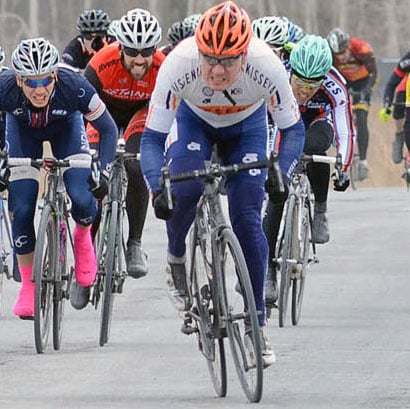
starting a new thread about leadout practice here. I'd like to start collecting our wisdom/learnings/crazy rants, about our attempts at leadouts. In the Cat 4s, we have shown that we can kill it to get breakaways that stick out in front of the field and give them plenty of space with smart and non-obvious blocking. We have guys who can, if they're well positioned, kill it in the sprint. We have attempted leadouts, with less than stellar results. Part our problem is on the final lap, we're kings of the park by the band shell, and we've burned ourselves out by the temple or parking lot leaving us 750-500 meters with nobody to keep the swarming masses at bay.

I think we need to do two things: A) Not do a single burnout paceline where folks go until they explode we should be looking to run a rotating paceline with our sprinter being the gatekeeper allowing guys back in the rotation, nobody works more than 20 seconds and jumps back into the train to have another go round. B) once we hit the temple that is the point where we should start going like a bat on fire, being shot out of a cannon, on rails, guided by lasers. If we have 4-6 guys at that point going all-out, nobody has to go for more than 10-15 seconds to take us to the finale and nobody can come around the Kissena Train.
LEADOUTS
The Form Up
Getting your riders together can be surprisingly difficult in a race. Some may be in front, some the back, right, left, center, they will be all over the place. Designate one rider to set the train in motion. During your pre-race meeting (yea, you should have one!) decide who and when the team will organize. Typically the designated sprinter will have another teammate in attendance throughout the race so that rider is the most likely candidate to start the paceline. The rest of the team must quickly slot in around this duo. Initially you can simply surround the sprinter as your team moves into their designated place in the rotation. Once you have a cohesive formation it’s time to do your thing. So do YOUR thing – get out in the wind, away from the rest of the field, or at least on the periphery. Don’t play games with position, execute your strategy and dominate the finish.

Team vs Team
Want to know who the fastest, strongest leadout riders are? Why not race for it! Split your team in two, or three, small trains and race each other to the line. It’s also a great time to practice some tactics and handling skills, but ultimately the point is to practice fast group riding and see what the order of the leadout might be. Try it on different courses, in different conditions and with a differing mix of riders to see how things change and what the fastest combination truly is.

Motorpacing
If you can find an experienced driver, then pacing behind a scooter or motorcycle is another step up in realism. Though most often used for individual training, group motorpacing is the best way to simulate the speed, and requisite high speed handling demands, of a race finish. Practice rotating through the draft at race speed. Jump from the back of the group to the front, or drop to the side of the draft and try to hold the same speed for as long as your riders can – then sprint to get back on!

(via) http://pezcyclingnews.com/?pg=fullstory&id=6050
http://www.cyclingtipsblog.com/2010/12/anatomy-of-the-leadout-with-mark-renshaw/

SPRINTING
http://www.cyclingtipsblog.com/2009/07/cavs-perfect-sprint-technique/
http://www.cyclingtipsblog.com/2009/04/common-sprinting-mistakes/
2 lead out trains??? SMASHING !!! Why the hell not, if 1 train gets broken\blocked\gappped we have a back up. I propse a 3rd option for the finale....before the sprint heats up, shortly after the downhill, have a 2 to 3 man escape attempt. Make the wheelsuckers panic! We have the numbers to block and cover. If we can get a bunch guys on the front after the downhill to ride on the left side of the road...we can launch 2 of them up the road on the right and put the block on. I can visualize this working. Perhaps we can practice this technique on the 1st sprint lap? Discuss...
I think the two part final K is an interesting idea. Go with a two up attack on the outside just after the chute at the bottom of the hill, while on the left side we maintain a consistent leadout that is motoring along at a high pace. Of course the two folks going hard as an attack are going to have to go really hard to overcome the leadout group going hard as well.

I think doing some leadout battles isn't such a bad idea. We can play around with this in some morning workouts as a means of practicing leadout/sprint strategy. Split into two teams and try running competing leadout trains.
Can't we just send guys off the front solo every race for the win?

:) Just kidding marc, we will do lead-outs!
I think the 1k suicide attack would work best if we didn't have enough guys to do a real train to the finish. It allows the sprinter (and hopefully a leadout man) to follow wheels, forcing others to burn matches to catch the attack.

I'm not sure about the utility of attacking our own leadout train, though. I think if we did that, the train would be torn between leading out and blocking, which is a recipe for losing control of the front.
http://youtu.be/KcO1mEpExX4
Another important component of the leadout is getting yourself to the front. While it's nice to pick up teammates and follow one another up, there are limitations to this method. You want to have an idea of when you should be at the front. It's like you're creating an intermediate finish line for yourself. For example, on the last lap in prospect, being in the top 10 or 20 before you start going downhill is where you want to be. And if you're in the 11-20 spots, you want to be either holding or moving up on the downhill.

Have an agreed-upon area where people will meet. for example, on the right before the temple. At the temple, the road curves right a bit, so the pack will move right, but it should pretty quickly start moving toward the left side of the road again. Move up on the right when the pack goes left.