Kissena Forum Archive

Mentoring

404 comments · 3490 views
FWIW I've been using JP's move up on the right when the pack bends left like a crazy-man recently to huge benefit. Seems so simple (and easy) after he said it but it never occurred to me before.
Posted By: Jules RoazenFWIW I've been using JP's move up on the right when the pack bends left like a crazy-man recently to huge benefit. Seems so simple (and easy) after he said it but it never occurred to me before.
Double true
My goals for the next few weeks, by series:

AVD Spring Series: Top 10 at any cost
L&C: Green Jersey a priority over top 10
Mangoseed: Top 10 via breakaway or sprint


Excellent post, John. The 4's can do a lot with that knowledge.
Christian we can get you in the green jersey. Sort it out with Ryan and Dan...Anyone going for green or KOM should plan on staying in the series until the end. If the KOM isn't spoken for, I wouldn't mind taking a flyer at it. yacks
Let's try making one of these every Thursday morning. We can swap roles around to give everyone a feel for it.

http://youtu.be/56N7kS0zvos
For best real-world results the last guy should ideally be a capable sprinter too: strongman > sprinter > faster sprinter
Notice the last guy is out of the seat until he blows, if your blowing up and it's still too early, switch down a gear and hammer it out of the seat.

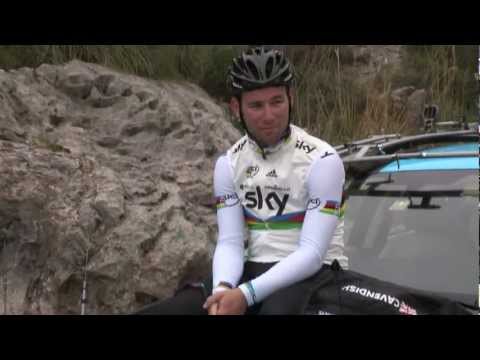
“I can sit on Mark Renshaw’s wheel — he can surf the side of the peloton for two kilometres and then still go fast. A lead-out man is a sprinter, but he’s not a sprinter. It’s like a team pursuit isn’t just a bunch of four pursuiters. A lead-out isn’t going as fast as you can, it’s getting the best out of nine guys to deliver that one guy who’s got to cross the line first.”


“You can’t replace George Hincapie. We’re going to get two people to replace that one job”
HTC-Columbia’s lead-out is a work of art, and watching it operate in the final kilometres of Tour de France stages in the last two years has been an education. Mario Cipollini’s Saeco train, or Petacchi’s Milram train might have been able to dominate simply by riding hard, but things are far less predictable these days. Lead-outs have become highly technical, tactical affairs — as other teams surge to try and take over, the leading team has to respond in an instant, or get swamped.

“It’s not being the fastest team, it’s being the team that is in control. There are loads of lead-out trains going on,” says Cavendish, who got hold of the helicopter television shots of the last five kilometres of all the 2009 Tour sprints from Eurosport.

“There’s no commentary to follow, it’s just the helicopter shots. I’ve studied them all. I study the other teams to see what they do wrong. So does Mark Renshaw. We use that to make sure we don’t make the same mistakes. If you notice, there’s something we do that nobody else does. Columbia are always in control.”

For 2010, the lead-out train is still a work in progress. Renshaw will retain his position as last man, but HTC have had to think a way round the absence of George Hincapie.

“You can’t replace George. We’re going to get two people to replace that one job,” says Cavendish.

“But we’ve got six riders who can be those two people.”

The attention to detail which goes into Cavendish’s sprints is quite incredible. He is well known for his scepticism of judging riders purely by their power outputs, and when he talks about his own methods of racing, it’s not surprising. Wattages are only a small part of a very long equation, although Cavendish’s reputed low numbers don’t look that low to us.

“You’d be surprised at my watts,” Cavendish says.

“Most people who say that their maximum is 1,600 watts won’t put out 1,600. My maximum is 1,580, and that is a lot. Not many guys will do more than a hundred more than that. But no one will ever get close to that in a race after 200 kilometres,” he continues.

“I put out 1,490 today in training, on bad form, but I won’t put that out in a race. It’s not watts, and it’s not just my frontal area in a sprint. It’s everything beforehand. How I ride in the peloton. My pedalling action. How I sit. I save so much energy for the finish.” (via http://www.cyclesportmag.com/features/mark-cavendish-interview/)
The last quote is quite inspiring.

Funny, never noticed it before but in the video you can see how incredible his pedal stroke is, whilst sprinting, at 44mph. Lots just stomp down on the pedals, he clearly keeps his stroke well rounded even in that situation.
And thats a good point he mentions at the end, you hear of other guys in the peleton pushing bigger numbers, 1800, neallry 2k watts but none of them have the same position as Cav. He is so low, so aero and he STILL manages that kind of power in practically a standing TT position. If I just stand upright and hammer it ive seen big numbers but is it aero and more importantly is it fast when your already doing over 30mph your battling mostly against the wind. Every 1mph requires exponentially more power to go faster so being aero is so important. I think its clear that absolute numbers dont equate to speed, particularly if there is an incline where of course w/kg is king, same goes for the snap.


This is a great video of timing, position and technique. Next time your out in the park, try and sprint with your head that low and take a look how your power data drops like a stone!

http://youtu.be/iCUD0CPKJSM
Ashley, if you look at 1:28 as Renshaw/Cav shut the door on Dean/Farrar going into the final corner. That slight slowing the Garmin guys had to do, gave Cav the completely uncontested sprint you see in that video. I am not denying he's the best sprinter of a generation, but that was a nice little piece of tactics giving Cav a significant advantage.

luckily we don't have a lead-in like that for the park, which would lead to weekly carnage in every race as folks all contest for getting into the top 3-4 into the final corner.
How it's done

http://www.youtube.com/watch?feature=player_embedded&v=i-J2bIsPDH8#!
Yes but he had blood the consistency of a chocolate milkshake. His blood stream was 10% EPO, 55% red blood cells, 25% cocaine and 10% plasma. If we were running on that, you bet we could *KILL* the Cat 4 L&C Cup competition.
And we'd sweat chocolate milk.... Helloooo ladies!
that was insane

does it matter that he was doping, considering most of the other dudes were too?
WDC,
It does matter. For one thing, he had an average untreated hematocrit, so he had farther to go to reach the 50 cutoff. For another, he was a high responder, so that was a second benefit. And a third is that not everyone was doing it. Just about everyone at the top of major stage races in 1999 either had been busted or was busted within several years, but then the guys we should be lionizing are the ones who were barely able to pedal in il Pirata's wake. His entire career, once he started to show promise, was built on chemistry.
damn that man could dope!

jalabert? olano? virenque?

those scrubs could have learned a thing or two about doping!
clearly the whole squad was doped to the gills as they were doing an UPHILL LEADOUT...
WDC,
Exactly. I can't speak for the programs of others, but, for his era, Pantani was meticulously doped. I wish this was his legacy, not the soaring tributes to his climbing prowess.
all i'm saying is that we should be giving him props for being at the top of the prevailing hustle of his time

. . .

even if significant components of said hustle revolved around steroid dick cream, risotto-thickened blood and generous rails of dried iguana adrenal gland
^lulz

Yeah, it's still so sick to watch - no matter how much dehyrated goat's dick he was huffing.

MANNISH WATER!
awesome analogies. yea uphill leadout is gangsta, they're just passing riders like its a training ride. i agree, while we may never see the same times up those crazy cols, it is still an impressive feat of performance and agility.
The thing that is impressive is watching what a difference a hematocrit of 60 makes. They're BLASTING by the worlds finest like a bunch of Freds on State Road.
good stuff, stokes
This would be great David.

Maybe two sessions would work well; one for the more basic stuff (tire change, cassette/chain change) and another for the stuff that less people probably know how to do (re-cabling, truing, derailleur adjustment).
This would be great, and I'm all for it.

I'm not a fan of "how to change a tire" because I think that's too basic for our team/club.

My top two are:

1) how to adjust a rear derailleur
2) how to true a wheel
I would love to attend this --unfortunately, I'll be out-of-town from mid-June until July 4th. If we can have a mid-july session, that would be great... if not, I understand. -Norm
How to build a wheel? It's my next project.
Christian, building wheels is fun. Be prepared to start with cheap parts and then dismantle the wheel and start again. The first few sets are really just for practice, but I've built about 12 pairs now and I'm beginning to feel comfortable with the process. However I'm still only building standard box section alloy wheels (albeit with low spoke counts and high tension). Carbon wheels I pay a pro.

Topics for the advanced session:
- Setting up the shifting system (includes re-cabling and adjustment). It may be worth doing this for a road bike and a TT bike (which are suddenly popular in the team) because the latter can be a real PITA to get smooth shifting.
- Adjusting bike position: how to take the basic measurements and then how to adjust (setback, saddle angle, etc)
- Knowing WHEN to replace parts (chain wear/stretch, have a bike with worn bearings and let people feel what that is like)
- Headset adjustment
- How to mount a tubular nice and square without getting glue over your nice carbon rims.
This is a great idea. Count me in.
I think wheel building is it's own topic, maybe to be led by Ian and William or others with experience in the future.


This sounds like a great idea. I'm excited.
Once I get confirmation for a date, I will create a poll to judge who might be coming and the topics most likely to hold their attention. On the one hand, if tire changing is too basic for most, then maybe interested parties can arrive a little early and we can change a tire out front of the shop (but how many of you know how to use a boot to mitigate a large gash in the casing of the tire and how many know the difference between a speed patch and a vulcanized patch?) On the other hand, wheel building is definitely an advanced topic that will take too long for our initial 1.5 hr workshop. Anyway, wheel truing is more relevant to most people.
Vulcan patch. Puh-leeze. Child's play.