Kissena Forum Archive

Bicycle Tech/Gear Discussion Thread

8105 comments · 108281 views
Sram electronic shifters...appear minimalist and light weight...just like their cable actuated ones.

http://velonews.competitor.com/2014/05/gallery/spotted-sram-electronic-drivetrain_327147
Would a bb30 crank fit into a 68mm frame (with adapters)? or it only goes the other way around?
Only the other way around from my quick Google. I did see some crazy homemade solutions.
@Philip it depends on the specific crank.

True BB30 cranks are only 68mm wide including bearings and so the spindle is too short to fit 68mm BB shell + external cups.
Examples of true BB30 would be Canondale SISL and SRAM Red.

However a number of manufacturers have cranks that are 30mm wide with a longer spindle. Often (but not always) refered to as BB386.
The Rotor 3D+ is an example - designed for BB30, BBRIGHT and BB386. FSA have one too as do THM.
In this case you can get a set of external bearing cups (ROTOR BB30-BSA is one example).

I think the only concern with this set up is the small bearing size required to cope with the fatter axle.
Thanks Brendan and Ian. Very helpful
Phillip, you are too kind.  Ian provided the only helpful advice.  Happy tinkering!
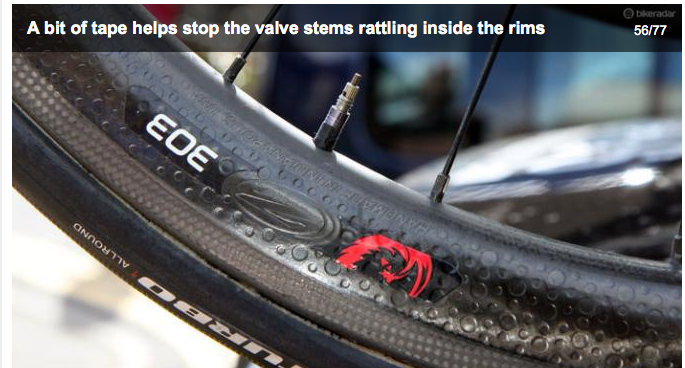
Nice trick:
image
I accidentally left a nipple or two in my rear wheel when I rebuilt it (they were stuck in there, I did a shake check before taping it all up and none came loose).  At low speeds, it sounds like I'm being chased by Team Maracas.
For those wondering what the teeth of a worn chainring look like compared to those on a new one, here's a new ring on top of a worn ring. The rings are identical except for color (old is silver, new is black...black is the new silver) and date of manufacture.  Also attached is a picture of each ring individually.


Ceramic bearings seem not to be worth the expense:

Based on this analysis, for a bike with high-efficiency bearings installed in the front and rear hubs, the total drag from both hubs is likely around 2.5 watts. Hubs with lower efficiency bearings would most likely create about five-to-six watts, given similar conditions.

Because the drag depends on rpm, the differences are even smaller for BB bearings or pedal bearings.

(Also interesting that you cannot simply copy/paste text from the VeloNews website)

My personal experience with BB bearings is different.
Sans chain: 1980's loose bearing Campy record BB in a properly faced/chased BB shell - the cranks would spin and spin
A 1990's sealed bearing Campy record BB is almost as good.
External bearing systems (Shimano 7800 onwards) cranks would spin about 2 revolutions BUT replacing the stock shimano BB with an Enduro Zero ceramic BB and the cranks spin much more freely and for many more revolutions.
Likewise the stock shimano bearings in the BB86 bracket on my BMC were crap, but the Ceramicspeed replacements are much much better.

In this context I think ceramic bearings help significantly.

As for wheels i think the story might be diffent: my Dura Ace wheels spin wonderfully on their loose cup/cone bearings and I cannot imagine that there would be any improvement with ceramic.


But how many watts to overcome the resistance? This is the important point. And you would need to answer that question under a load. Your spinning involved no load whatsoever.

I'm not an engineer, but I suspect that if the differences were as dramatic as you say, then the pro peloton would all be using the old Campy ball bearing system. (FWIW, Don Winston, ex-Kissena board member, is an engineer and swore up and down that at the rpm and loads we use, ceramic bearings make no sense).
It's fun to own nice things but bearing resistance isn't something that matters at my level of racing.  If I was a professional, competing against superhumans, and supplied by my own equipment sponsors, I'd go for it.  But fitness seems like the primary limiter on the amateur circuit.
But I can't throw money at fitness! I can throw money at ceramic bearings. 
Dan, this is where I suggest an expensive personal coach who will tickle you out of bed every morning, force you onto a bicycle, and hang on your wheel screaming "faster!"
dstokes said:
Ceramic bearings seem not to be worth the expense:

Based on this analysis, for a bike with high-efficiency bearings installed in the front and rear hubs, the total drag from both hubs is likely around 2.5 watts. Hubs with lower efficiency bearings would most likely create about five-to-six watts, given similar conditions.

Because the drag depends on rpm, the differences are even smaller for BB bearings or pedal bearings.

(Also interesting that you cannot simply copy/paste text from the VeloNews website)

2.5 watts is big.  5-6 watts is huge.  

Here's the text, Stokes.  I didn't have a problem cutting and pasting.

"Based on this analysis, for a bike with high-efficiency bearings installed in the front and rear hubs, the total drag from both hubs is likely around 2.5 watts. Hubs with lower efficiency bearings would most likely create about five-to-six watts, given similar conditions."

That written, the right tires with latex tubes can do as much good for much less.  

Let's have this discussion in the watts in the bank thread.  That's why I created it.

It is true that Winston was opposed, but Friction-Facts has a paper showing differences in the drag of different pulleys, most of the ceramics did better, but it could have been for other reasons than just the bearings.  Smoothness of races, roundness of balls, contact of seals, and lube.  
^there is a one balled guy in Texas says different...
These tests were not done under load. You need a pretty crazy setup to test bearings fo realz.
You might want to look at this: http://www.friction-facts.com/equipment/hub-efficiency
My comment regarding testing under load was in response to Ian's comment. His tests were not done under load.

JP, that is a pretty crazy setup.


Is parrafin higher friction?   just wondering , cause... I know this is probably a worn out topic but.... yay for parrafin!  i think.  i finally got around to updating the chain cleaning set up.  life suddenly got really good in the chain department.   no messy greasy chain cleaning device, no expensive cleaning products, no quandary about what to do with the dirty chain cleaning water, no mess on the floor etc... this is like a surgical procedure...

1: chain comes off super easy with a KMC link
2: chain goes into big canning jar of laquer thinner, (actually, about 2 inches of thinner, and 1 inch of water. the thinner is lighter, stays on top, and the solids like metal bits and sand sink through to the bottom, thus making the thinner last longer)
3: chain comes out, jar lid goes back on quickly, chain goes into small bucket of warm water with soap.  chain is pretty grease and dirt free at this point, but the soap helps remove the last film. 
4: chain gets quick water rinse.  (so far, about 3 minutes, no greasy mess, very little water and solvent used, no solvent down the drain)
5: this is the really fun part... drop chain into a 2 qt fryer from hardwarestore with 2 lbs of canning parafin.  the wax will get hot quickly, and smoke if too hot, so like butter in the pan, just below smoking temp.  when the chain goes in, all the water sizzles.  deep fried chain!  as the wax heats the chain to the wax temp, the wax goes into the little tight spots.  when the the chain is well cooked, and juicy inside, lift out, and (wearing gloves cause the shizzle is hot!) wipe excess off easily with rag.

man, that  chain that is clean to the touch, dry, perfectly lubed, and sand dont stick to it so much.  must serve with spotlessly clean cassette for best flavor and effect.  but... wondering about the friction...
McKay,
It's definitely easy to do once you have the paraffin and the setup.  I was doing it as a teen, and even popping a link wasn't bad.  The wax is so hot that whatever grease is in your chain will get pushed out by the paraffin.  your wax will be dirtier though.

It can be easier than you suggest.  I use a coffee can and 1lb of paraffin and heat up the can in a pot of boiling water.  I don't use gloves; just loop a small length of wire on the open link.  When I pull it off, I just rest it on a paper towel.  No need to wipe.  The dried wax will flake off.

If there's a drawback, it's the time it takes to relube.  but then again, you can just drip in your fave' lube if you're short on time and wax when you have the time

Now, about the friction.  It's about as low as you can get.  

http://velonews.competitor.com/2013/02/bikes-and-tech/six-watts-from-lube-boulder-lab-separates-fact-from-friction-fiction_264446

http://redkiteprayer.com/2013/06/the-drag-of-chain-efficiency-part-i/ 

http://redkiteprayer.com/2013/06/the-drag-of-chain-efficiency-part-ii/
Monthly paraffin party at McKay's
Paraffin or dry weather Rock'n Roll Lube (they have a wet and dry weather version).
Oversized pulleys are a significant win too.

Paraffin is nice but indeed a total chore. When I was a junior we used to cook chains up in the back yard with a camping stove and fruit can. Now days I'm averse to removing my chain unless to replace it, that is one part of your bike you want to avoid installing and uninstalling -- if you've had a chain fail you know what I'm talking about.
SRAM quicklink. What's the big deal. Though I think my 9 speed drive train may be somewhat more robust. I'm going to ACE hardware to buy canning wax this week. I used to do this as a young un. Mind you, I also used to boil the chain in 10w-40 (which actually scored pretty well in the friction test).
@ Stokes 
Probably not a big deal, but personally I've had enough chain failures with both quicklinks and standard (no SRAM though) to avoid chain futzing. Admittedly due mainly to inept US LBS mechanics.
dstokes said:
SRAM quicklink. What's the big deal. Though I think my 9 speed drive train may be somewhat more robust. I'm going to ACE hardware to buy canning wax this week. I used to do this as a young un. Mind you, I also used to boil the chain in 10w-40 (which actually scored pretty well in the friction test).
Quicklinks can't be reused.  But I think you can stick a Wippermann 10sp connex link on non-Wippermann chains.  

I should have mentioned the reinstalling issue for people with Shimano and Campy chains.  If I rode them, I wouldn't be removing regularly.

Like Wrongway, I like the Rock 'n Roll stuff.  I've been using Squirt this spring.  It seems to work pretty well, though the chain doesn't look as clean as it does with RnR.
I have been using 9-speed SRAM chains (e.g., PC971) for the last 15 years (at least) and regularly removing/reinstalling the quicklink in order to take the chain off for cleaning. Over and over again. I usually use my chain for 1 year. I suppose I would remove/reinstall the quicklink 4-6 times over this period. I guess I should read the instructions.
I have reused SRAM quicklinks on SRAM 10 speed chains for the lifetime of several chains without issue.  I did this knowing that SRAM declares them not to be reusable, to which I say bullshit.  It's just to avoid litigation, I tell myself.  Whatever issues Malcomson had can be attributed to his stratospheric power output.  Or a stoned mechanic.  Keep it under 200 watts and your chain will live forever!
http://www.bikeradar.com/us/mtb/gear/article/trail-tech-mastering-master-links-36757/

this article states 9-speed can be, 10- and 11- can't.  Don't have the owners manual to consult.  Seems that if it's called PowerLock they definitely recommed one-time use.

There is this master-link from Lickton, which is patented and there are versions to work with almost all chains.  I got one as something to leave in my seat bag in case my chain broke on the road.  

http://www.lickbike.com/sectionsublist.php?SECTION=0051&SUBSECTION=150