Kissena Forum Archive

Bicycle Tech/Gear Discussion Thread

8105 comments · 108281 views
Jules said:
America!


Related, I'm getting my family the hell out of town next July 4th. It is TERRIFYING here up in Washington Heights.
Marc, hate to break it to you but it is terrifying (OR SO EXCELLENT depending on your age or professional football player status) everywhere that night.
Me's thinks it's all that "explosive play" that helped us develop ammo that can hit the enemy 1.5 miles away...Jules keep your shitty, impotent Canadian ammo in Canada please...at 3:30 mark
 https://www.youtube.com/watch?v=wVHEHgnOSOI

More on disc brakes, this time from Santana Tandems

"But, you might ask, aren’t motorcycle-style disc brakes more powerful?

Surprisingly, no. The engineers at Shimano and Avid (companies that produce both types) have confirmed Santana’s test results. Even the newest and most powerful bicycle disc brakes haven’t yet caught up the power of the best V-style (or linear-pull) rim brake.

The inescapable limitation for the motorcycle-styled brakes is that the rotor (or disc) is too small. Anyone who understands bicycle disc brakes will agree that with exactly the same hand lever, hand strength and caliper, an 8-inch (203mm) disc will stop a bike about twice as effectively as a 4-inch disc. This is true because braking power is a function of leverage, and is directly proportional to the length of the lever arm (which, in the case of all bicycle brakes, is the distance from the axle to the braking surface). With a rotor twice as large, the same amount of hand power provides doubled braking power, which allows you to stop twice as quickly—and in half the distance."

http://santanatandems.com/Techno/UnderstandingBraking.html                                         


Is the "V-style" those that were commonly used on MTBs before discs. And sometimes I see what I think are called "mini-V" on CX bikes. Why they aren't called "U-style" escapes me however.

I wonder if the more relevant question is how do disc brakes compare to cantilever brakes in terms of stopping power?

something was funky with JP's cut-n-paste...here ya go:

http://santanatandems.com/Techno/UnderstandingBraking.html

But also, is everyone just drinking the Kool-Aid here? Why does everyone (but JP and Santana Tandems) say disc brakes are "more powerful" than cantilevers?
Following up on my Stages issue I replaced the battery and in the several sessions since then it has only dropped the signal once. 

For the record I've never dropped a hot pocket ever.

But also, is everyone just drinking the Kool-Aid here? Why does everyone (but JP and Santana Tandems) say disc brakes are "more powerful" than cantilevers?
Because everyone is comparing hydraulic disk to cable cantis.

I'd like to see hydro vs hydro. I had cable disk brakes on my Aloominator and hated them. Arguably worse stopping power than the cantis. Happy to have sold it.
Jules said:

But also, is everyone just drinking the Kool-Aid here? Why does everyone (but JP and Santana Tandems) say disc brakes are "more powerful" than cantilevers?
Because everyone is comparing hydraulic disk to cable cantis.

I don't think so.  Read the Santana article.  The issue is the distance from the fulcrum (the hub) to the stopping mechanism.  A 700c wheel  is a 622mm rotor while "disc" road bikes have 140 or 160mm rotors.  It's easier to stop a larger rotor.  And once you've locked up a wheel, you've demonstrated that your brakes are plenty powerful.  Road bike v-brakes, the kind found on the Giant Propel, have a reputation for being grabby.  That means they're possibly too powerful.   

I would also like to see hydro vs. hydro.  

Has anyone ever had a pedal back itself out of a crank arm while riding?

Yesterday I was headed out on my mountain bike fully loaded with camping gear to spend a night in Harriman. At about the Japanese restaurant on 9W I felt my right foot go wobbly. I looked down and my pedal was 3/4 of the way unthreaded. It ended up doing a number on the crank threads when it started wobbling and I couldn't get it rethreaded. I single leg pedaled to Piermont. The bike shop was open but with a skeleton crew and they were only able to try and crank the thing into the already fucked threads. It lasted to Nyack where it totally fell out and I had to abort. I called a friend who lives in Tenafly to come and pick me up and drive me to the A train.

I can't figure out why the pedal would have unthreaded itself. I've always tightened pedals down to hand tightness being careful not to over-tighten. I've ridden tens of thousands of miles and never had a pedal even come a little loose.
Has anyone ever had a pedal back itself out of a crank arm while riding?


I have.

The one time it occurred was the first ride after servicing a pedal.  Turned out I hadn't properly  tightened the nuts that adjusted the play on the bearings.  Basically, the nuts tightened further while I rode, creating lots of drag, to just about the point that there was no spin left whatsoever.  This is what took the pedal off the crank.  And I'd suspect as much for your situation, as normal use should further tighten the pedal onto the crank arm. 
This pedal seemed fine and I hadn't monkeyed with it recently - in fact I hadn't ridden the bike since summer. But I suspect you're right since I don't think there could really be any other explanation. I'm going to go ahead and check the pedals on all my bikes for drag cause that sucked.
Wow that sucks. Still, probably saved yourself a cold evening in a tent.
Jules said:
Wow that sucks. Still, probably saved yourself a cold evening in a tent.

Yep, but a cold night I had been looking forward to for weeks.
Jules said:
Wow that sucks. Still, probably saved yourself a cold evening in a tent.
Yep, but a cold night I had been looking forward to for weeks.
Sucks. Sorry to hear it.
I've come to the conclusion that SRAM are by far and away the industry leaders in marketing.  

It is totally beyond me as to why all the cycling journos are peeing their pants about eTap.  It has been voted as tech innovation of 2015 over multiple sites.  Yep, it's going to be baller (of course- its a $2500 groupset at the top of their range).  But, why on earth is it so revered?  Campag and Shimano had theirs out ~5 years ago.  And it's always been great.  The idea that removing a few wires (that are hidden in the frame no less) is anything more than an incremental, and I mean tiny incremental, step is just plain odd.  Also, don't forget, the satellite shifters that make electric gears so versatile *are* wired in SRAM's group.  

You trade off some convenience (easy set up, although, after the bike shop you bought your bike from has set up your your wired electric gears you never ever change it as it doesn't need updates like cables) with having to deal with 4 separate batteries instead of the Shiamno/Campag 1.  I suppose that the idea of changing gears with both shifters is novel, but it's hard to see how this would be either better or worse than the current layouts?  As a parallel, Shimano now have their synchro shift where with one shifter you go up or down and it chooses which derailer is best depending on what gear you are in.  So, this totally circumvents the need to use the other hand/shifter at all!

Me is confused.  I am not saying that eTap is bad.  It'll be superb for sure.  But arguing that it is anything more than another electric groupset that got to the party 5 years late is hard for me to understand.  If they'd have been selling it sub $2000, then they'd have been revolutionary.

Adam, you and JP (and probably more) disagree with me here; but it's "revolutionary" or a "game changer" because eventually all group sets will be electronic and wireless. Just like eventually everyone had "indexed" shifting, then downtube shifters went away and everyone had "brifters."

I'm not the gear guy on the club by any stretch of the imagination, and I'll lose 99 out of 100 arguments/discussions on gear stuff with most of you. But in this case, I'm just going to wait you all out and then say, "I told you so" in my head when you are all deciding to outfit your newest rig with Ultegra eShift vs Force eTap.

To me, eTap doesn't feel so much "5 years late to the party" as much as it makes Shimano and Campy feel like an intermediate point in an inevitable eventuality. As such, it kind of feels like those guys are now 1/2 a step behind SRAM in this department. To me, that's what I think. 

I think several people on this club, not to mention mechanics can tell gruesome tales of dealing with internal cable routing, no? It's kind of a big deal if you can set up a drivetrain in 10 minutes like they report in the latest VeloNews.com piece.

Think of the time that saves shop mechanics to work on other stuff. Not a big deal in February, but in July? #timeismoney

Also, it's set to be revolutionary because people love the clean look. They hate exposed wires and cables. The last time I posted something about etap I got read the riot act by someone claiming how inefficient/worrysome/unreliable wireless transmission systems are and how much better wires are are transferring signals. Fine, okay, I guess?

(I mean, I will say that I've shredded every wiring harnesses on every cycling computer I've ever owned and wouldn't be thrilled about worrying about ripping pulling wires out of a shifting system as I handle my bike in and out of trunks to travel to races.)

More relevantly, when was the last time anyone spent any money on a wired cycling computer, or a wired power meter?

And remember when Shimano when to the Campy style hidden cables? Was that about improving function? Maybe, it seemed like a style move to me. Maybe more aero, that's legit, I guess.

Not sure what the apparent SRAM vitriol is all about here. When Shimano Dura Ace came out, I felt like the majority of the discussion was like, "when is it going to trickle down to more affordable gruppos?" instead of "damn Shimano are master marketers, my mechanical shifting is 1000 times better than any electronic system."
Haters gonna hate...If it weren't for SRAM.. Shimano would still have that rats nest of cables hanging in front of your handlebars
Scroll back for my original comments:

1) multiple batteries is worse not better
2) signal interference is real
3) another f-ing wireless protocol on top of ant+/bluetooth?
4) internal tensioned wires are hell; battery wires are pretty straightforward
5) "clean look?" are people riding bikes without brake cables these days?

Adam, as for why? What else is there - yet another story on bottom bracket standards? Cycling press is about as un-objective as press gets. 
I find this discourse about "wired" or "wireless" shifting amusing...electronic shifting is here.  Parsing out the pros and cons of one system over another is silly.  A decade ago I was on nine speed with protruding cables, narrow rims & tires, too much tire pressure, a saddle that made the bits & pieces go numb, tires with low thread counts that rode like wagon wheels and no puncture belts...no custom "fit" centers with laser sensors and algorithms (see chronic back pain)...no power meter just heart rate...chamois technology that made any rides over 2 hours a main-taint-enence issue, Cytomax was pretty much your only option...no gps on the bike...helmet technology consisted of a piece of flimsy plastic with lots of vents that looked good in magazine...no strava...a one inch head tube attached to a fork that felt like a leaf spring...a frame with a bottom bracket that moved like it was twerking..
We have it good now...cept that even with all this fancy tech...the dopers are still pissing in the punch bowl...le sigh
^you can put your pens down now lads. 2016's post of the year is up.


Adam said:
I've come to the conclusion that SRAM are by far and away the industry leaders in marketing.  

It is totally beyond me as to why all the cycling journos are peeing their pants about eTap.  It has been voted as tech innovation of 2015 over multiple sites. 
Adam,

Considering the other stuff that came out in 2015, I think the subjective award is fair, though not pee in the pants worthy.

SRAM definitely is the Avis ("we try harder") of bike companies.  And the folks at Zipp and Quarq were definitely in that mold before they SRAM bought them. 

While I do think SRAM does a better job of wooing bike writers than Shimano or Campy, it isn't the answer. To me, it's that most of the people doing the writing are fairly young and easy to influence, might be predisposed to uncritical writing, love the attention they receive from the industry, don't have an editor over them demanding they do better, and aspire to work for a bike company some day.  


Adam, you and JP (and probably more) disagree with me here; but it's "revolutionary" or a "game changer" because eventually all group sets will be electronic and wireless. 
I take you back to 1999


It was around for several years. I think Mavic ceased production in 2004.  

Mektronic had it all--wireless shifting, ergonomic levers, multiple shift points, an integrated wireless computer.


Planes have had fly by wire for 20 years, where the control surfaces are controlled by electronic signals rather than direct hydraulic connections from the cockpit. if it works for Airbus, it's good enough for me. Granted I will be one step ahead of Marc in switching over to electronic shifting sometime in 2020.

Yacks, I kinda miss box section rims with 32 spokes with 19mm tires. the tires didn't need to provide suspension because your noodley fork and the rims that flexed severely was what softened those bumps. We need 28mm tires now because everything else is stiff. Also don't forget the food you ate while drinking your Cytomax, a Powerbar that had the consistency of decade old window caulk.

@Marc- we make the same point.  Yes, all electric groups will have no wires in 10 years.  I agree.  My point was that this really is an incremental step.  The difference between wires/no wires?  Nothing.  The big jump was getting a decent, reliable electric group that never fails (probably give that to the first generation Shimano Di2 in 2010, Mavic notwithstanding!).  The next big jump will be getting that same functionality/reliability at Shimano 105 level or on SRAM Rival.  Compared to them cutting the retail price to 25-30% of what it currently is, taking away a few wires really doesn't seem that big of a deal.  Hence my confusion about the enthusiasm.

@Marc/@twoyacks- absolutely no hating here or anti SRAM vitriol.  I ride SRAM on one of my rigs.  Like it very much.  Personally like the way SRAM looks a little better than Shimano.  I am absolutely sure too, that the eTAP will be superb.  Just don't think it is a major jump technologically over what is out there.

@Jules- spot on: tensioned cables inside frames should be illegal.  I would 100% swap my internal routing for external.  Also, someone once said it offers a "cleaner" look.  Not sure that is true.  To this day most custom steel/titanium frames have external routing and it looks superb to me.  I am not totally sure that the more batteries is a good thing either, nor the swapping to coin-cell for the shifters.  Would think that charging the shifters would be more convenient.  My powermeter takes coin-cell batteries.  Although I only need to swap them out ~twice per year, still annoying to have to buy some.  Would rather charge.  But that is being somewhat pedantic.

@mugwump- I think you are right about the journalism.  It is really, really hard to get decent cycling copy which isn't poisoned by "reviews".  Pretty sure that a lot of what you say about the quality of the cycling media is more or less apt.
Dan it's not at all clear that Fly-by-wire in planes is a net benefit. 

http://www.radiolab.org/story/black-box/

Yacks, I kinda miss box section rims with 32 spokes with 19mm tires. the tires didn't need to provide suspension because your noodley fork and the rims that flexed severely was what softened those bumps. We need 28mm tires now because everything else is stiff. 

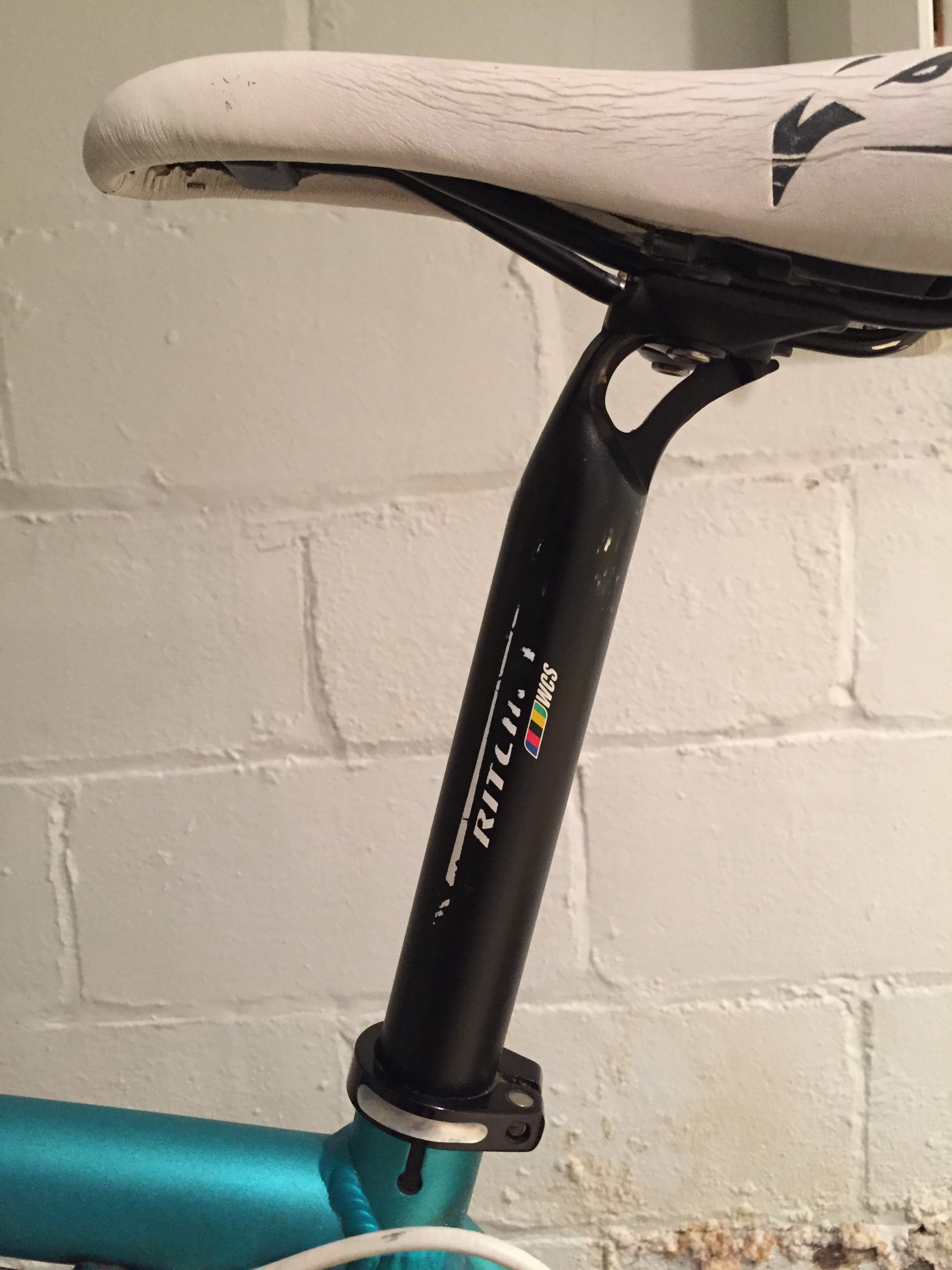
This is often overlooked.  As frames got stiffer, other things needed to get softer, more flexy, more compliant.  This could be why 31.8mm diameter seat posts are disappearing, and Cannondale has committed to 25.8mm posts in their new bikes, and several companies put pencil-thin seat stays on their bikes, along with a massive bottom bracket juncture.  

Though 32 spoke wheels were pretty stiff.  It was the frames and forks that flexed around them for comfort.  The fork rake on my SLX Merckx is a beautiful, elegant curve, as was typical when it was built.  The extra material to make the curve helped damp road vibrations.  It also was heavier than a straight blade fork of the same material.   

My 31.6 aluminum post emerges from a sloping top tube (see stiff) aluminum frame with the force of a phoenix and harpoons my caboose at every rut and rivet in the road.  After a 3 hour ride, I'm left feeling like a shucked clam.  With that I must "ass you" a question...think the Somerville Sports Factory Team Brooklyn guys are missing my prose?

Hmmm http://www.engadget.com/2016/01/05/garmin-varia-vision-and-sport-watches/

helpful or distracting?