Kissena Forum Archive

Training to Race: Faster, Stronger, Awesomer

2133 comments · 23940 views
Warning No formatter is installed for the format not-found
Thanks. I will let her know
An interesting excerpt from Friel's Fast over 50 regarding HIIT.

http://velonews.competitor.com/2015/03/training-center/book-excerpt-ned-overend-high-intensity-training-masters_362176

High Intensity shorter duration over longer rides at lower intensities - the takeaway from this piece for me is that you get more recovery time (if you emphasize recovery), and it hurts more, which is in part why you do it.  Not just over 50, though, it seems to apply to someone crunched for time, like any rider who has a full-time job.  Meaning, well, most of us.  
This is a reiteration of what's been posted here before, I know.  I also apply the HIIT philosophy for the trainer, so a 2 hour outdoor ride becomes 1 hour or less simply because of the harder efforts a trainer allows me to make, without any downhill coasting or coffee stops.
The part that I took from it was:

"... training the way I prefer is a big motivator and the primary reason I have had longevity in endurance sports."

I'm always a little careful, because people like Ned Overend, Roger Aspholm or Laura Van Gilder, are the obvious choice for pieces like this, but also outliers --- They are successful because most can't do what they do.

There's also something to be said about the fact that their jobs, might not depend, but still benefit from top performance. Their clients care if they podium a race. My clients couldn't care less.

When I was riding a lot, already in my 40s, something I realized after a few years, was that my base was immense. If you don't really stop for long periods, base accumulates year over year. Then, I could just do high intensity, and reaps benefits. 

Unluckily for the rider in me, I stopped for a few years, and it is all gone.

I can only dream of the massive base someone like Overend owns. He can do any training he wants on top of it.
BTW, regardless of my small pseudo rant above, this interpretation of the quote is more important: if riding and training is fun, I'll have longevity.
eloy said:
, but also outliers --- They are successful because most can't do what they do.

There's also something to be said about the fact that their jobs, might not depend, but still benefit from top performance. Their clients care if they podium a race. My clients couldn't care less.


this
Some note from Chris Baldwin on training, posted today in FB by Alec Donahue:

http://www.bikeradar.com/road/gear/article/nine-golden-rules-for-training-41354/

This one I found specially key:

2. Do the workIf you are tired, ease into workouts. Use the first rep or set as a warm up to progress from, but do the work. There was a time when I was bummed when a workout was not perfect. A wise rider asked me, “Did you do the work?” – the answer was yes, and I got stronger from it. It is easy to crush it when you are feeling amazing, but the other days make the difference. Some days are diamonds, some days are stones… but they can both be good training days!
Cross posting from the Peaks thread:

 Join us on Monday, April 27th at 8:00pm EDT for our "Racing Tactics of the Pros".  To make sure you get the best advice available, I asked a few PCG coaches to join us so we have 2 time Olympian, National and World Champion Amber Neben and the winningest US Pro ever to race, Scott Moninger.  Between these two, you have over 450 pro victories.  Great session focused on learning from the pros.  It is free, just sign up here:  https://attendee.gotowebinar.com/register/70681370516233985 as spots are limited.

Hey team, this webinar should be a good one. I'm not as familiar with Amber Neben (but honestly, her palmares speaks for itself, no?), but Moninger is double-legit, the real deal. They should have some good answers to your questions and some good stories to tell too!
My coach says the absolute opposite of this.  Hard to know what to think.  I have come to the following conclusion; if you are in a base building phase or want to lose weight- doing the workout, even if it isn't perfect it is the route to go.  If you are doing high end stuff, your goal is to exceed what you can already do by a few percentage points and ergo improve.  If you are in fact a few percent below what you can already achieve because you are off that day, you are not actually meeting the requirements.  But, you will burn calories (keep losing weight) or contribute to your low end fitness.  The downside to 'do the work' is that you might make the following high end workouts the next day an "off day" too as you haven't rested.  A risk, especially as the base/weight loss phases of training often don't coincide with the 110% threshold periods.  So, really not sure I think this point is an intelligent one-
2. Do the work

If you are tired, ease into workouts. Use the first rep or set as a warm up to progress from, but do the work. There was a time when I was bummed when a workout was not perfect. A wise rider asked me, “Did you do the work?” – the answer was yes, and I got stronger from it. It is easy to crush it when you are feeling amazing, but the other days make the difference. Some days are diamonds, some days are stones… but they can both be good training days!

Generally speaking though, for most amateurs the maxim of simply 'ride your bike more' is accurate.  So, although this idea of MTFU, do the workout is probably best 90% of the time for 90% of amateurs, the reasoning here is spurious.
The reason why do the work is effective is that it is simple and straight ahead.

Anything else is probably getting lost in details and over thinking.

Do the work, means do the work when it was meant to be done. If you are doing them on other days, then you are not doing the work. Duh, obvs.

This wont work just for amateurs.

Al Donahue is the top most cx coach in the United States, and Chris Baldwin (who wrote the quote) rides for Bissell and has won the US TT national champs a few times. 
Pros get nuanced to make sure they are making the right decisions, and they get specific on their discipline requirements -- like Tim's MTB pro, that does workouts in gravel -- 

But otherwise, keeping it simple is key, d
o the work is the basic approach of almost all professionals I have met -- from Chris Horner, to Powers, to Myerson, to Gaby Durrin, to Dan Chabanov, etc. 


before the training peaks stuff I had been stuck doing pretty much the same old.  A 3 hour weekend ride solo and during the week 1 hour interval day followed by a 45 minute recovery day followed by a day off....repeat.
I'm doing as much as I physically can on the TP program without burning out.  Just the change in intensity and where I'm putting down the watts = improvement for me.  That point in a race where I'de normally get popped is now much further down the road.  When I have to dig to hold a wheel or bridge a gap, my legs seem to go numb, but they keep turning over.  I have a lot more confidence knowing that a year ago I would be in massive distress in these situations.  My ceiling has moved up.  I am still having end of race power outages...but now I can focus on that during a race instead of simply trying to finish. The genius of the power meter = the #'s don't lie. My power is up and that is encouraging.  That's all I got...
eloy said:


Al Donahue is the top most cx coach in the United States, and Chris Baldwin (who wrote the quote) rides for Bissell and has won the US TT national champs a few times. 

This is probably the most salient point here.

As an aside, there are days when for love nor money you cannot hit the numbers you need to - but unless it's illness it's probably because you haven't rested (or eatern) properly - and baby... REST IS WORK TOO.
I have a question about aerodynamics and riding position.

While at Bear, I came out onto a two lane road where we had both lanes.  I was midway in a small group of 6 or so, on a level road into a slight downhill before the start/finish.  Having spotted a group ahead, I got on the front, down into my drops and cranked it.  I've trained in my drops a lot this year, and found it felt much more comfortable, at the speed I was going, to tilt my head down, looking at my top-tube, helmet vertical. 
I've practiced this also - never, ever, do you want to ride with your head down.  However, there was no one in front of me for half a mile, and I pulled us into the center of the road and followed the dotted white line so I would have extra time in this position before looking up, then back down.  Tracing the dotted line kept me from thinking about the pain.

Is this less aero than head up, helmet horizontal?  Clearly, head up is safer, but head down felt really good and I had plenty of room to ride without looking, though I really only went 7-10 seconds before looking up each time.  Or is it wiser to sacrifice any gains for absolute safety?
Maybe.

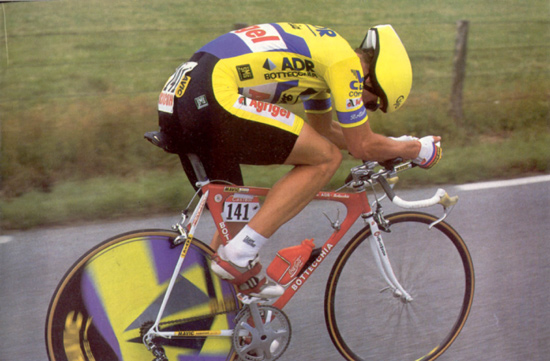
In the late 80s and 90s it was believed that head down was in fact more aero -- that has sinced been debunked, but also covered by an intense increase on aero gear, tunnels, helmets, etc...

If you see videos of Indurain or Lemond, you'll see them tilt their heads down and then come back up for a moment to check the road and so on. That was the way then. No longer today.


But here's the key part, you weren't time trialing, you wanted to pump it hard and catch a group up ahead. In those kind of situations: Just do whatever the hell you need to do.

Yes, there might be more efficient ways. But if you felt that helped close the gap, by all means, go for it.
Set a new power record today.  I am very excited about this.  I primarily told my girlfriend about this wonderful news but she had nowhere near the enthusiasm that such an announcement should elicit.  Ergo, I am posting here.

Thank you for your support.

Great Adam! Remember, setting power records during training rides always exponentially more awesome. I on the other hand today, did a workout, that I will call, "So you think you're tough, why don't you just STFU and keep on training your weak-ass self."
I have a question about aerodynamics and riding position.

Is this less aero than head up, helmet horizontal?  Clearly, head up is safer, but head down felt really good and I had plenty of room to ride without looking, though I really only went 7-10 seconds before looking up each time.  Or is it wiser to sacrifice any gains for absolute safety?
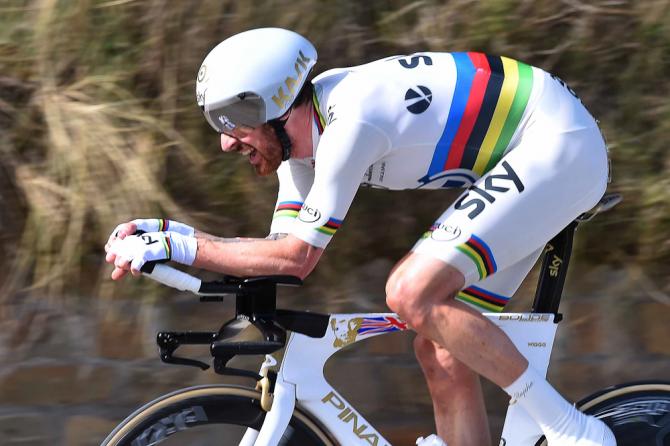
The bob-tailed helmets that Wiggo' and others use are largely in response to some research indicating that the long-tailed helmets were only effective if they just about contacted your back and you didn't move your head at all.  

I think head down with a conventional helmet like yours is probably more aero than head up. 

The topic of warming up (and to a much lesser extent, stretching) gets a lot of play on the forum. Here's one more perspective on it from ex-Pro CX racer and SS World Champ, Mo Brunno Roy:

http://www.cxmagazine.com/mo-bruno-roy-stretching-race-cyclocross-yoga


Wondering what it took Pro Adam Myerson to get second at the end of a 50-mile crit?

He tweeted:

"Today’s sprint was 42 seconds long at 884 watts average, 1287 peak. 39 mph. Dahlheim jumped at the pit because we had to catch the break."


FWIW, I believe he weighs between 155-160lbs.


42 seconds?  Surely that included following wheels/leadout??
Throwing this in here because it's about training - a tl:dr version of Tim's tactics seminar a while back. Take a read if you didn't get to catch the seminar, as there's some real gold in here.

http://www.pezcyclingnews.com/toolbox/toolbox-three-common-racing-mistakes/#.VXcnxxNViko


So I haven't been riding hard for a couple of months and now I'm not in shape anymore.  It seems that my legs burn up at a much lower HR than they used to.  For example, if I'm at 165 BPM, my legs burn and feel tired.  Used to be that 165 BPM was in my "I can do this all day" range.  (For HR zone purposes, I'm 28 years old and my HR generally hits low 200s during race-ending sprints).  I don't really get out of breath more easily than I used to, but my legs just can't keep up with my HR, it seems.

Is it normal for HR and leg strength to disconnect after weeks of not training?  What's happening to my body?!?!?! What's the fastest way to get my legs to cooperate again?  I think I'll just keep trying to do threshold laps of CP, which is what I think I used to do.

Is it just that now I tend to ride after work when I'm tired?  Then again, it happened on Saturday on the group ride and I was rested.

How long does it take to bounce back?  Now that it's gone, I realize that that fitness was years in the making :(

Yes, Brendan, totally normal. Here's a Training Peaks article that goes into more detail.

http://home.trainingpeaks.com/blog/article/how-much-down-time-is-too-much-the-concept-of-detr

As far as how long it takes to bounce back? That depends. Old dogs with many years of experience do it quicker. Young guns like yourself? Well, you've got work to do. The article cites a case of an olympic athlete who took off 8 weeks from training and it took him 20 weeks to get it back. #welcomeback #cyclingishard

In general, what I would say is that just getting back on your bike right now, with more regularity is the most important thing. And get in one day of intensity per week. Don't follow a good week of riding, with a few weeks of no riding. Better ride two or more times every week, then hitting it hard 7 days for one week then getting side-tracked and no riding for the next two.

But lucky for you, you are a TrainingPeaks coached athlete, probably worth checking in with Tim to see if he has any specific advice for you.
Brendan, get onto the training peaks on-ramp and then move to the main plan.

there is no shortcut unless you have a doctor friend in Spain 
I'm currently a fan of micro-dosing...err...micro-intervals.  In my experience it goes a long way towards training your legs to flush lactic acid. Of all the training peaks workouts, I've found that one to be the best.  Racing isn't steady...its punchy, so your training should mimic that...imo

micro-bursts are the standard crit and cx workout. 15 seconds all out, 15 seconds easy for 8 to 10 minutes, and then again 2 or 3 times. the pain, but yeah.
Ok – so despite my confidence in my taper plan, I'm starting to fear that I'm going too easy this week in the lead up to GMSR. My general plan was to go into Day 1 a little over fresh, so that come stage 3 I'm hyped and ready to rock.

Two weeks ago, I spent about 4 days off the bike (one day was serious active recovery – cruising around Portsmouth on a city bike with my wife. This was my longest break since January). Coming back, I hit last week hard, and on the weekend did a serious FTP workout on Saturday and good endurance on Sunday.

This week: Rest M/T. Yesterday I rode endurance with some 4 high end bursts (>300%). Today I did 3 x10 at the high end of tempo.

I felt awful yesterday, but felt great today. Anyone have any suggestions on tomorrow/this weekend? I was thinking some AR/opener type workout tomorrow; Sat. 2+ hrs with some tempo/FTP. Sun: Endurance. 

Anyone have any thoughts on this? I'll figure it out someday (I hope). 
Seems fine.

Tapers are rarely perfect.

For me, I'd put in a hard weekend, and then, monday and wednesday off, with Tuesday a mix of efforts and thursday whatever your typical openers are.
Some new content on my site.  If you like race data, this one is for you.

http://kensingtoncycling.club/2015/09/12/mt.-tam-hill-climb-race-report/