Kissena Forum Archive

Bicycle Pictures and Videos

4908 comments · 90771 views
eloy said:
It is impossible to look sharp on a bicycle with a mechanical engine.

This is only relevant while stopped....as when moving, you'll be going so fast that people won't be able to focus




That Giant video is hysterical on so many levels and the rider so obviously violates rules #5, #11, #25, while making a mockery of rule #55

http://www.velominati.com/the-rules/
looking sharp is always relevant. if you think otherwise, you've made a mistake.
I just recalled a moment, about 3 years ago, before my son was born and I rode more, didn't have an injured knee, and was fitter. I was climbing my local mountain and passed a couple people on e-bikes. They looked at me and asked where my motor was. I tapped my thigh and with a smile told them that it's here. 
On another note, I recall reading that Merckx now rides an e-bike, but the kind the UCI is looking for. He's 72, and wants to keep up with younger folk. 
The official mushroom of the Kissena Cycling Team

Phil Gaimon's "Worst Retirement Ever," Episode 7: Lookout Mountain (Golden, Colorado)

https://www.youtube.com/watch?v=OOUiDEcvEKM

This was, by far, my favorite episode.

/// and as an addon, data overlay vid:
https://www.youtube.com/watch?v=rp83LhcC-8Q

Superstar.
https://www.youtube.com/watch?v=T5mAIp5-oks
This film is about 20 minutes long, and I hope you take the time to watch it. I am totally bias, but found it to be one of the best cycling films I have ever seen:

"Yo decía: ¿A qué hora, Dios mío?"

https://player.vimeo.com/video/229698829
Fascinating look into carbon bike manufacture

https://www.youtube.com/watch?v=XMnegeYuLW4
Jules said:
Fascinating look into carbon bike manufacture

The heat lamp portion of the process seemed alarmingly imprecise considering the rest of manufacture.

There was also a comment about how hot they get the carbon.  They heat it to 130 degrees Celsius (266 F).  That might seem hot.  But braking can generate more heat than that.  On rim brakes, temps close to 600 degrees Fahrenheit have been recorded, and 400 F is easy.  Now, translate that heat to rotor disc brakes.  If anything, rotors should get hotter.  I assume they put in heat sinks of some sort, but there is rarely any info about how frames are designed to handle that heat.

It's also a pity they didn't plug CyclArt more.  I believe that company was bought and moved from California.  And they're a big deal in the custom bike business.

mugwump said:
Jules said:
Fascinating look into carbon bike manufacture

The heat lamp portion of the process seemed alarmingly imprecise considering the rest of manufacture.

There was also a comment about how hot they get the carbon.  They heat it to 130 degrees Celsius (266 F).  That might seem hot.  But braking can generate more heat than that.  On rim brakes, temps close to 600 degrees Fahrenheit have been recorded, and 400 F is easy.  Now, translate that heat to rotor disc brakes.  If anything, rotors should get hotter.  I assume they put in heat sinks of some sort, but there is rarely any info about how frames are designed to handle that heat.

I suspect wheel manufacture is a different beast which is why they left it out.
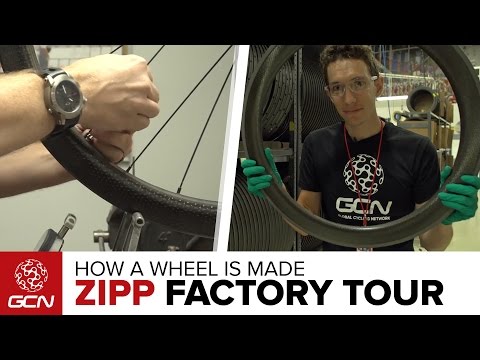
Have you guys seen this GCN vid of the Zipp factory tour? It's pretty great.  Not "Yang is going to spend $2000 on wheels great", but still, great.
https://youtu.be/M-j2imuN9T8

Here's where they do brake testing:
https://youtu.be/M-j2imuN9T8?t=8m22s
Jules said:
mugwump said:


I suspect wheel manufacture is a different beast which is why they left it out.
It's not about wheel manufacture.
It's about the heat transferring through the rotor to the brake to the frame.
Ask yourself this: if a fork softens at 130C, and those temperatures are easy to generate under moderate rim braking, how much greater will heat generation be at the rotor, which is a much smaller circle and has much less opportunity to cool, what will happen to the fork once those temperatures start to be achieved as the rotor heats the pads, and transfers to the caliper?
Can't get enough Adam Myerson? PRoblem solved.

https://www.youtube.com/watch?v=XxlTArCJFbs
I am not sure what you are suggesting. I am not a fan of disc brakes on road or even cx bikes... but, have you ever seen a fork or rear stay break because of heat? 
mugwump said:
Jules said:
mugwump said:


I suspect wheel manufacture is a different beast which is why they left it out.
It's not about wheel manufacture.
It's about the heat transferring through the rotor to the brake to the frame.
Ask yourself this: if a fork softens at 130C, and those temperatures are easy to generate under moderate rim braking, how much greater will heat generation be at the rotor, which is a much smaller circle and has much less opportunity to cool, what will happen to the fork once those temperatures start to be achieved as the rotor heats the pads, and transfers to the caliper?
Ah from the rotor. So here is the thing; the rotor itself has very little mass, so I'm not sure how much heat there is.

This is the "matchstick and lumber yard burn at the same temperature" phenomenon. Very different amounts of heat.

Total speculation of course, #ymmv
Jules said:

Ah from the rotor. So here is the thing; the rotor itself has very little mass, so I'm not sure how much heat there is.

This is the "matchstick and lumber yard burn at the same temperature" phenomenon. Very different amounts of heat.

Total speculation of course, #ymmv
That the rotor has little mass means that it heats up and cools down faster.  Think of boiling water.  it takes much less time to get an ounce of water to boil than quart.

And the rotor's heat has do to with the amount of force that the rider and the bike have produced.  
next time i finish a big descent i'll reach down to my rotors and report back to this thread


Just letting off the brakes for a few seconds will drop the temperature pretty fast.  With carbon rims, there were stories that just laying off them for 1 second could drop rim temperature 100 degrees Fahrenheit.

But, you should know that if you overheat the fluid and it goes from liquid to gas, it will feel squishy at the hand as the gas squeezes the rotors further, slowing you down, then you'll let go and that will engage the reservoir.  I think at that point, your brakes will have nothing, until you start pumping the levers again.
Nice...
https://www.youtube.com/watch?v=T2aYLKRWEbw&feature=youtu.be
*obligatory Napoleon Dynamite sweet jumps reference
Jules said:
mugwump said:
Jules said:
Fascinating look into carbon bike manufacture

The heat lamp portion of the process seemed alarmingly imprecise considering the rest of manufacture.

There was also a comment about how hot they get the carbon.  They heat it to 130 degrees Celsius (266 F).  That might seem hot.  But braking can generate more heat than that.  On rim brakes, temps close to 600 degrees Fahrenheit have been recorded, and 400 F is easy.  Now, translate that heat to rotor disc brakes.  If anything, rotors should get hotter.  I assume they put in heat sinks of some sort, but there is rarely any info about how frames are designed to handle that heat.

was thinking more about this and i talked to someone who has done a bit of carbon fiber work in her day.  she explained that it's incorrect to think about the resin and heat lamp like wax. the fiber and resin don't become liquid at a certain temperature, cool to harden, and become liquid again at that same temperature.  the change is chemical, not physical.  the properties change.
Jules said:
mugwump said:
Jules said:
Fascinating look into carbon bike manufacture

The heat lamp portion of the process seemed alarmingly imprecise considering the rest of manufacture.

There was also a comment about how hot they get the carbon.  They heat it to 130 degrees Celsius (266 F).  That might seem hot.  But braking can generate more heat than that.  On rim brakes, temps close to 600 degrees Fahrenheit have been recorded, and 400 F is easy.  Now, translate that heat to rotor disc brakes.  If anything, rotors should get hotter.  I assume they put in heat sinks of some sort, but there is rarely any info about how frames are designed to handle that heat.

was thinking more about this and i talked to someone who has done a bit of carbon fiber work in her day.  she explained that it's incorrect to think about the resin and heat lamp like wax. the fiber and resin don't become liquid at a certain temperature, cool to harden, and become liquid again at that same temperature.  the change is chemical, not physical.  the properties change.
I'm not suggesting it will become liquid.  It will soften though.  Read up on Tg or glass transition temperature.  

"A typical measure of maximum service temperature is the Glass Transition (Tg). This is the point (well, region) where the resin softens from a being a rigid glass-like material to a softer, more rubbery state. This is usually a fairly reversible transition- the material will regain most of it's properties if cooled back down, though the structure may have deformed (and this won't spring back) which may lead to weakening.
 
For an epoxy-based composite, the Tg will typically be in the region of the curing temperature. Clever chemistry can boost this. Typically moisture uptake in ageing will reduce the Tg. You're looking at a maximum Tg, for an aerospace epoxy, of ~200°C- more typically 100-180°C. Other resin systems may be able to achieve higher Tg but will have processing issues. Cheaper resin systems will have poorer performance in this regard.
 
For outright stability you're looking at what temperature the resin will degrade and burn at. This again varies with resin system, and typically a resin that cures at a higher temperature will withstand a higher temperature. For epoxy, you're looking at charring above about 220-250°C."

https://www.quora.com/What-is-the-maximum-temperature-stability-of-carbon-fiber-composite-and-glass-fiber-composite
i think you've highlighted something that i always struggle with when it comes to bikes: balancing my lack of technical knowledge with my ability and desire to understand my bicycles.  frankly, i think a lot of people from the industry could do a better job of balancing this tension.

bikes are accessible because once assembled, i can basically figure out how to fix it without any real technical background.  however, the design and manufacture of bicycles is a different story.  those things are done up by people with extensive backgrounds in technical fields and degrees in things like engineering and material science.  just because i can process the trickle-down market speak from the marketing people who spoke to the engineers does not mean i am in a position to critique specific engineering decisions.

trying to be an expert can be fun but it's important to keep my limitations in mind.  i encounter this often in my profession when a client thinks because they have read one isolated part of "the law" they somehow become ready to tackle the whole process.  i'm not saying that they never provide insight, but generally they miss the big picture because they didn't spend years learning about all the other systems that interact with their situations.

science and engineering are like law in this way.  i might be able to find the answer to one specific question.  but the solution relies on a number of other questions that i will probably not know to ask.  nor do i have formal education, or extensive real world learning, to understand what i'm failing to see as an issue.  

a lot of these answers i find aren't analysis or principles, they are conclusions.  I might learn the vocabulary and repeat their expert conclusions but the people qualified to make the decisions understand the whole process and not just the results.

this is highlighted for me every time i try to talk to my wife about bike stuff.  she has a degree in engineering and our discussions generally proceed as follows


so forgive me if i'm not going to read up on Tg and resin stuff :)
 frankly, i think a lot of people from the industry could do a better job of balancing this tension.


I agree.  I see it all the time myself. 

Rochester Cyclocross 2017 Highlights

https://www.youtube.com/watch?v=oRqKZRdRGdc

high level hotness. Nittany is next.
Sven Nys showed up and raced at the Chicago cup last Sunday. He also rode the stairs.


http://www.cyclingweekly.com/videos/watch/watch-ag2r-development-rider-crashes-high-speed-as-time-trial-bars-snap-after-going-over-bump